Ernie Ball 5-String Regular Slinky Cobalt Bass (.045–.130): Rex Brown's Spector NS-5 low end
Written with AI help · Updated
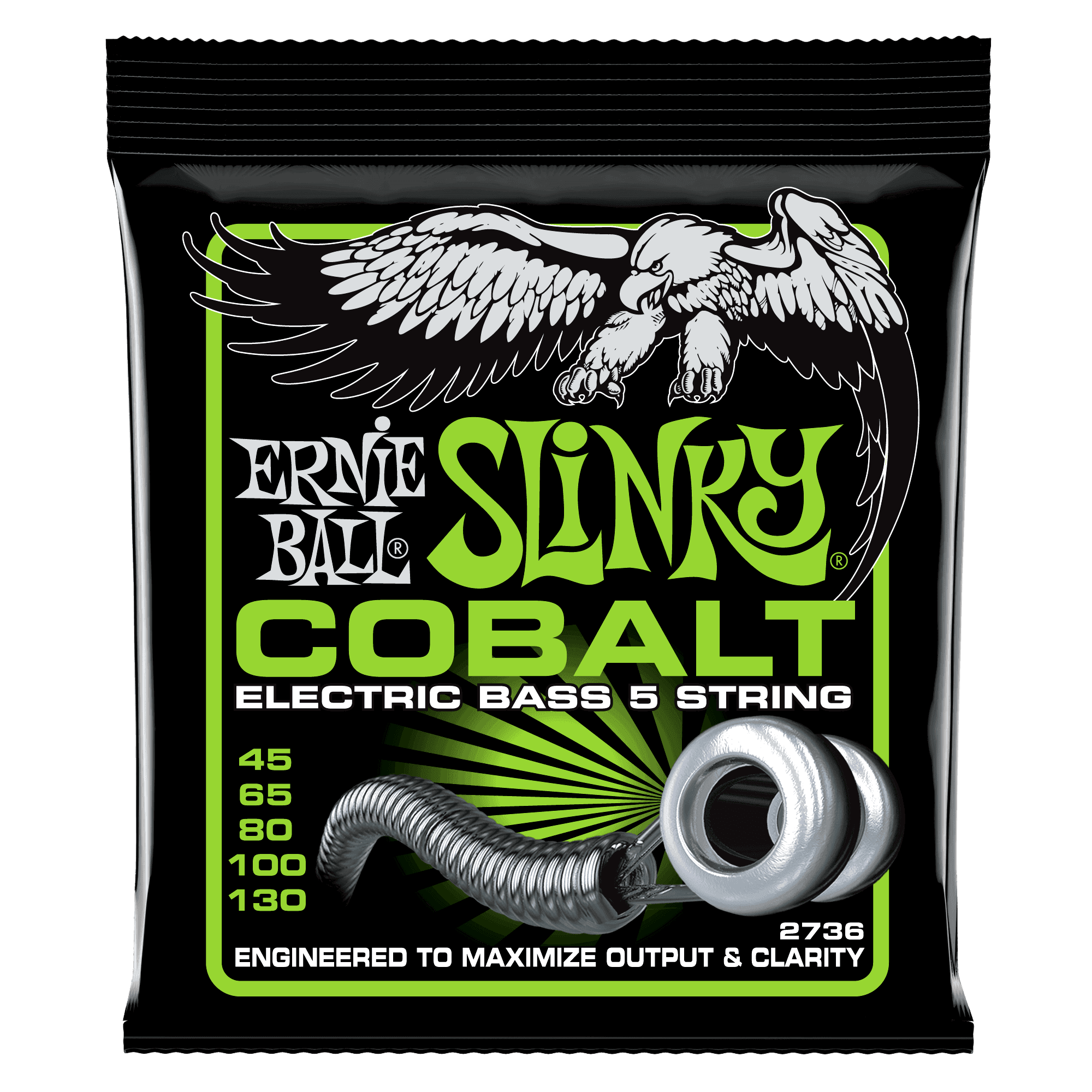
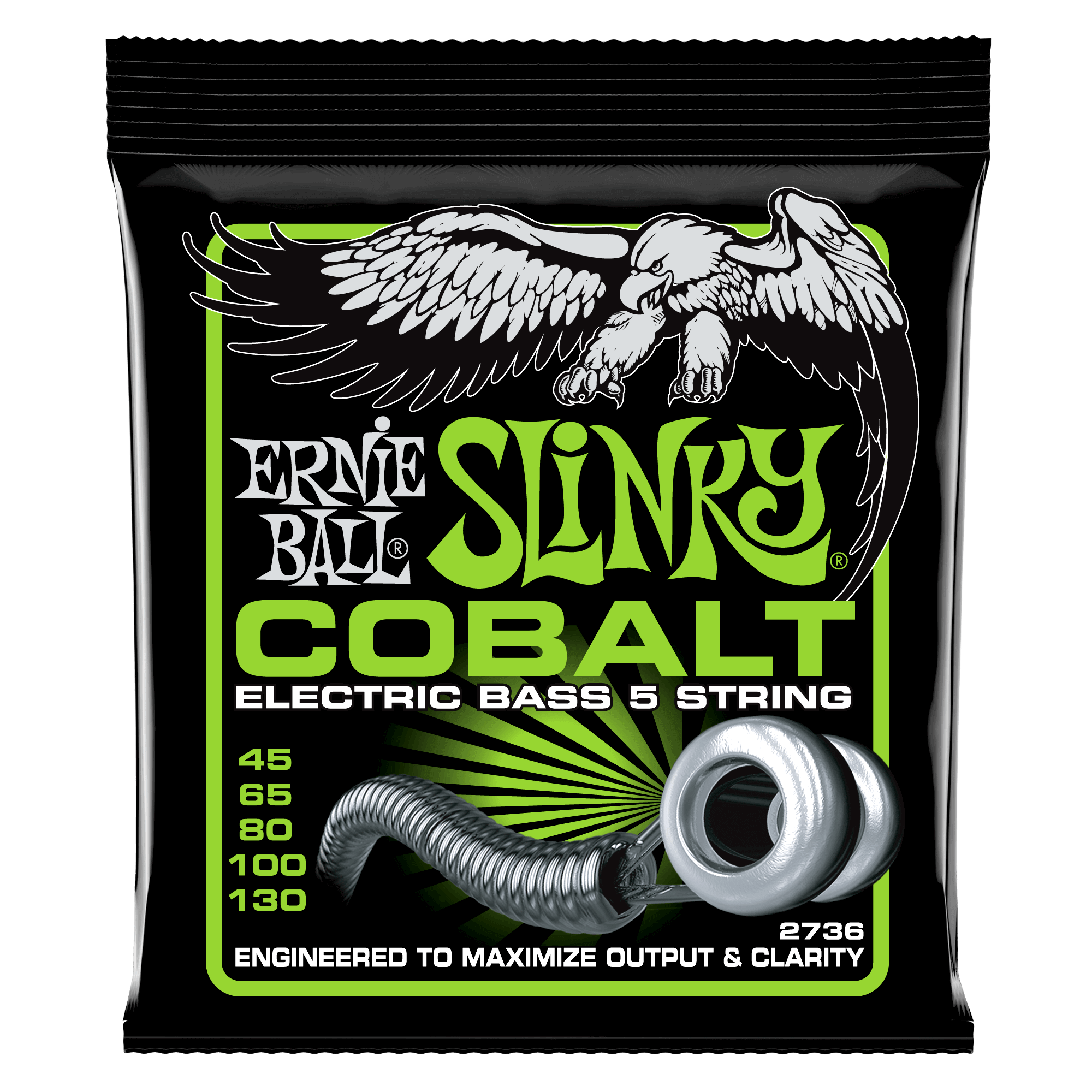
Ernie Ball 2736 Regular Slinky Cobalt Bass (5-String) strings run .045, .065, .080, .100, .130, a long-scale 5-string gauge wrapped in cobalt alloy instead of nickel-plated steel for more output and a tighter low end through passive pickups. Pantera bassist Rex Brown strings his 2023 Spector USA NS-5 with this exact set, per Premier Guitar's 2024 Rig Rundown. Pick it for B-standard rock and metal that wants Cobalt's extra bite on the low B.
What this set is
Ernie Ball's 5-String Regular Slinky Cobalt Bass takes the brand's standard 5-string gauge, .045 to .130, and winds it in a cobalt alloy instead of nickel-plated steel. Ernie Ball's own product listing describes the Cobalt line as engineered "to maximize output and clarity," giving bassists "an extended dynamic range, incredible harmonic response, increased low end, and crisp, clear highs," with cobalt creating "a stronger magnetic relationship between pickups and strings than any other alloy previously available."
It's also a documented touring-pro gauge, not just marketing copy. Premier Guitar's 2024 Rig Rundown on Pantera found this exact set on bassist Rex Brown's 2023 Spector USA NS-5, the five-string he calls his "baby": "the 5-string Spector takes Ernie Ball 5-String Slinky Cobalt Bass Strings (.45–.130)," in the outlet's own words.
The 5-string gauge isn't simply Ernie Ball's 4-string Hybrid Slinky Cobalt Bass (.045–.105) with a low B bolted on. The A and E strings step down slightly, .085 to .080 and .105 to .100, so the whole set balances around the added .130 low B instead of just extending the same top-string tension across a wider neck. Anyone moving from a 4-string Cobalt set to this one should expect a genuinely re-engineered gauge, not a simple add-on string.
Anatomy
- Model
- Ernie Ball P02736 Regular Slinky Cobalt Bass (5-String)
- MPN
- P02736 (Model # 2736EB per retailer catalogs)
- Gauge
- .045 – .130 (Regular Slinky, 5-string)
- Gauge set
- .045, .065, .080, .100, .130
- String count
- 5 strings
- Core wire
- Tin-plated hex steel
- Wrap wire
- Cobalt alloy
- Coating
- None, uncoated
- Winding
- Standard roundwound
- Intended scale
- Long scale, Ernie Ball's standard 5-string bass length
- Intended tunings
- B standard (B-E-A-D-G) primary; handles E standard on the top 4 strings
- Package
- Single pack
Cobalt vs nickel: the tone difference
Voicing through a passive pickup
- Output
- Ernie Ball's own claim: a stronger magnetic relationship with pickups than any other alloy the company has shipped, the same voicing shift documented and measured on the guitar Cobalt Slinky line.
- Low end
- Ernie Ball markets the Cobalt bass line specifically for increased low end alongside the output bump, useful on a 5-string's .130 low B where clarity under a dense mix matters most.
- Top end
- Ernie Ball's own claim for the Cobalt line: "crisp, clear highs" versus nickel-plated steel at the same gauge, most noticeable on the wound D, A, E, and low B strings.
- Bend feel
- Ernie Ball describes the Cobalt wrap as wound for added flexibility, marginally softer under a bending finger than the equivalent nickel gauge.
For the fully measured Cobalt vs nickel breakdown (output dB, brightness curve, longevity, bend feel), see Cobalt vs nickel Slinky: the voicing difference, measured. That comparison is built on Ernie Ball's guitar Cobalt line: the wrap-wire alloy and Ernie Ball's marketing claims carry over to bass, but CYS hasn't independently measured bass-specific numbers.
Where this sits in Ernie Ball's Cobalt bass family
Ernie Ball ships more than one Cobalt bass gauge, in both 4-string and 5-string spreads:
- 4-string, lighter top: Hybrid Slinky Cobalt Bass (SKU 2733), .045–.065–.085–.105.
- 4-string, standard top: Regular Slinky Cobalt Bass (SKU 2732), .050–.070–.085–.105.
- 5-string, this set: Regular Slinky Cobalt Bass, 5-String (SKU 2736), .045–.065–.080–.100–.130.
- 5-string, lighter: Super Slinky Cobalt 5-String Bass (SKU 2737), .040–.060–.070–.095–.125.
- 5-string, heavier: Power Slinky Cobalt 5-String Bass (SKU 2738), .050–.070–.085–.105–.135, built for down-tuned 5-string metal.
The nickel equivalent of this exact 5-string gauge is 5-String Regular Slinky Bass (.045–.130), the working-pro prog-metal default. Same gauge, cobalt wrap instead of nickel.
Full picture of how the Cobalt name works across Ernie Ball's whole catalog: Cobalt Slinky gauges explained.
Who plays it: Rex Brown's second Pantera bass
Pantera bassist Rex Brown tours with basses in two different Cobalt gauges. His signature Gibson and Epiphone Thunderbirds, both 4-strings, run the Hybrid Slinky Cobalt Bass. His 2023 Spector USA NS-5, a black-and-white gloss five-string he calls his "baby," takes this 5-string set instead. Premier Guitar's Chris Kies wrote it directly in the outlet's 2024 Rig Rundown: "the 5-string Spector takes Ernie Ball 5-String Slinky Cobalt Bass Strings (.45–.130)."
The NS-5 runs an EMG 40DCX pickup, part of EMG's active X series, the same family as the EMG X pickups on Brown's touring Thunderbirds, per the same Rig Rundown. So the Cobalt alloy's output bump reaches Brown's rig through an active preamp on both instruments rather than a passive circuit. Brown's full gear breakdown, from strings through pedalboard, is on his CYS bassist profile.
For the full documented roster of Ernie Ball Cobalt users, guitar and bass, see Who plays Cobalt Slinky strings: the documented pro users.
Best for
- B-standard 5-string metal and hard rock that wants Cobalt's output and low-end bump on the .130 low string. Pantera's Rex Brown is the clearest documented example, running this exact set on his Spector USA NS-5.
- Players stepping up from 4-string Cobalt who want the same alloy and technology with a 5th string for extended range, without switching brands or wrap-wire families.
- Passive-pickup 5-strings especially, though the magnetic-response claim still applies through an active preamp like the EMG X set on Brown's own Spector.
Worst for
- Players chasing maximum string life. Cobalt is uncoated, same wear curve as any uncoated roundwound; Ernie Ball's own longevity line is Paradigm (Everlast nano-treatment), not Cobalt.
- Drop-tuned 5-string metal below B standard. The .130 low string is built for B standard. A 6-string Cobalt set handles further-extended range with more purpose-built tension.
- Budget-conscious players. Cobalt costs more per set than Ernie Ball's standard nickel 5-String Regular Slinky Bass at the same gauge.
Install and break-in
Because this is a full gauge redesign rather than a 4-string set plus an extra string, give a 5-string bass a proper setup check when moving to this gauge for the first time, nut slot width for the added B string, saddle spacing, and truss rod relief. Break-in runs about the same as any fresh roundwound, 15 to 20 minutes of playing before the top end settles. Stretch each string, pull up gently a few times, retune, repeat, before a gig or session.
Verdict
5-String Regular Slinky Cobalt Bass is Ernie Ball's extended-range answer inside its Cobalt bass line: a purpose-built .045 to .130 gauge, not a 4-string set with a low B tacked on, wound in the same cobalt alloy that Pantera's Rex Brown runs on his Spector USA NS-5. It's a real touring gauge, not just a catalog filler.
If you're coming from a nickel 5-string set and want more output and low-end presence at the same gauge, this is a straightforward upgrade. If you're chasing the lowest price per set instead, the nickel 5-String Regular Slinky Bass costs less for the identical gauge.
Related
Related