Eyal Levi: death metal producer, Audiohammer founder, URM co-founder
Eyal Levi produced The Black Dahlia Murder, Whitechapel, August Burns Red, and Suicide Silence at Audiohammer Studios, and co-founded URM Academy. What strings fit his rhythm-guitar lane.
Written with AI help · Updated
Eyal Levi produced a generation of death metal and technical metalcore at Audiohammer Studios, The Black Dahlia Murder, Whitechapel, August Burns Red, Suicide Silence, and co-founded URM Academy with Joey Sturgis and Joel Wanasek. He was also guitarist for Dååth, which gives him an unusually deep perspective on string choice from both sides of the glass. His lane sits in Drop C down to Drop A on 7-string, with heavy gauges in the .011–.060 range and above.
Who Eyal Levi is
Eyal Levi is a producer, mixer, engineer, and former guitarist whose catalog defines the technical-death-metal and heavy-metalcore lane of the 2008–2016 era. Audiohammer Studios in Sanford, Florida is the physical base for the work: The Black Dahlia Murder's catalog through that era, Whitechapel, August Burns Red, Suicide Silence, DevilDriver, Impending Doom, and many more. He was also the guitarist for Dååth, a Roadrunner-era technical death metal band, which puts him in an unusual position: most producers in this lane have never been on the player's side of the glass.
He is one of the three founders of URM Academy (Unstoppable Recording Machine), alongside Joey Sturgis and Joel Wanasek. His public-facing output in 2026 is weighted toward URM content, Nail the Mix sessions, and the Drumhammer podcast, which, despite the name, covers production across the full metal spectrum.
This page is the guitar-string context for his production lane. We describe the strings that fit his production style; nothing here is a direct endorsement claim absent sourced citation.
Production signatures
Four things identify an Eyal Levi-era technical-metal production:
- Death metal rhythm clarity. The palm-muted rhythm work on a Black Dahlia Murder or Whitechapel record sits tighter and more articulate than peer productions because the tracking captures the picking attack cleanly, which requires string tension that lets the guitarist execute the part without flab on the low string. This is a gauge discussion as much as a mic-and-preamp discussion.
- 7-string rhythm tonality. A disproportionate share of his catalog is 7-string material. The low B-down-to-A string on a 25.5" scale needs specific care, he does not typically produce 8-string records or fan-fret extended-range music, so the 7-string low string is the extreme-low-end anchor.
- Lead guitar presence. Solos in this lane have to cut through dense rhythm-and-drum arrangements. The Cobalt wrap question, fresh-string question, and pick-choice question all matter for leads that need to read as musical rather than as noise against a wall of chug.
- Drummer-first mix philosophy. His podcast and education content emphasize drum tracking and drum sound. Guitar choices in the mix sit around the drum sound, which means guitar tones that fight the kick and snare don't survive the mix process. Gauge and string age affect whether the guitar sits in the right frequency pockets to coexist with the drum mix.
Strings that fit the Audiohammer-era tech-metal lane
Drop C / Drop B (6-string, 25.5" scale)
.011–.054 minimum for Drop C. .012–.056 if the same session drops to Drop B within a song or album. Ernie Ball Beefy Slinky, D'Addario NYXL 11–54, or the Cobalt-line equivalent all fit.
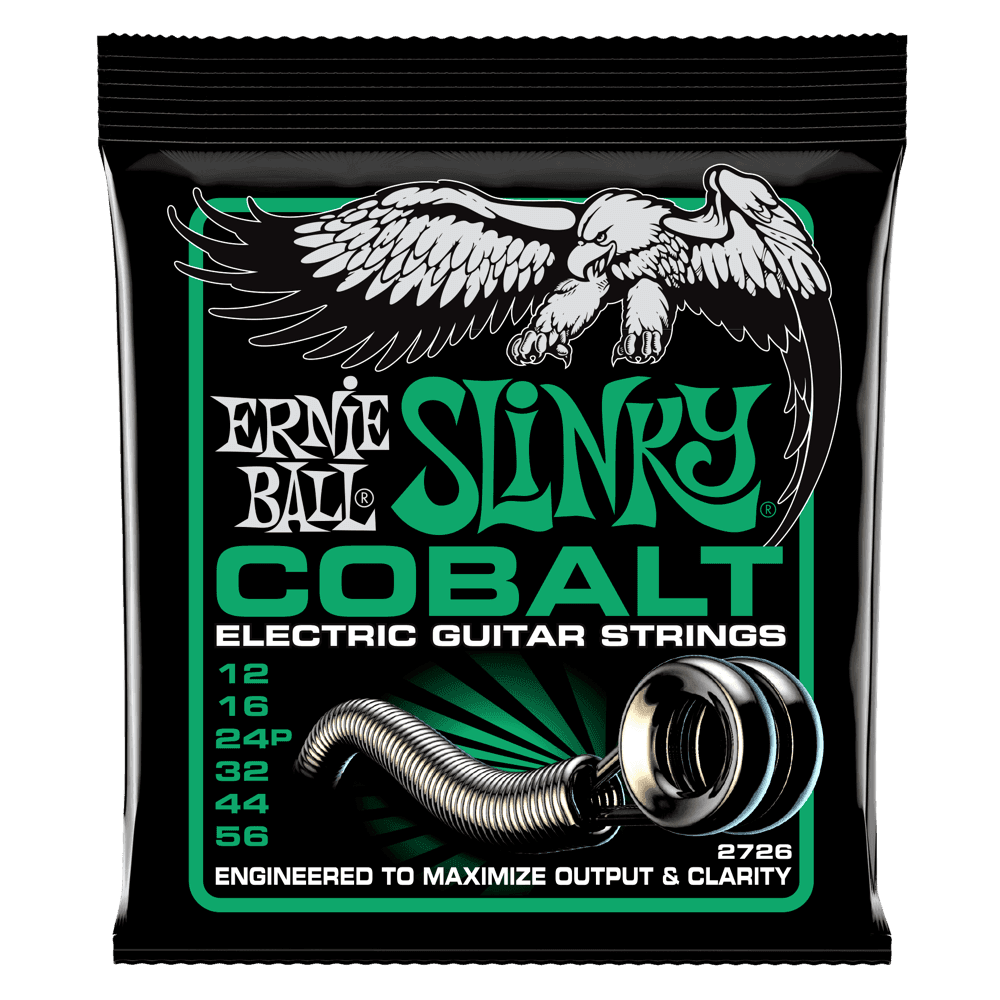
Not Even Slinky Cobalt (.012–.056)
Why this one: The heavy-Cobalt option for Drop B tech-metal 6-string work, upper-midrange presence that cuts through the dense kick + bass + low guitar pocket without requiring gauge-beyond-.056.
7-string Drop A / Drop G# (25.5" scale)
.010–.062 or .010–.059. The low string is the most context-sensitive decision in the set, too light and palm mutes flap; too heavy and the top strings go stiff.
Coated for long tracking schedules
Audiohammer-era sessions often ran days per guitar track. Coated sets (Elixir Nanoweb, Ernie Ball Paradigm, D'Addario XT) survive the tracking window without needing string-age compensation on each take.
Why his guitar-player perspective matters
Producers who have never played in the genre they produce default to processing choices (amp sim presets, tight EQ templates, aggressive gate profiles) that work generically. Producers who have performed in the genre make tracking decisions that reduce how much of that processing is necessary, because the source already sounds like the record. Levi's Dååth-era guitar playing puts him in the second category.
The practical consequence for string choice: he tends to track guitars that are set up the way a working guitarist would set them up, not the way a compromise-for-the-mix template would. That means respecting gauge choice, pickup choice, and pick attack rather than overriding them. The records sound more like the bands than like the producer, which is why the catalog has the range it does.
Related
- Related producer pages: Joey Sturgis (URM co-founder, metalcore lane), Joel Wanasek (URM co-founder, metalcore/crossover), Andy Sneap (British metal / thrash side), Adam "Nolly" Getgood (prog/djent).
- Genre pages: death metal in Drop C, metalcore in Drop B.
- Drumhammer is his podcast; URM Academy is the school. Both are useful if you want to go deeper on how these records were made.