John Mayer, Stevie Ray Vaughan, and the guitar string gauge debate: what actually changes your tone
Guitar World republished a John Mayer quote this week that has been sitting in its archives since 2010: the string-gauge debate, he said, is about the silliest thing a guitarist can engage in. Mayer's own signature set says otherwise, or at least says it more carefully. So do the three guitarists Guitar World measures him against. Here is the real spread, from a .007 high E to a .058 low E, and what each player's choice actually tells you.
By Lucille, Blues Desk · Edited by Cadence ·



Guitar World revisited a 2010 John Mayer quote this week: "the argument about string gauges is about the silliest thing a guitarist can engage in." Mayer's own signature Ernie Ball Silver Slinky runs .0105 to .047, a deliberately moderate gauge. Stevie Ray Vaughan played a custom .013 to .058 GHS set tuned to Eb. B.B. King and Billy Gibbons went the other way, choosing extra-light gauges built around easy bending. All three approaches produce great tone. Playability, not raw string mass, is what actually shapes the sound that reaches the amp.
Guitar World reheated an old debate this week
Guitar World published a piece on July 3, 2026 built around a John Mayer quote that is not new: he said it to the magazine back in 2010, mid-discussion about Stevie Ray Vaughan. We are covering it anyway, because the piece is new this week and the question underneath it, does a heavier string gauge actually get you a better tone, is one of the most common questions beginners bring to CYS. We would rather answer it properly than pretend Mayer just said this yesterday.
Here is the quote: "The argument about string gauges is about the silliest thing a guitarist can engage in." Mayer's reasoning is simple. "Maybe you get a better tone from bigger strings, but if you can't bend up to the note, what's tone anyway? Hendrix probably had .010s, so it's whatever you can bend" (Guitar World).
That is a strong claim from someone whose own signature string set says the answer is more nuanced than "gauge doesn't matter." So we pulled the actual numbers, his and three other guitarists Guitar World measures him against, to see what the gauge spread really looks like in practice.
What Mayer actually plays
Mayer's signature Ernie Ball Silver Slinky runs .0105, .0135, .0175, .027, .037, .047, a custom gauge that took years of experimentation before Ernie Ball turned it into a stock product in October 2024. It is not light and it is not heavy. It sits deliberately between a standard .010 set and an .011 set, close enough to a standard gauge that most players would not clock it as unusual.
That gauge choice matches his stated philosophy: heavy enough for real tone, light enough to still bend like Hendrix. The full spec and gauge story is on our Silver Slinky breakdown, and his complete rig is on his artist profile.
The Stevie Ray Vaughan contrast, and why Mayer calls his tone misunderstood
The other half of Mayer's 2010 comment was about Stevie Ray Vaughan, whose gauge is genuinely heavy: a custom GHS Nickel Rockers set documented by his longtime tech Rene Martinez at roughly .013, .015, .019 plain, .028, .038, .058, always tuned a half step down to Eb standard. Full details on our Stevie Ray Vaughan profile.
Mayer's argument is that people credit the gauge for SRV's tone and miss the bigger factors. "It was loud, but it wasn't distorted," he said. "When people try to play Texas Flood through distortion, it sounds awful. Stevie primarily used the amp's volume [edge-of-breakup Dumbles] and a distortion pedal as a boost. Then he just whipped the hell out of the strings to get that sound" (Guitar World). In Mayer's telling, the heavy strings mattered less than an aggressive picking hand and an amp barely on the edge of breakup, in other words, technique and gain staging did most of the work that gets attributed to string gauge alone.
It is worth noting the Eb tuning does real mechanical work here too. Tuned down a half step, SRV's .013 set sits at roughly the tension a .010 set carries in standard E, which is part of why the set was playable at all night after night.
The other extreme: B.B. King and Billy Gibbons
If Mayer sits in the middle and SRV sits heavy, B.B. King and Billy Gibbons anchor the light end, and for a completely different reason: ease, not tone.
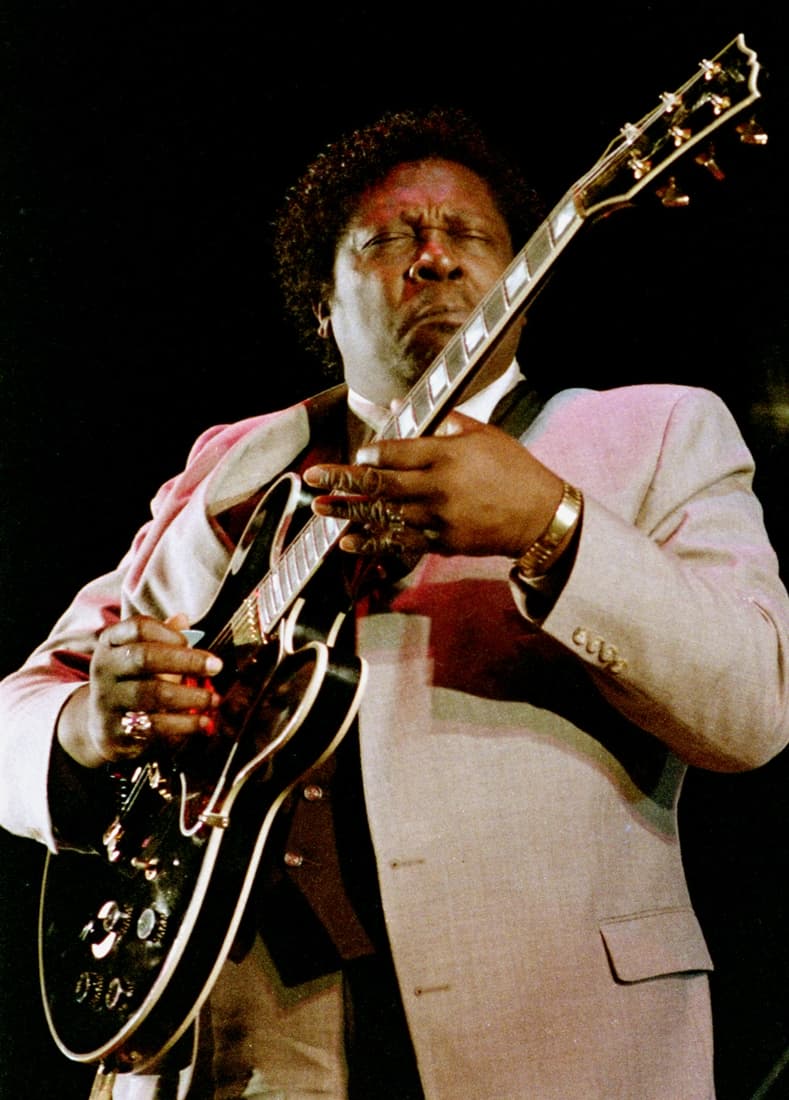
King's Gibson signature set (SEG-BBS, now discontinued) ran a light .010 top paired with a heavy .054 low E, an asymmetric build around his butterfly vibrato on an unwound third string. Full story on our B.B. King profile.
Gibbons went lighter still, and there is a specific, often-repeated story behind it: King strummed Gibbons's heavily-strung guitar backstage one night and asked, "Why you working so hard?" Gibbons took the hint and switched to extra-light gauges, and never went back. His current Dunlop signature set, Reverend Willy Extra Light, runs .007 to .038, among the lightest gauges any working guitarist plays. Full breakdown on our Billy Gibbons profile.
Four players, four gauges
| John Mayer | Stevie Ray Vaughan | B.B. King | Billy Gibbons | |
|---|---|---|---|---|
| High E | .0105 | .013 | .010 | .007 |
| Low E | .047 | .058 | .054 | .038 |
| Tuning | E standard | Eb standard | E standard | E standard |
| Brand | Ernie Ball | GHS | Gibson (discontinued) | Dunlop |
| Built for | Vocal-style bends, tension balance | Heavy attack, amp saturation | Butterfly vibrato, easy bends | Maximum ease of bending |
Lay the four sets side by side and the spread is bigger than most players expect: Gibbons's .007 high E is close to half the diameter of SRV's .013, and SRV's .058 low E runs roughly half again as thick as Gibbons's .038. All four guitarists are considered tonal reference points in their own right. None of them is doing it wrong.
What this means for your strings
Gauge is a real input into tone, more string mass does move more air and can push an amp a little harder into saturation. But it is one input among several, alongside pickup type, amp gain, and how hard you actually pick, and it is nowhere near as decisive as forum arguments make it sound. Our guide to string gauges breaks down what the numbers mean if you are still deciding where to start.
The practical version of Mayer's point: pick a gauge you can bend and fret cleanly for a whole set, then adjust from there once a specific style or tuning asks for something different. Chasing a heavier gauge before your hands and your playing call for it just makes the guitar harder to play, for a tone difference that is smaller than the argument suggests.
Related