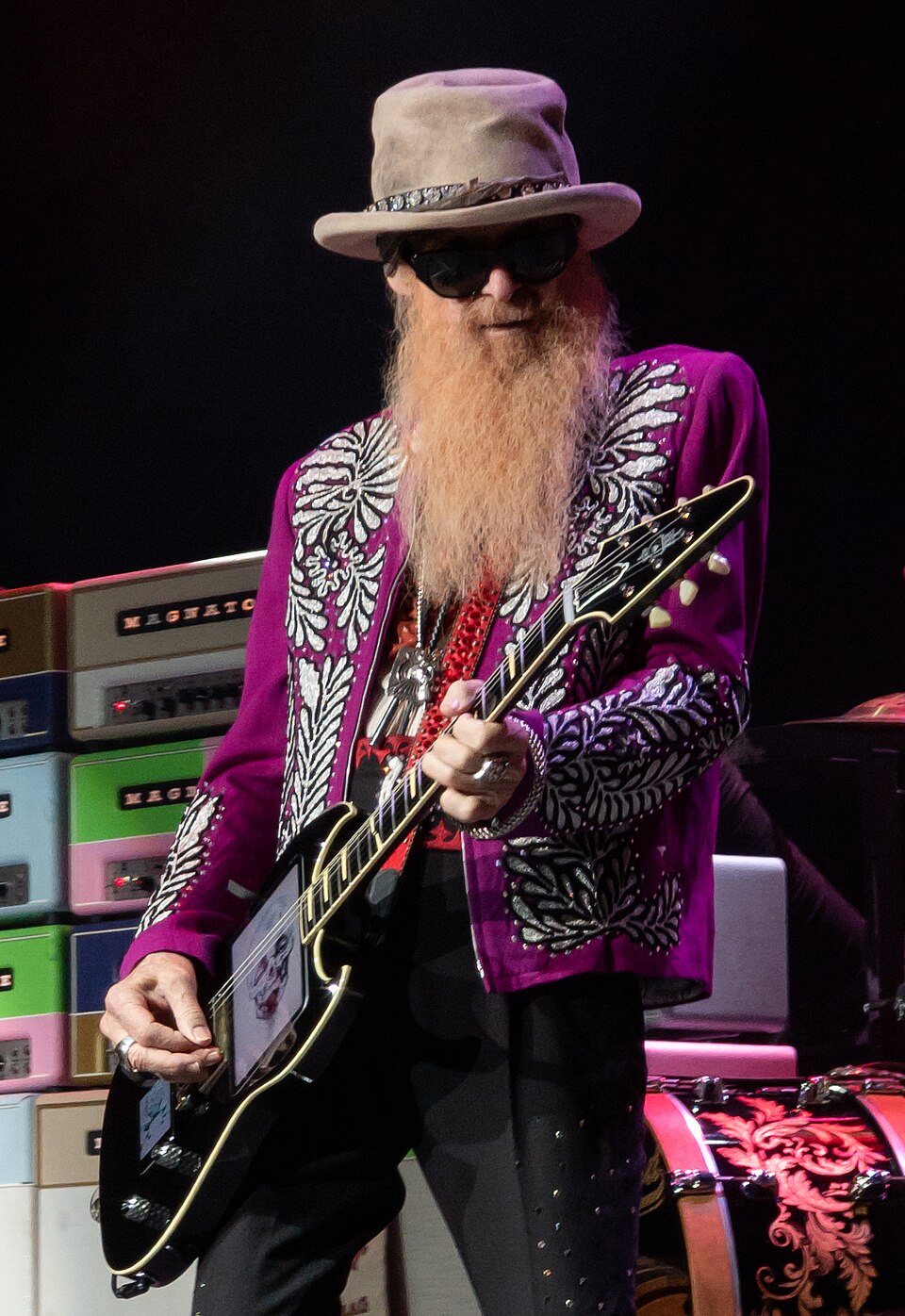
Billy Gibbons's guitar strings: the Pearly Gates rig, sourced
Documented string gauges, brands, and tunings Billy Gibbons uses with ZZ Top on his 1959 Les Paul 'Pearly Gates'. Dunlop Reverend Willy Extra Light (.007–.038). With citations.
ZZ Top · written with AI help · updated
Billy Gibbons uses his Dunlop signature set Reverend Willy Extra Light (.007, .009, .011, .020w, .030, .038), extreme-light gauges he switched to after a famous backstage moment with B.B. King, who strummed Gibbons's heavy-strung guitar and asked, 'Why you working so hard?' His primary instrument is 'Pearly Gates,' a 1959 Gibson Les Paul Standard he's played for the entire ZZ Top catalog. Tone signal chain runs Pearly Gates into a vintage Marshall or Fender.
Who Billy Gibbons is
Billy Gibbons is the founding guitarist, lead vocalist, and primary songwriter of ZZ Top, a Texas blues-rock trio formed in 1969. The band's catalog from Tres Hombres (1973) through La Futura (2012) sits at the center of American hard-blues guitar tradition, and Gibbons's tone, a 1959 Les Paul through a Marshall or vintage Fender, with .007-gauge strings, is one of the most identifiable in classic rock. Alongside fellow Texan Stevie Ray Vaughan, he's one of the two guitarists most responsible for keeping Texas blues in the mainstream rock conversation.
What he plays
Dunlop Reverend Willy Extra Light (.007, .009, .011, .020 wound G, .030, .038) on Pearly Gates, his 1959 Les Paul Standard. The set is sold under his nickname (Reverend Willy G) and in his exact custom gauge. He's been on extreme-light gauges since the early 1980s, when a backstage conversation with B.B. King ended with King picking up Gibbons's heavy-strung guitar, strumming it, and asking, "Why you working so hard?"
Gibbons moved to lighter gauges and never went back. The Dunlop signature relationship formalized that gauge into a production set.
Electric guitars
Four decades of documented instruments, from the $250 Les Paul that made him famous to a one-off Gibson he's only been touring with since April 2026.
Primary instrument since 1968 · original kept off the road
1959 Gibson Les Paul Standard, "Pearly Gates"
Gibbons bought it for $250 from a rancher near Downey, Texas, and it has appeared on every ZZ Top album since. He's turned down a $5 million offer to sell it. These days the original stays in storage; live, Gibbons plays a John Bolin-built replica, fully hollowed, with a Duncan humbucker in the neck and a Thomas Nelson Cream T pickup in the bridge, its headstock reading "Gibbons" instead of "Gibson."
Source: Ground Guitar, Billy Gibbons gear archive; MusicRadar rig tour.
Signature model since 2005 · co-designed with Bo Diddley
Gretsch G6199 Billy-Bo Jupiter Thunderbird
Bo Diddley gave Gibbons an original 1959 Jupiter Thunderbird as a gift, and Gibbons didn't want to risk it on the road. Gretsch's production reissue carries TV Jones Power'Tron pickups, a mahogany neck, and a chambered maple-and-mahogany body. In Gibbons's own words on Gretsch's product page: "we didn't risk subjecting such a rare instrument to the rigors of the road... it's now the main stage guitar with a groove." He tours with white, red, and black examples.
On loan since April 2026 · one-off build
Gibson CEO#11 Custom Explorer
A Vintage Cherry Sunburst Explorer with a two-piece figured maple top, hand-built by Gibson's own CEO, Cesar Gueikian, and given to Gibbons to play on ZZ Top's Elevation Tour. It's not a catalog model. Like Gueikian's other one-off "CEO" builds, most famously the SG Kirk Hammett played at Back to the Beginning, it's expected to eventually go to auction for the Gibson Gives charity.
Source: MusicRadar, Cesar Gueikian's custom CEO#11 Explorer.
Built 1998 · tribute instrument, not a stage rig
"Muddywood"
Gibbons salvaged a cypress beam from the collapsing roof of Muddy Waters's childhood cabin at Stovall Farms, Mississippi, and had Memphis's Pyramid Guitar Co. build it into a guitar as a tribute. Two were made: a rougher test piece Gibbons said he'd likely use on tour, and the finished, Mississippi-River-painted instrument he donated to the Delta Blues Museum in Clarksdale, where it's on permanent display today.
Amps and effects
The vintage Marshall that built the ZZ Top sound, the current signature amp partnership most fans haven't caught up on yet, and the one pedal detail Gibbons has confirmed himself.
Foundational · defined the classic ZZ Top tone
Marshall Super Lead 100W (1968) and old Fender combos
In Gibbons's own words: "at the heart of almost everything we've done... is Pearly Gates run through either a Marshall or an old Fender. That simple-but-deadly combination is still tough to beat." Asked in the same interview why Marshalls seem less visible onstage now, he explained the touring rig runs a Marshall tube preamp into Marshall's now-discontinued 120/120 power amp, "the cornerstone for our guitar and bass tones," just rack-mounted instead of standing in stacks behind him.
Source: Guitar World archive, Dear Guitar Hero: Billy Gibbons.
Current signature partnership
Magnatone Billy Gibbons Collection (Chrome Grape)
Magnatone's Master Collection heads and combos (the Super Fifty-Nine M-80, Super Fifteen, and Baby M-80), built around British-inspired EL84 and EL34 tube circuitry, finished in a limited Chrome Grape cosmetic designed in collaboration with Gibbons. It's the clearest sign his amp story today is bigger than the vintage Marshall history most gear write-ups stop at.
Six in the chain · confirmed by Gibbons himself
Bixonic Expandora (overdrive)
A Guitar World reader once asked how six Expandora overdrives in a row don't turn into a muddy mess. Gibbons's answer: "combinations of multiple effects are manageable when using a slight edge from each, which avoids the unwanted collision of tones. However, at this point, sometimes the grind of excessive noise becomes its own thing." The rest of his board is rarely documented with this level of detail; the Expandora count is the one specific pedal fact he's put on the record himself.
Source: Guitar World archive, Dear Guitar Hero: Billy Gibbons.
Strings
The signature set that started with a piece of advice from B.B. King.
Signature set · endorsed · .007–.038
Dunlop Reverend Willy Extra Light
Billy Gibbons's documented signature gauge, in his exact custom spread (.007, .009, .011, .020 wound, .030, .038). At .007 high E, it's one of the lightest commercially available rock sets on the market. The bend-melt feel of every ZZ Top lead starts here, paired with the feathered right-hand touch that keeps these strings from going pitch-sharp under a hard attack.
Source: Ultimate Guitar; Stringjoy gauge breakdown.
Picks
A signature quirk in Gibbons's rig, and it isn't a piece of plastic.
Signature quirk · a coin, not a pick
Mexican peso coin, hand-beveled
Gibbons traces the habit to his years near the Mexican border: large-format peso coins, beveled down by a machinist into a playable edge. Those coins haven't been minted in decades, so he's protective of the stash he has left. When he's not reaching for a peso, he plays a Jim Dunlop "Billy G Special," made from a plastic-like material originally developed for racing-car windshields.
Why this fits the rig
A Les Paul at .007–.038 in E standard sits at very low tension, meaningfully lower than a stock .010 set. That gives Gibbons the fingertip-light bend feel his lead vocabulary depends on (the vocal phrasing of the La Grange lead, the slide-into-vibrato that defines Sharp Dressed Man's solo). The trade-off is pitch stability under pick attack: Gibbons's right hand is feathered enough that the strings don't go sharp under the attack, most players who try the gauge find their picking is too aggressive for it.
The signal chain, Pearly Gates' PAF-style humbuckers into a Marshall or old Fender, historically did the rest; today that's as likely to be a rack-mounted Marshall preamp or a Magnatone Chrome Grape amp as an actual vintage stack onstage. The gauge isn't tone-shaping per se; it's feel-shaping. The tone is the guitar, the amp, and Gibbons's right hand. The gauge buys him the bend feel he wanted from the moment B.B. King handed him back his guitar.