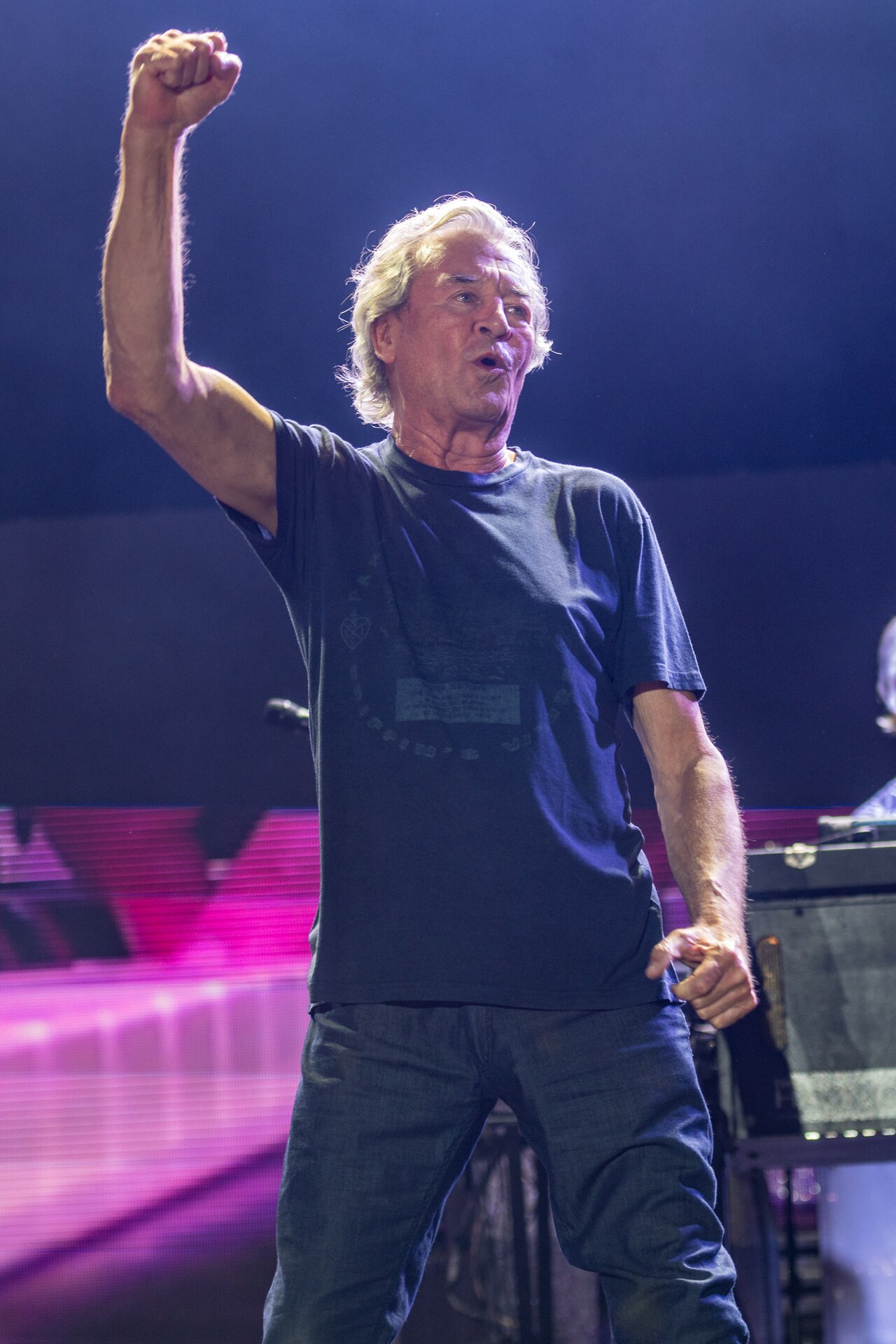
Ian Gillan: Deep Purple's voice, decoded
Ian Gillan has fronted Deep Purple across three stints since 1969: Machine Head, a 1983 run with Black Sabbath, and 2026's SPLAT! The Jesus Christ Superstar story, sourced.
Deep Purple · written with AI help · updated
Ian Gillan has fronted Deep Purple across three stints since 1969, the voice behind 'Smoke on the Water,' 'Child in Time,' and Machine Head. Born August 19, 1945, in Chiswick, England, he joined Deep Purple's Mark II lineup alongside bassist Roger Glover in June 1969, sang the role of Jesus on the original 1970 Jesus Christ Superstar recording, fronted Black Sabbath's Born Again in 1983, and still leads Deep Purple today, on 2026's SPLAT!
Who Ian Gillan is
Ian Gillan was born August 19, 1945, at Chiswick Maternity Hospital in Middlesex, England. His father Bill was a storekeeper from Govan, Glasgow; his mother Audrey's own father had been an opera singer. Gillan grew up in Cranford, Middlesex, and left school to work an ice-machine manufacturing job before music took over, drawn in first by Elvis Presley records played at his local youth club.
He worked through a string of local bands, Garth Rockett and the Moonshiners, the Javelins, and the soul group Wainwright's Gentlemen, before joining Roger Glover's band Episode Six in April 1965. Episode Six released nine singles without a UK chart hit, but it's where Gillan and Glover began writing songs together, a partnership that would outlast the band itself. In June 1969, Deep Purple's Ritchie Blackmore, Jon Lord, and Ian Paice caught Episode Six at a pub gig and offered Gillan the vacant singer job, asking if he knew a good bassist too. Glover came along. Both joined on June 16, 1969, replacing vocalist Rod Evans and bassist Nick Simper.
Gillan made his first onstage appearance with Deep Purple at London's Speakeasy Club on July 10, 1969, filling out a thin set list with instrumentals because the new lineup had barely rehearsed. That changed fast: during rehearsals at Hanwell Community Centre later that year, Gillan wrote the vocal melody and lyrics to "Child in Time," a song that became the calling card of the Mark II lineup he'd just joined, alongside Ritchie Blackmore on guitar and Ian Paice on drums.
Three stints, one voice
Add up the years and Gillan has fronted Deep Purple for more than 43 of the band's 58 years since its 1968 founding, a tenure no other vocalist in the band's history comes close to matching.
Every stint, start to finish
- Stint one (June 1969 – June 30, 1973)
- Recruited alongside Roger Glover for the Mark II lineup. Recorded Deep Purple in Rock (1970), Fireball (1971), Machine Head (1972), Who Do We Think We Are (1973), and the live Made in Japan (1972). Resigned by letter, written on tour in Dayton, Ohio, citing exhaustion.
- Stint two (April 1984 – 1989)
- Rejoined the reformed Mark II lineup, announced on Tommy Vance's radio show. Recorded Perfect Strangers (1984) and The House of Blue Light (1987). Fired after tensions with Blackmore resurfaced; Joe Lynn Turner took the mic for 1990's Slaves and Masters.
- Stint three (1992 – present)
- Returned at the urging of Roger Glover, Jon Lord, and Ian Paice for the band's 25th anniversary. Recorded The Battle Rages On (1993) through 2026's SPLAT!, spanning guitarists Blackmore, Joe Satriani, Steve Morse, and Simon McBride.
The voice: Arthur Brown, screams, and Child in Time
Gillan has said Arthur Brown, of the theatrical 1968 hit "Fire," inspired him to bring screaming into his own singing: "He changed my life." That influence is all over "Child in Time," the 10-minute Deep Purple in Rock epic Gillan wrote the words and melody to, which builds from a near-whisper to a full scream and back.
Rolling Stone's 2012 readers' poll ranked the recording eighth on its list of the best vocal performances in rock history, ahead of Nirvana's MTV Unplugged rendition of "Where Did You Sleep Last Night" and behind Led Zeppelin's "Stairway to Heaven." The magazine's write-up put it plainly: "One of their standout moments is 1970's 'Child in Time,' a 10-minute epic that showcases frontman Ian Gillan's crazy vocal range. The band has largely ignored it in recent years, probably because their 67-year-old singer can't hit those notes anymore."
Deep Purple has, in fact, mostly retired "Child in Time" from live setlists in recent decades, a tacit acknowledgment of exactly what Rolling Stone described.
What plays behind that voice
Gillan doesn't play a string instrument, so there's no signature set carrying his name. What backs him up, though, is well documented: Ritchie Blackmore's scalloped Fender Stratocaster (and later Steve Morse's and Simon McBride's guitars) on one side, Roger Glover's bass on the other.
Guitar, factory-fit strings
Fender USA Bullets 3250L (.009-.042)
The nickel-plated steel set that ships on Ritchie Blackmore's own Fender signature Stratocaster, the guitar behind most of the Mark II catalog Gillan sang over.
Source: Fender, official product page.
Bass, current main
Roger Glover's Vigier Excess, Ernie Ball strings
Glover has played Ernie Ball strings since the mid-1990s on his Vigier signature bass. No exact gauge is publicly documented, so this is the closest current four-string Ernie Ball match.
Source: Roger Glover's full bass profile.
USA Bullets 3250L Nickel Plated Steel (.009-.042)
Why this one: The factory-fit set on the Stratocaster behind Machine Head, In Rock, and the rest of the Mark II catalog Gillan is best known for singing.
Super Slinky Bass (.045-.100)
Why this one: Glover's documented brand since the mid-1990s. Super Slinky Bass at .045-.100 is the closest current Ernie Ball four-string match to his signature Vigier's stock .040-.095.
The wilderness years: solo bands, Rainbow's near-miss, and Black Sabbath
After leaving Deep Purple in 1973, Gillan sank money into a hotel and a motorcycle company, Mantis Motor Cycles, both of which failed; a 1974 investment in Kingsway Studios worked out better. In 1975 he formed the jazz-inflected Ian Gillan Band, then in 1978 a harder-rocking group simply called Gillan, whose lineup eventually included guitarist Bernie Tormé and, later, future Iron Maiden guitarist Janick Gers. 1980's Glory Road and 1981's Future Shock both charted in the UK Top 5, Gillan's commercial peak outside Deep Purple. He folded the band in 1982, citing damaged vocal cords.
Around Christmas 1978, Ritchie Blackmore offered Gillan the vacant singer job in Rainbow, following Ronnie James Dio's exit. Gillan turned it down, though the two jammed together at the Marquee Club, their first shared stage since 1973.
In April 1983, Gillan joined Tony Iommi, Geezer Butler, and Bill Ward, the founding members of Black Sabbath, replacing Ronnie James Dio for the album Born Again. It's one of the more divisive records in either band's catalog. Gillan quit after Sabbath's second North American tour behind it, then rejoined a reforming Deep Purple in April 1984.
Fired, and back again
The 1984 reunion produced Perfect Strangers and 1987's The House of Blue Light, but Gillan was unconvinced by the results: "I can't feel the spirit of the band." Tensions with Blackmore resurfaced by 1989, and after an argument, Roger Glover told Gillan he'd "gone too far this time." He was fired, replaced by former Rainbow singer Joe Lynn Turner for 1990's Slaves and Masters.
At the urging of Glover, Jon Lord, and Ian Paice, who wanted him back for the band's 25th anniversary, Gillan returned in 1992 to finish The Battle Rages On, largely rewriting lyrics and melodies over material already tracked with Turner. Blackmore, unhappy with the decision, left Deep Purple for good in 1993, after the European tour promoting the album. Gillan has fronted every lineup since, through guitarists Joe Satriani, Steve Morse, and current guitarist Simon McBride, and remains the band's singer on 2026's SPLAT!, its 24th studio album.
In a November 2025 interview with Uncut, Gillan revealed he now has only around 30 percent of his eyesight and raised the possibility of stepping back from performing: "It creeps up on you, you don't really notice."
Armenia and life outside the band
Gillan's connection to Armenia began with Rock Aid Armenia, a charity re-recording of "Smoke on the Water" made with Bryan Adams, Tony Iommi, David Gilmour, Brian May, and others to fund earthquake relief after 1988's Spitak earthquake. He's called Armenia his "spiritual motherland," performed with its State Philharmonic Orchestra in 2010, and helped fund a music school in Gyumri, opened in 2013. In 2011, after both received the Armenian Presidential Medal of Honour, Gillan and Tony Iommi formed WhoCares, an ad hoc charity recording project.
Away from music, Gillan supports Queens Park Rangers and follows cricket. He married Bron in 1984, to whom he dedicated Black Sabbath's "Keep It Warm"; she died in November 2022. Their daughter Grace Gillan is also a singer. He lives near Lyme Regis, Dorset, and keeps a second home in southern Portugal.