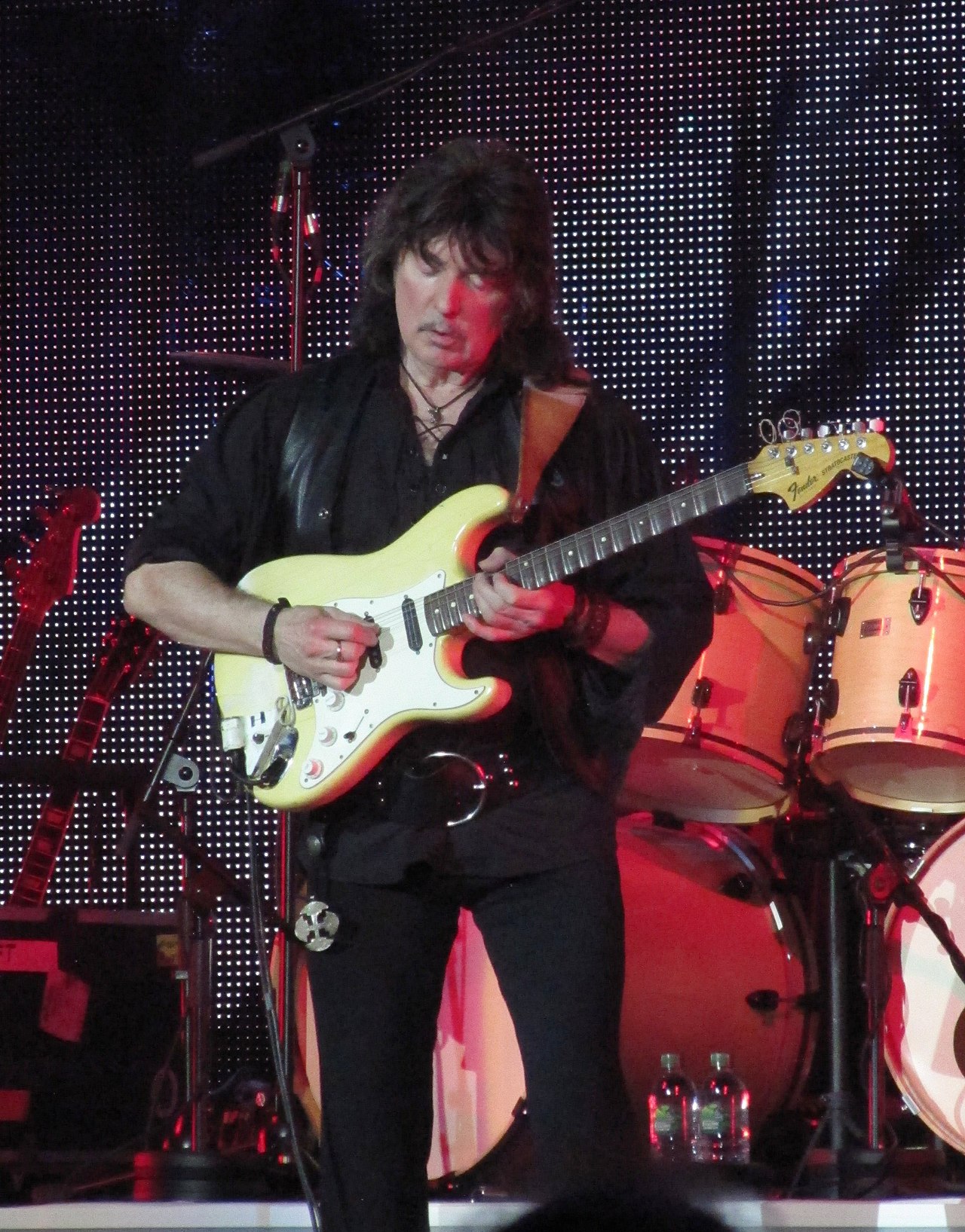
Ritchie Blackmore's guitar strings: the Deep Purple and Rainbow rig, sourced
Documented string gauges and gear Ritchie Blackmore plays on his scalloped Fender Stratocaster across Deep Purple, Rainbow, and Blackmore's Night. Picato RB77 Artist Signature (.010–.048) and Fender USA Bullets (.009–.042). With citations.
Deep Purple / Rainbow / Blackmore's Night · written with AI help · updated
Ritchie Blackmore plays a Fender Stratocaster with a graduated scalloped fingerboard; his signature model ships from the factory with Fender USA Bullets (.009–.042). For decades he has also carried a Picato RB77 Artist Signature set (.010–.048) under his own name. Deep Purple and Rainbow's guitarist tunes to standard E almost exclusively. He switched from Gibson to Fender between In Rock (1970) and Fireball (1971), trading easier string flow for Fender's tension and wah-wah tone.
Who Ritchie Blackmore is
Richard Hugh "Ritchie" Blackmore (born April 14, 1945, in Weston-super-Mare, Somerset, England) is the guitarist behind one of rock's most-imitated riffs and one of its most restless careers. He got his first guitar at 11 from his father, on the condition he take lessons properly, and spent a year on classical guitar before switching to electric and taking lessons from session player Big Jim Sullivan. He left school at 15 for an apprenticeship as a radio mechanic near Heathrow Airport, then spent the early 1960s as a working session guitarist around London.
He co-founded Deep Purple in 1968 after meeting keyboardist Jon Lord in a Hamburg club, alongside drummer Ian Paice, singer Rod Evans, and bassist Nick Simper. The band's early records leaned toward orchestral rock, including 1969's Concerto for Group and Orchestra with the Royal Philharmonic, but Blackmore tired of that direction. With the Mark II lineup (Ian Gillan on vocals, Roger Glover on bass), he pushed the band toward a harder, simpler sound on In Rock (1970), the record that set the template for everything that followed. Machine Head (1972) produced "Highway Star," the only guitar solo Blackmore has ever said he's committed to memory, and "Smoke on the Water," whose riff has outlasted the rest of his catalog in cultural reach; Blackmore has said its endurance comes down to simplicity.
Blackmore left Deep Purple in 1975, once the Mark III lineup (David Coverdale, Glenn Hughes) had run its course, to form Ritchie Blackmore's Rainbow with vocalist Ronnie James Dio. Rainbow leaned further into the classically-influenced, guitar-hero style Blackmore had been sketching inside Deep Purple, and Rising (1976), including the Blackmore-composed "Stargazer," is the era's high point. He rejoined the classic Mark II Deep Purple lineup for a 1984 reunion (Perfect Strangers, The House of Blue Light), then left the band for good in 1993. In 1997 he formed Blackmore's Night with vocalist Candice Night, now his wife, playing renaissance and folk-rock material that remains active today. He was inducted into the Rock and Roll Hall of Fame in 2016 as a member of Deep Purple. Musicologist Robert Walser has credited him as "the most important musician of the emerging metal/classical fusion," the lineage that runs forward to neo-classical shred players like Yngwie Malmsteen.
What he plays
A Fender Stratocaster with a graduated scalloped rosewood fingerboard, based on Blackmore's favorite Stratocaster from the 1970s. Fender's own Ritchie Blackmore Artist Signature model reproduces the details: a maple "U"-shape neck with a vintage bullet truss rod, a 3-bolt "F"-stamped neck plate with Micro-Tilt, a 7.25-inch fingerboard radius with 21 vintage-style frets, dual Seymour Duncan Quarter Pound Flat SSL-4 single-coil pickups (the bridge unit reverse-wound and reverse-polarity for hum cancelling), and a non-active "dummy" middle pickup that keeps the classic 3-pickup Strat look without an actual middle pickup wired into the circuit.
USA Bullets 3250L Nickel Plated Steel (.009–.042)
Why this one: The factory-fit set on Blackmore's own signature Stratocaster. Bullet-end construction is built for tremolo guitars, which matters for a player famous for punishing his whammy bar.
His signature Stratocaster ships from the factory with Fender USA Bullets 3250L nickel-plated steel strings, gauged .009–.042 (9-11-16-24-32-42). Separately, UK string maker Picato, in business since 1953, has sold an Artist Signature set under his name for decades: the RB77, gauged .010–.048 (10, 11, 14 plain third, 26w, 38w, 48w), nickel roundwound on a hex core and built for standard E tuning. The Picato set runs noticeably heavier through the middle and low strings than the Fender factory set.
Blackmore started on Gibson guitars and switched to Fender Stratocasters between Deep Purple's In Rock (1970) and Fireball (1971). In a 1991 Guitar World interview he described the adjustment: "It was difficult, because it's much easier to flow across the strings on a Gibson. Fenders have more tension, so you have to fight them a little bit. I had a hell of a time. But I stuck with the Fenders because I was so taken with their sound, especially when they were paired with a wah-wah." He also credits Eric Clapton with an early nudge toward finger vibrato: after asking Clapton about his "strange" vibrato style, Blackmore spent two or three years developing his own technique, which started showing up in his playing by 1968 or 1969.
Why this fits the rig
The scalloped fretboard and the string choices work together. Fender's own copy describes the scalloping as starting lightly around the fourth or fifth fret on the low E, A, and D strings, and immediately on the G, B, and high E strings, growing deeper toward the upper frets. Cutting away wood beneath the strings lets a fretting finger push a string further before it touches the board, which suits a player built around wide bends and constant finger vibrato rather than flat, pressed-down chording.
The two documented string sets split the difference between two goals. Fender's factory Bullets (.009–.042) stay light and fast, useful for a touring signature guitar aimed at a broad range of players. Picato's RB77 (.010–.048) runs heavier, especially the plain .014 third string and the 48-gauge low E, which trades some speed for more sustain and a firmer feel under aggressive whammy-bar work, a well-documented Blackmore habit; he has described going through custom quarter-inch tremolo arms because he kept snapping the standard ones. Both sets are built around standard E, which covers nearly the entire Deep Purple and Rainbow catalog without retuning between songs.
If you want this rig
The standard E tuning and factory Fender Bullets gauge are the easiest starting point if you want to get close to Blackmore's setup without hunting down a UK specialty brand. Pair a Stratocaster-style guitar (or an actual scalloped-neck model) with a .009–.042 nickel-wound set and a wah-wah pedal for the Fireball-through-Machine Head tone.
USA Bullets 3250L Nickel Plated Steel (.009–.042)
Why this one: Same part number Fender ships on the Ritchie Blackmore Artist Signature Stratocaster today. Bullet ends suit any tremolo-equipped guitar, not just Fenders with a bullet-style string tree.
For players chasing the heavier Deep Purple and Rainbow-era feel, Picato's RB77 Artist Signature set (.010–.048) is the documented alternative, though it currently ships through UK string specialists rather than Amazon.