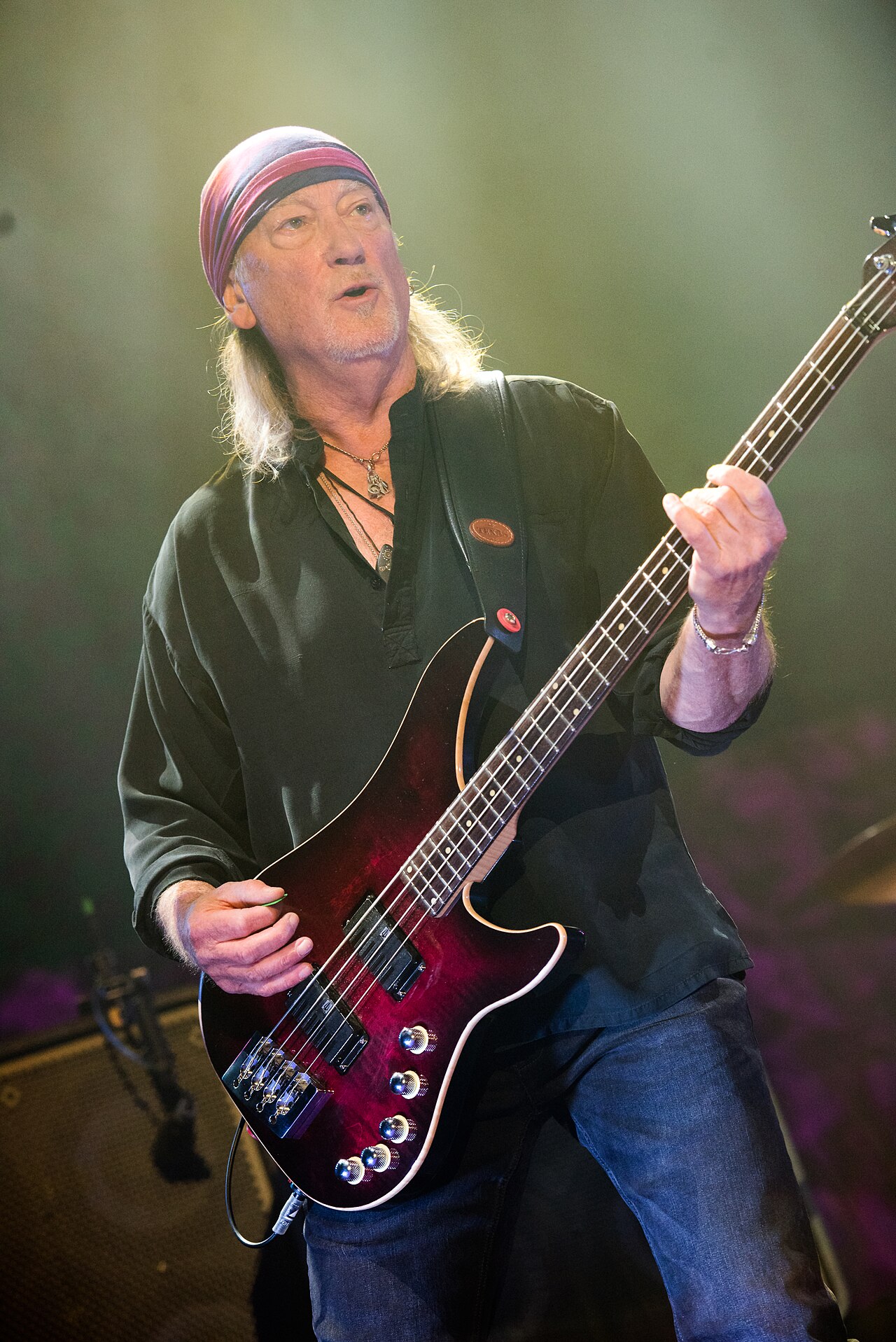
Roger Glover's bass rig: the Deep Purple sound, sourced
Documented bass gear Roger Glover has played with Deep Purple: Fender Precision, Rickenbacker 4001, and Gibson Thunderbird with Rainbow, then a Vigier signature bass since the 1990s.
Deep Purple · written with AI help · updated
Roger Glover has played bass for Deep Purple since 1969, with a 1973-1984 gap, co-writing the title of Smoke on the Water and anchoring Machine Head and Made in Japan. He played Fender Precision and a Rickenbacker 4001 through the Mark II era, then Gibson Thunderbird with Rainbow. Since the mid-1990s he has played a Vigier signature bass, with documented Ernie Ball and Picato strings. Rock and Roll Hall of Fame inductee, 2016.
Who Roger Glover is
Roger David Glover, born November 30, 1945, in Brecon, Wales, has played bass for Deep Purple across two separate stretches spanning 1969 to 1973 and 1984 to today, more than four decades combined. He joined the band's Mark II lineup in 1969 alongside vocalist Ian Gillan, arriving together from their previous band, Episode Six. That pairing produced the run that defined hard rock: Deep Purple in Rock (1970), Fireball (1971), Machine Head (1972), and the live album Made in Japan (1972).
Glover is credited with the title of "Smoke on the Water." Two days after the Montreux casino fire that inspired the song, he says the phrase came to him in a dream. Gillan wrote the lyrics around it, though Glover was initially unsure about using a title he thought sounded like a drug reference.
He and Gillan left Deep Purple together in June 1973. Glover spent the rest of the 1970s producing records for Judas Priest, Nazareth, Status Quo, and others, then joined Ritchie Blackmore's Rainbow as bassist, lyricist, and producer from 1979 to 1984. When the classic Mark II lineup reformed in April 1984, Glover rejoined Deep Purple and has stayed ever since. The band was inducted into the Rock and Roll Hall of Fame in 2016. On 2021's Turning to Crime, Glover sang co-lead vocals on "The Battle of New Orleans," the first time he had sung any part on a Deep Purple record. Drummer Ian Paice, the sole member left from the band's original 1968 lineup, has anchored the rhythm section alongside Glover for most of the past five decades.
Bass guitars
Six documented basses across five decades, from Deep Purple's Mark II breakthrough to his current signature Vigier.
Current main · Signature since mid-1990s
Vigier Excess Roger Glover Original
A solid two-piece alder body with a naturally-aged maple neck, 24 frets, and a 33.8-inch scale, built with Vigier's own single-coil pickups. Ships stock with .040-.095 strings. Glover has played Vigier basses since the mid-1990s, about 27 years as of a 2020 interview, and reaches for this signature model live.
Source: Vigier's official product page.
Studio use · Now What?! and Whoosh! sessions
A borrowed vintage Fender Precision, then his own Squier
Producer Bob Ezrin brought a battered old Fender Precision into the Now What?! (2013) sessions, an instrument previously used on records by Pink Floyd, Peter Gabriel, and Alice Cooper, and played by Tony Levin. Glover liked it enough to buy his own for the Whoosh! (2020) sessions: a $300 pink Squier Precision. "I was knocked out, it's so lovely," he said. "When I play a bass at home, that's usually the one that I pick up."
Source: Guitar World / Bass Player, 2020.
Mark II era · 1969-1973
Fender Precision Bass
Documented as one of his basses through Deep Purple's early Mark II years, the run that produced In Rock, Fireball, and Machine Head, alongside a Fender Mustang and a Rickenbacker 4001.
Source: Wikipedia, citing Guitar magazine, October 2003.
Mark II era · the "Smoke" bass
Rickenbacker 4001
In his own 1995 words: he "trundled it out on Smoke, more for the looks than the sound" after growing unhappy with its tone, though a new nut later improved it. In a separate 2020 interview he said he has since given the bass to his daughter.
Sources: The Highway Star, archived Glover Usenet post, 1995; Guitar World / Bass Player, 2020.
The Fireball (1971) bass
Fender Mustang Bass
In his own words: "I've still got the Fender Mustang that I used on Fireball." Still in his collection today, decades after the record.
Source: Guitar World / Bass Player, 2020.
Rainbow era · 1979-1984
Gibson Thunderbird
In his own words: "the Gibson Thunderbird that I used with Rainbow." Wikipedia separately dates his Thunderbird use to the late 1970s, the years leading into Rainbow.
Source: Guitar World / Bass Player, 2020.
| Mark II (1969-1973) | Rainbow (1979-1984) | Mid-1980s | Mid-1990s to present | |
|---|---|---|---|---|
| Main bass | Fender Precision; Rickenbacker 4001 live | Gibson Thunderbird | Peavey Foundation (Peavey Fury Bass neck) | Vigier Excess Roger Glover Original |
| Band | Deep Purple | Rainbow | Deep Purple (reformed 1984) | Deep Purple |
| Amps | Not documented in sources reviewed | Not documented in sources reviewed | Not documented in sources reviewed | TC Electronic; SWR in earlier years |
| Strings | Not documented in sources reviewed | Not documented in sources reviewed | Not documented in sources reviewed | Ernie Ball and Picato (brand documented, gauge unconfirmed) |
Also worth noting: in the mid-1980s Glover played a Peavey Foundation bass fitted with a neck from a Peavey Fury Bass, per Wikipedia. It's the thinnest-documented chapter of his gear history, no interview quotes turned up in the sources reviewed for this page, but it fills the gap between the Rainbow-era Thunderbird and his move to Vigier in the mid-1990s.
Strings
Brand documented · Exact gauge unconfirmed
Ernie Ball and Picato
Wikipedia documents Ernie Ball and the UK maker Picato as Glover's strings since the mid-1990s, the same era he moved to Vigier basses, but names no specific set or gauge. What is confirmed: his signature Vigier ships from the factory at .040-.095, an exact match to Ernie Ball's Extra Slinky Bass. CYS can't confirm Glover strings his own Vigier with this specific Ernie Ball set, but it's the documented factory spec for his signature instrument.
Source: Wikipedia, citing Guitar magazine, October 2003; Vigier's product spec sheet.
Amps
Glover's current live rig runs on TC Electronic gear. In his own words from a 2020 interview: "I got turned on to them a few years ago. Their gear blew me away, it was so tight and round. If you can imagine a sound being a circle, it was that. It was perfect, and I use half the amount of speakers that I used to use, and it's more powerful." He plays through side fills on stage rather than in-ear monitors, saying a two-week trial with in-ears "frustrated" him.
Wikipedia separately documents SWR heads and cabinets as an earlier-era choice, dating from around when he switched to Vigier basses in the mid-1990s. Neither source pins down exactly when the change from SWR to TC Electronic happened.
Next steps
- Deep Purple's full band history and gear encyclopedia: the Deep Purple band hub.
- Deep Purple's guitarist: Ritchie Blackmore's guitar rig.
- Deep Purple's drummer: Ian Paice's kit.
- The closest documented string match: Ernie Ball Super Slinky Bass (.045-.100).
- More classic-rock bass: Bassists index.