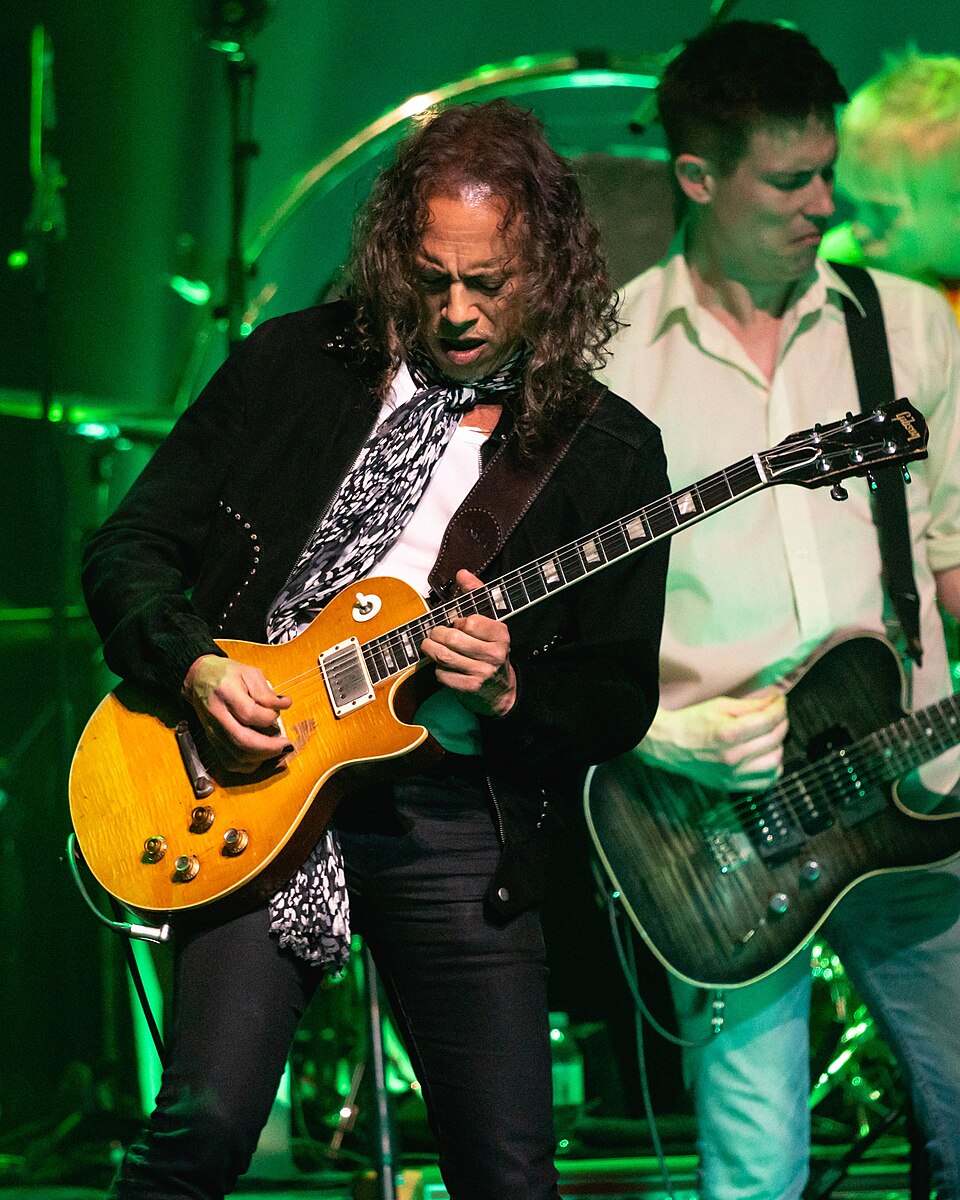
Kirk Hammett's guitar rig: the Metallica lead arsenal, sourced
Documented strings, guitars, amps, and effects Kirk Hammett uses with Metallica. The Ernie Ball RPS-10/RPS-11 hybrid set (.010 to .048), the ESP KH signature line, the Mesa Boogie Rackmount Dual Rectifier years, the Randall KH signature era, the current Fractal Axe-FX III live rig, and Greeny. Every claim cited.
Kirk Hammett uses a custom Ernie Ball hybrid set across Metallica's catalog: the .010, .013, and .017 plain strings from Regular Slinky RPS (2241) paired with the .028, .038, and .048 wound strings from Power Slinky RPS (2242). Total gauge .010 to .048. There is no off-the-shelf 'Kirk Hammett signature' Ernie Ball pack: he hand-mixes from the two RPS sets. Primary guitars are the ESP KH-2 line (the Mummy, the Ouija, the Frankenstein graphic series) with EMG pickups. Live tone since 2017 runs through a Fractal Axe-FX III modeling a Mesa Boogie Dual Rectifier and a Fortin Meathead.
Who Kirk Hammett is
Kirk Lee Hammett (born November 18, 1962, San Francisco) is the lead guitarist of Metallica, position held since 1983, when he replaced Dave Mustaine on the eve of the Kill 'Em All sessions. Before Metallica, he was a founding member of Bay Area thrash band Exodus (1979 to 1983). His lead playing across Metallica's catalog from Kill 'Em All (1983) through 72 Seasons (2023) is among the most-studied lead-guitar bodies of work in modern metal.
He has been a long-running ESP signature artist since the early 1990s with multiple production-model signature instruments (the KH-2 line in its various horror-graphic finishes) continuously made. Long-documented Ernie Ball user, formal signature partner of Dunlop (KH95 wah, KH Jazz III pick) and EMG (KH Bone Breaker pickup set). Bandmate James Hetfield sits on rhythm and lead vocals.
What he plays
A custom Ernie Ball string hybrid, an ESP KH-2 signature in front of a Fractal Axe-FX III that models his classic Mesa Dual Rectifier and Fortin Meathead blend, with a Dunlop Cry Baby Rack Wah in the signal chain. Most of Metallica's catalog is in E standard or Eb standard; selected later material drops further.
The current rig, sourced
- Strings
- Custom hybrid: .010, .013, .017 plain strings from Ernie Ball Regular Slinky RPS 2241 plus .028, .038, .048 wound strings from Power Slinky RPS 2242. Combined gauge .010 to .048. Documented by Kirk on Ernie Ball's String Theory series.
- Primary guitars
- ESP KH-2 'The Mummy' (Boris Karloff 1932 graphic, EMG 81/60, Floyd Rose) has been his main live guitar for roughly 30 years. The full KH-2 graphic line (Ouija, Frankenstein, Dracula, Bride of Frankenstein) rotates around it. Greeny, the original 1959 Peter Green / Gary Moore Les Paul, comes out for 'Whiskey in the Jar.'
- Pickups
- EMG 81 bridge + EMG 60 neck across the classic KH-2 catalog. The newer ESP/LTD KH-V and current builds ship Kirk's EMG Bone Breaker KH-BB signature set (BB-B ceramic bridge + BB-N Alnico 5 neck).
- Amps
- Live, paired Fractal Audio Axe-FX III units modeling a blend of his Mesa Boogie Dual Rectifier and Fortin Meathead. Studio (72 Seasons): a 100W Marshall master-volume JMP plus Mesa Dual Rectifier for solos, an old Randall KH signature head for clear midrange, Friedman HBE Deluxe for rhythms.
- Wah
- Dunlop Cry Baby Rack Wah (DCR-1SR / DCR-2SR) live. The Dunlop KH95 pedal is the floor-format version of his rack settings.
Why this fits the rig
The .010 to .048 hybrid sets Kirk in the sweet spot between bend-ease for lead work and rhythm thickness for the down-picked passages he shares with Hetfield. The .010 high E gives him the bend feel he needs over a full tour without hand fatigue; the .048 low E gives him a tighter rhythm voice than the standard .046 in Regular Slinky 2221. The brass-wrap RPS reinforcement keeps the plain strings on the guitar through aggressive pick attack and Floyd Rose dive use.
EMG active humbuckers are the canonical high-output, low-noise spec for high-gain tube saturation: the .010 set into the EMG 81 into the Dual Rectifier (or its Fractal model) is the lead-clarity-on-top-of-rhythm-thickness that characterizes Metallica's recorded mix from ...And Justice for All forward. The Floyd Rose on his ESP signature guitars is what enables the dive-bomb and wah-into-divebomb leads (the Enter Sandman outro, the One solos) that are part of his lead vocabulary.
Electric guitars
The ESP KH signature catalog and the documented backups, sourced from Ground Guitar's Kirk Hammett gear archive with per-instrument primary sources.
Acquired ~1996 · Nickname "The Mummy" · Primary live
ESP KH-2 "The Mummy"
His primary live guitar for roughly 30 years. Body finished in the artwork of the 1932 Boris Karloff Mummy film poster (Kirk owns the original poster). Eye of Horus inlays instead of the standard KH-2 skulls. EMG 81 bridge plus EMG 60 neck, Floyd Rose tremolo. Never released commercially because Universal holds the Mummy character license.
Acquired ~1993 · First major graphic custom
ESP KH-2 "Ouija"
First major graphic custom Kirk played extensively live, midway through the Black Album touring cycle. Phosphorescent (glow-in-the-dark) Hasbro Ouija-board graphic, sent to ESP's Custom Shop in Japan as a photocopied layout. Standard KH-2 specs underneath: EMG 81/60, Floyd Rose.
Acquired 1987 · First custom ESP
ESP MM-270 "Zorlac"
Kirk's first custom ESP, the prototype for the signature line that followed. Alder body and maple neck (a brighter, sharper-attack spec than his prior Gibson), vertical skull-and-crossbones inlays, "Zorlac" sticker on the body. The visual departure that started the horror-graphic aesthetic.
Built 1991 · Black Album tour primary
ESP MM-290 "Caution"
Built 1991, primary live guitar through the Black Album tour and the Live Shit: Binge & Purge era. Alder body, maple neck-thru construction (an upgrade from the bolt-on Zorlac), horizontal skull-and-crossbones inlays, EMG 81/60. The "CAUTION HOT" sticker below the bridge and "Kirk's Guitar" label near the neck pickup were added later in the 1990s.
Built 1992 · 24.75" Gibson scale
ESP KH-3 Eclipse "Spider"
First used in 1992 on the Black Album tour. Pushead-designed "Spider 13" graphics on the lower bass bout. Inlay set: spiders on frets 1 to 9, skull-and-crossbones on frets 12 to 24. 24.75-inch Gibson-style scale (shorter than his other ESP guitars), alder body, maple neck, rosewood fingerboard.
Introduced 2011 · 100-unit ESP run
ESP KH-2 SE "Greenburst"
2011 special edition with a custom Greenburst finish, green inlays, and a matching green logo. EMG 81/60, 25.5-inch scale, neck-thru construction, extra-thin U-profile neck, 24 XJ frets, original Floyd Rose bridge. Limited to 100 ESP pieces worldwide (with a wider LTD KH-SE run of 300).
~1999 · Red Frankenstein graphic
ESP KH-2/M-II "Frankenstein"
Gifted by ESP's Custom Shop around 1999, in time for the St. Anger sessions. Alder body, neck-thru, rosewood fretboard, 24 extra-jumbo frets. EMG 81 bridge plus EMG 60 neck. Boris Karloff Frankenstein graphic from the 1931 Universal film, rendered in red instead of the original black-and-white.
Source: Ground Guitar, ESP KH-2/M-II 'Frankenstein' archive.
Mid-90s · KH-2 graphic variant
ESP KH-2 "Dracula" / "Bride of Frankenstein"
Two further horror-poster KH-2 builds: the Dracula graphic adapted from the 1931 film poster, and the Bride of Frankenstein graphic from the 1935 film poster (designed by Chris Compston). Standard KH-2 specs underneath: EMG 81/60, Floyd Rose, alder body. ESP made multiple Dracula variants with small layout differences.
Source: Ground Guitar, ESP KH-2 'Dracula' archive; ESP KH-2 'Bride of Frankenstein' archive.
Mid-90s transition · Flying V replacement
ESP KH-1 Flying V
The KH-1 retired Kirk's 1979 Gibson Flying V from the road around the end of the Black Album cycle, when touring with a vintage Gibson became impractical. The pre-production black Vs photographed during the 1993 Nowhere Else to Roam and 1994 Shit Hits the Sheds tours were likely ESP MV-290 series or custom prototypes (some with Jackson-style headstocks during ESP's lawsuit period).
Acquired 1979 · Kill 'Em All and Ride the Lightning primary
1979 Gibson Flying V
Kirk's main instrument during Exodus and his transition to Metallica. Bought at Leo's Music in Oakland (corner of Telegraph and 55th) by trading his Stratocaster plus money from his Burger King job. Primary studio guitar on Kill 'Em All (1983) and Ride the Lightning (1984), with partial use on Master of Puppets, Garage Days, and ...And Justice for All.
Acquired ~1984 · Ride the Lightning super-strat
1984 Fernandes Stratocaster (modified)
Kirk's entry into the super-strat market during the Ride the Lightning era, modified with a Floyd Rose tremolo and locking nut. The double-locking system made possible the dive-bombs and harmonic flutters on tracks like "Creeping Death" that were mechanically impossible on his fixed-bridge Gibson V.
Acquired ~1983 · Post-Kill 'Em All
1983 Jackson Randy Rhoads RR1T
Custom Jackson RR with the asymmetrical V shape (longer upper horn, shorter lower horn) Jackson originally built for Randy Rhoads. Maple neck-through with alder body wings, easier 22nd-fret access than Kirk's set-neck Gibson. He went with the RR1T fixed-bridge variant (string-through Tune-O-Matic) despite the rising popularity of locking tremolos at the time.
Acquired ~1989 · The "One" music video guitar
1989 ESP 400 Series
The instrument Kirk played in Metallica's first-ever music video, "One" (early 1989). A standard production ESP 400 (ESP's Stratocaster-style model in a natural finish), filmed in the black-and-white promo cut with footage from Johnny Got His Gun. Notable as a milestone: Metallica's first promotional video after three albums.
Acquired ~1989 · Black Album era
1989 Gibson Les Paul Custom (blacked-out)
Kirk's "main" Les Paul during the Black Album production shift. Hardware blacked out to match the gloss-black finish. Stock passive humbuckers swapped for EMG actives to match his high-gain rack system's gain structure across guitar switches. Sperzel locking tuners added for tuning stability.
Acquired 1996 · Load / ReLoad tours
1996 ESP/George Fedden WaveCaster
Telecaster-style guitar with a hollow Lucite body filled with blue motor oil that visibly moves while the guitar is played. Body built by luthier George Fedden; neck and final assembly by ESP. Used during the Load and ReLoad tours (1996 to 1997), most visibly on "Am I Evil?" in the Cunning Stunts DVD. Now displayed at the Rock and Roll Hall of Fame in Cleveland.
Source: Ground Guitar, 1996 ESP/George Fedden WaveCaster archive.
Acquired 2014 · The Peter Green / Gary Moore burst
"Greeny" 1959 Gibson Les Paul Standard
The original 1959 Les Paul Standard Peter Green played in John Mayall's Bluesbreakers and Fleetwood Mac, then sold to Gary Moore in the early 1970s. Kirk bought it from Richard Henry Guitars in 2014 for a reported $2 million. The neck pickup is wound in reverse polarity (a likely factory error per luthier Jol Dantzig), giving the middle position a Strat-like out-of-phase quack. Quoted in Guitar World: "It's a unique guitar in that the pickup is turned around. It's facing the opposite way, so when you play with both pickups on in the middle position, it creates an out-of-phase sound that sounds like a Fender Stratocaster." Used live for Metallica's cover of "Whiskey in the Jar."
Source: Guitar World, Kirk Hammett talks about his prize (2016); Greeny, Wikipedia.
Amps
The Mesa Boogie heritage, the Randall signature era, and the current Fractal touring rig.
Live since ~2017 · Modeled tube tone
Fractal Audio Axe-FX III
Per his tech Justin Crew, Metallica's current touring rig runs no classic tube amplification: paired Axe-FX III units loaded with presets and scenes per song. Kirk's live tone is modeled on a blend of his Fortin Meathead amp and his Mesa Boogie Dual Rectifier. The decision was driven by repeatability across arena PA systems and per-song tonal variation that physical heads make slow.
Source: Guitar World, interview with Kirk Hammett's tech Justin Crew.
Live tone foundation · Mesa official 2011
Mesa/Boogie Rackmount Dual Rectifier
The amp Mesa's own 2011 rig documentation places at the core of Kirk's live rack: Rackmount Dual Rectifiers running into Mesa Traditional Straight 4×12s with Celestion Vintage 30s, alongside DBX Quad gates, Digital Music Corp GCX Expander switching, TC Electronic G-Major FX, and a Dunlop DCR Rack Wah. Kirk's stated preference (per the early Rectifier era) was that the Dual Rectifier "had more bark" than the Mark IV he had used on Black Album tour legs.
Heritage · Early '80s through Black Album
Mesa/Boogie Mark IIC+
Both Hetfield and Hammett have used Mesa products in their live and studio rigs since the Mark IIC+ hit the streets in the early 1980s. The Mark IIC+ played a significant role on the early Metallica catalog. Kirk used a Mesa Mark IV for leads on some legs of the Black Album tour before moving to the Dual Rectifier as his live primary.
Endorsement ~2009–2013 · Death Magnetic era
Randall KH120RHS Kirk Hammett Signature Half Stack
120-watt two-channel head designed with Kirk. Overdrive channel with dual gains, voicing switch, contour control; clean channel with boost. Paired with the KH412 cabinet. The KH signature line also included the larger KH103 head, the KH15 combo, and the KH1/KH2/KH3 preamp modules. Greg Fidelman cited an old Kirk Hammett Randall signature head on 72 Seasons studio sessions for its "clear, defined midrange."
Source: Randall Amplifiers official KH120RHS product page; Guitar World, Greg Fidelman on 72 Seasons gear.
72 Seasons studio solos · 2023
100W Marshall Master-Volume JMP + Mesa Dual Rectifier blend
Per producer Greg Fidelman, Kirk's solos on 72 Seasons were tracked with a 100-watt master-volume Marshall JMP plus a Mesa Boogie Dual Rectifier, with the old Randall KH signature head adding clear midrange. Rhythms used a couple of Friedmans, sometimes the HBE Deluxe and sometimes an early HBE head Dave Friedman modded himself.
Source: Guitar World, Greg Fidelman on Hetfield and Hammett's 72 Seasons gear.
Effects + Wah
Signature pedal · Pedal-format Rack Wah
Dunlop KH95 Kirk Hammett Cry Baby Wah
Dunlop's engineers tuned Kirk's Cry Baby Rack Wah EQ, volume, and tone settings into a pedal-format housing. Even-response heel-to-toe, thick top end, full dynamic range. The lead-vocabulary tone behind "Enter Sandman," "One," "Wherever I May Roam" outside the stadium rack.
Source: Dunlop official KH95 Kirk Hammett Cry Baby Wah product page.
Live rack · Stage primary
Dunlop Cry Baby Rack Wah (DCR-1SR / DCR-2SR)
The 1U rackmount Cry Baby Kirk uses in the studio and on tour, controlled from a stage expression pedal. Mesa's 2011 documentation of his live rig places it alongside the Dual Rectifiers, GCX switching, DBX Quad gates, and TC Electronic G-Major FX as the core stage chain.
Live rack · Time-based and modulation FX
TC Electronic G-Major Rack FX Processor
The G-Major handles delay, reverb, modulation, and pitch-shift duties in Kirk's pre-Fractal live rack. Mesa's official photograph of his 2011 rack shows the G-Major slotted with the DBX gates and the Dual Rectifiers.
Pickups
Signature set · Introduced 2018
EMG Kirk Hammett "Bone Breaker" KH-BB Set
BB-B ceramic bridge plus BB-N Alnico 5 neck. Active humbucker set with pre-amp adjustments tuned for high-gain clarity without sacrificing clean-tone definition. Ships in the current ESP and ESP/LTD KH signature builds (KH-V, etc.). Quik-Connect headers, prewired volume/tone, battery clip and output jack included.
Heritage · Classic KH-2 catalog
EMG 81 bridge + EMG 60 neck
The active humbucker pairing that powered Kirk's KH-2 line for most of its production history. The 81 (ceramic, high-output) drives tight high-gain rhythm and lead clarity; the 60 (Alnico, slightly warmer voicing) handles sustained neck-pickup lead phrasing. The 81/60 has been the canonical thrash-and-metal pickup spec since the late 1980s; Kirk's catalog from ...And Justice for All forward is the reference.
Source: Ground Guitar (per-guitar EMG specs across the KH-2 catalog).
Strings
The hybrid set he actually uses, in two packs. Plus the Super Slinky 9-42 set he played when he was a teenager.
Plain-string half of his hybrid · .010, .013, .017
Ernie Ball Regular Slinky RPS 2241 (.010–.046)
Kirk pulls the three plain strings from this pack: .010, .013, .017. Reinforced Plain Strings construction (brass wrap at the ball-end twist) keeps the .010 high E intact under his pick attack and Floyd Rose use.
Wound-string half of his hybrid · .028, .038, .048
Ernie Ball Power Slinky RPS 2242 (.011–.048)
Kirk pulls the three wound strings from this pack: .028, .038, .048. Combined with the lighter plain strings above, his working gauge is .010 to .048. Per his direct quote on Ernie Ball's String Theory: ".011s, I notice over the course of a tour my hand gets fatigued. If I go to .010s, it's okay."
Source: Guitar World, String Theory recap (direct Kirk quote).
Early career · From age 18
Ernie Ball Super Slinky (.009–.042)
The lighter set Kirk played from age 18 onward, before he settled into his current hybrid. Quoted on Ernie Ball's String Theory: "I was 18 years old. I started using Ernie Ball Super Slinkies because they didn't break." The .009 to .042 set is documented as his pre-Metallica and early-Metallica string of choice.
Source: Ground Guitar, Kirk Hammett Super Slinky 9-42 archive.
Picks
Signature pick · 1.38mm
Dunlop Kirk Hammett Jazz III (47-KH3N, 1.38mm)
Dunlop's signature Jazz III for Kirk: 1.38mm thickness, the classic Jazz III shape with a sharp point for fast picking. Ships in multiple colorways (green, purple sparkle, yellow glitter, white pearl). The .010 plain strings combined with a 1.38mm Jazz III is the canonical lead-attack spec across most of his catalog.
If you want this rig
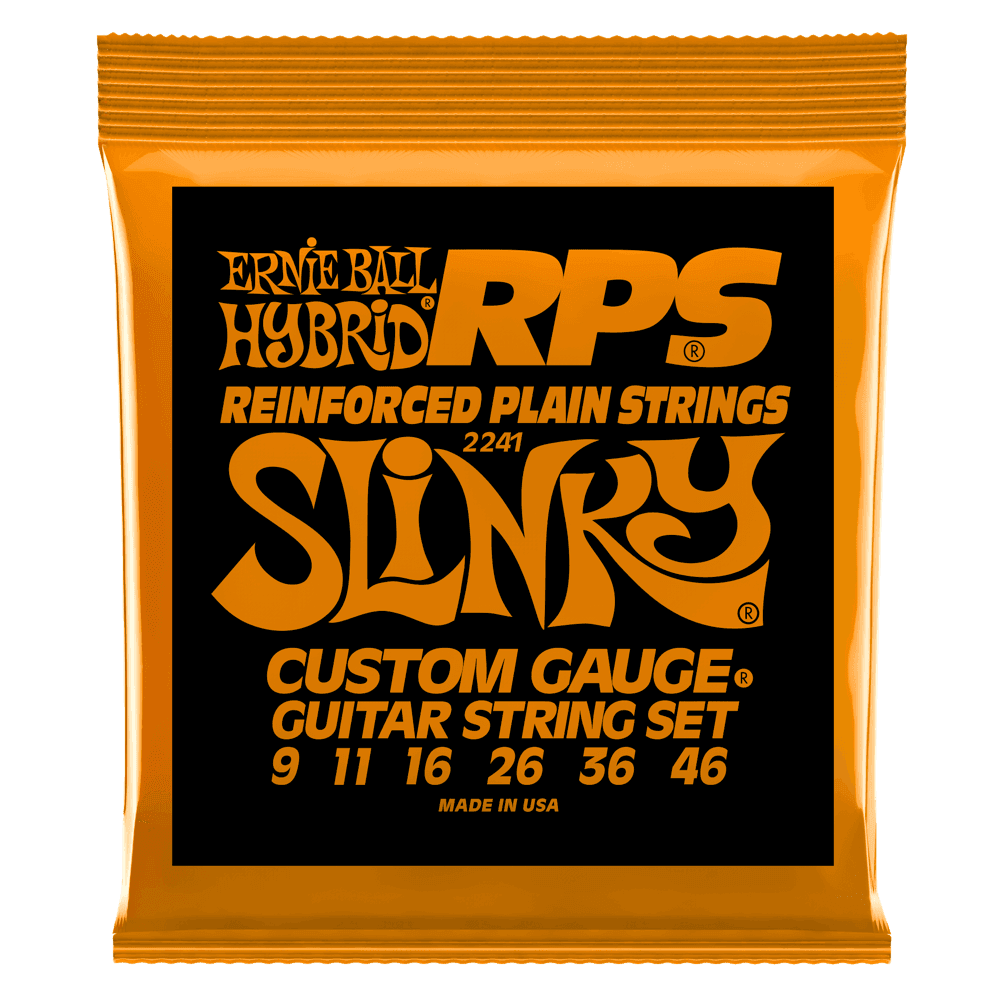
Regular Slinky RPS 2241 (.010–.046)
Why this one: Plain-string half of Kirk's documented hybrid. Use the .010 high E, .013, and .017 from this pack, pair with the .028, .038, and .048 wound strings from Power Slinky RPS 2242. Combined gauge .010 to .048.
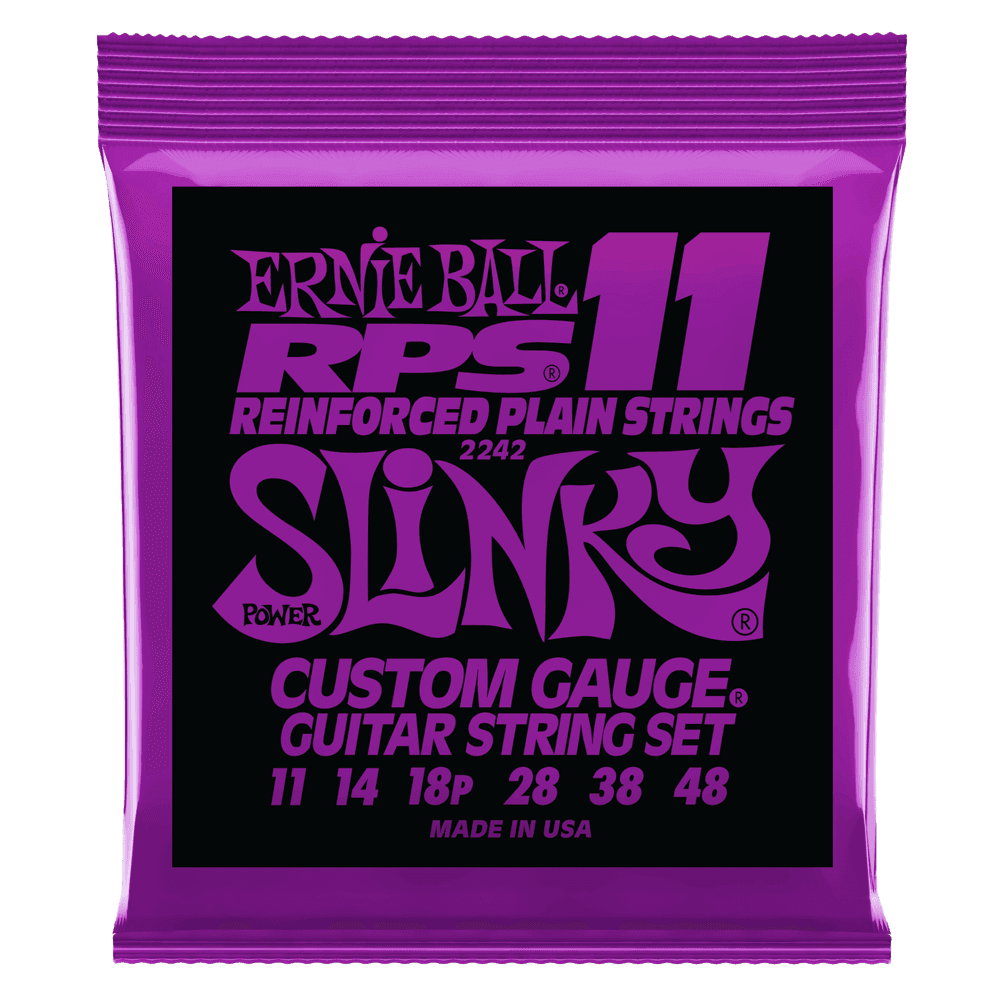
Power Slinky RPS 2242 (.011–.048)
Why this one: Wound-string half of Kirk's documented hybrid. Use the .028, .038, and .048 wound strings from this pack, pair with the lighter plain strings from Regular Slinky RPS 2241.