Ernie Ball 7-String Slinky Cobalt Custom (.009–.062): the Schecter KM-7 / Hauch lighter-top 7-string
Written with AI help · Updated
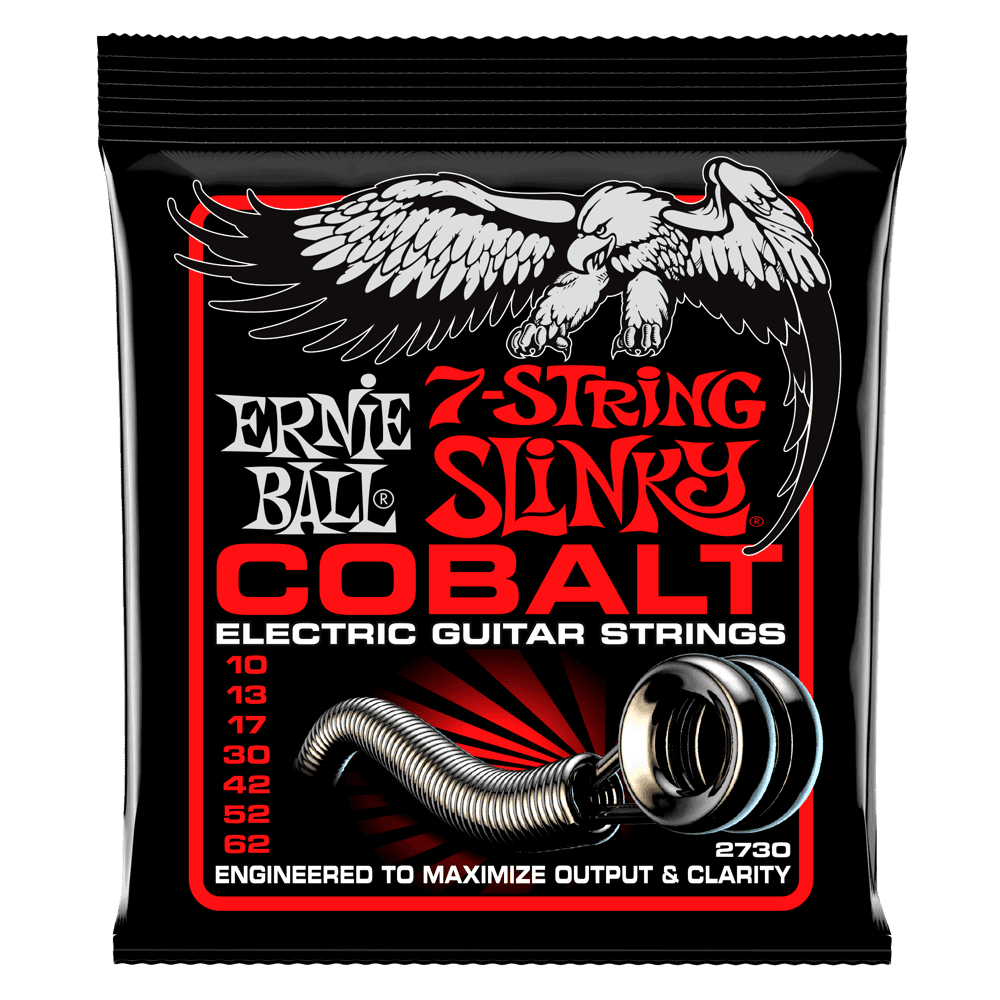
The .009–.062 seven-string is a custom gauge: a .009 plain top for shred-friendly bending, a .062 low string for Drop G# rhythm weight, and .011/.016/.026/.036/.046 in between. Schecter's KM-7 MK-III ships factory-strung with this exact gauge. Wes Hauch runs the same recipe in Ernie Ball Cobalt, confirmed in his own gear interviews; it is Ernie Ball's Hybrid Slinky Cobalt 6-string plus one Cobalt .062 single, both sold off the shelf.
Anatomy
- Status
- Non-stock custom gauge (not a retail Ernie Ball SKU)
- Configuration
- Cobalt 7-string with .009 plain top + .062 low string
- Gauge set
- .009, .011, .016, .026, .036, .046, .062
- String count
- 7 strings
- Core wire
- Tin-plated hex steel
- Wrap wire
- Cobalt-iron alloy
- Plain strings
- Tin-plated hex-core steel (.009, .011, .016 plain)
- Coating
- None, uncoated
- Winding
- Standard roundwound
- Intended scale
- 26.5" (the KM-7 MK-III's own scale); works on 25.5" 7-strings too, just a slightly looser feel
- Intended tunings
- Drop A, Drop G#, B standard with looser top feel
- Factory-strung on
- Schecter KM-7 MK-III Keith Merrow signature
- Purchase paths
- Ernie Ball Hybrid Slinky Cobalt 6-string (SKU 2722) + one Cobalt .062 single (SKU P10462); Schecter KM-7 MK-III factory-strung; or Ernie Ball custom string order
Tone
Voicing through a passive 7-string pickup
- Output
- Same 2–3 dB Cobalt push as the rest of the line. The .009 plain top is slightly quieter than .010 due to less mass; the wound strings make up for it.
- Lead playing
- The lighter top is the whole point. Fast picking patterns, multi-step bends, vibrato-heavy phrasing all feel like 6-string Super Slinky territory translated to 7-string.
- Rhythm playing
- .062 low string on the KM-7's 26.5-inch scale at Drop G# tension holds palm-muted chug without flap; even firmer on a 25.5-inch 7-string. The cobalt voicing's low-string definition matters most here.
- Bend feel
- The lightest practical 7-string bending feel. Quarter-step bends are effortless; behind-the-nut bends and other expressive moves work like Vai's 6-string in Eb.
Why the asymmetric gauge
The .009-.062 7-string Cobalt is a deliberate asymmetric choice. A balanced gauge (e.g., the stock 2730 .010-.062) gives you firm rhythm and firm leads. A light-balanced gauge (.009-.054 or .010-.056, like the 2728) gives shred-friendly leads but loses low-string definition for heavy rhythm. The .009-.062 splits the difference: shred-friendly on top, rhythm-firm on bottom.
This works because:
- The high strings are the lead voice. Light top = effortless fast picking, wide bends, expressive vibrato. Same logic that made .009 popular for 6-string shred since the 1980s.
- The low strings are the rhythm voice. Heavy bottom = pitch-stable Drop A / Drop G# under high gain, no flap on palm-muted chug.
- Modern 7-string compositional architecture often separates the two. Solo prog-metal players write rhythm passages and lead passages on the same instrument; the asymmetric gauge serves both.
Who plays this set
Keith Merrow is the documented anchor. His Schecter KM-7 MK-III ships factory-strung with this exact .009/.011/.016/.026/.036/.046/.062 gauge; Schecter's own product spec sheet calls it out directly, listed generically as "Ernie Ball 7-String" rather than naming a specific line. Merrow's solo catalog (instrumental prog-metal, fast melodic phrasing, Drop A and Drop G# rhythm) is exactly the use case the asymmetric gauge was tuned for.
Wes Hauch (Alluvial, ex-The Faceless, Thy Art Is Murder) runs the same gauge in Ernie Ball Cobalt specifically, per his own account in a 2017 Wired Guitarist interview: "Ernie Ball Cobalt .9-46 with .62 low on the 7 string guitars." That's Ernie Ball's own Hybrid Slinky Cobalt 6-string set plus one .062 single, the same off-the-shelf build this page recommends above. His material spans technical death metal and djent on 6-, 7-, and 8-string; on 7-string, this gauge is his go-to.
Both pros land on the same asymmetric configuration. Hauch's own account confirms Cobalt for the wrap; Schecter's spec sheet confirms the gauge but not the specific string line, which is why this page treats the Cobalt framing as strongly supported rather than manufacturer-confirmed for Merrow's factory set specifically.
Best for
- Solo instrumental prog-metal on 7-string. Lead-fluid playing with Drop A / Drop G# rhythm passages.
- Schecter KM-7 MK-III players. This is the factory-strung set; replacement keeps the guitar feel consistent.
- Players who want Steve Vai-style 6-string light-top feel translated to 7-string.
- Drop A or Drop G# tunings primarily. The .062 is calibrated for those specifically.
Worst for
- B standard 7-string unless you specifically want a noticeably-loose top. The .009 plain in B standard sits at very light tension; many players find it too soft for chord-style playing.
- Beginners. The asymmetric gauge is a deliberate optimization for advanced players who know which strings they're emphasizing in their playing.
- Quad-tracked rhythm-heavy production work. A balanced .010-.062 (SKU 2730) is the cleaner choice for rhythm-only contexts.
Install and break-in
The .009 plain top requires a properly cut nut slot, most production 7-strings cut their nut for .010 or .011 plain on top. The KM-7 MK-III ships with a .009 factory-strung, so its nut is cut to spec for that gauge. On other 7-strings, the .009 may sit slightly low in the slot and rattle; a luthier can ream the slot to spec.
Break-in: 30–45 minutes. The .009 plain settles fastest of any string in the set.
Verdict
The .009-.062 seven-string is a deliberate, niche, and correct gauge for a specific kind of 7-string player: the solo or duo instrumental prog-metal player who writes lead-heavy melodic material against Drop A or Drop G# rhythm passages. Keith Merrow and Wes Hauch independently land on the same recipe; Schecter ships it factory-strung on the KM-7 MK-III because the gauge fits the artist's playing.
If your music sits in this lane, build the set (an Ernie Ball Hybrid Slinky Cobalt 6-string pack plus a Cobalt .062 single, order custom through Ernie Ball, or just pick up a KM-7 MK-III new). If your playing is rhythm-heavy or your tuning is B standard, the stock 2730 or 2728 is the right answer.
Affiliate link not applicable for this gauge. The .009–.062 7-string Cobalt is not a retail Ernie Ball SKU. Consumer purchase paths: Schecter KM-7 MK-III (factory-strung); an Ernie Ball Hybrid Slinky Cobalt 6-string pack plus a Cobalt .062 single; or an Ernie Ball custom string order. ProductCard suppressed accordingly.
Related
Related