Ernie Ball 7-String Regular Slinky Cobalt (.010–.056): the lighter 7-string Cobalt
Written with AI help · Updated
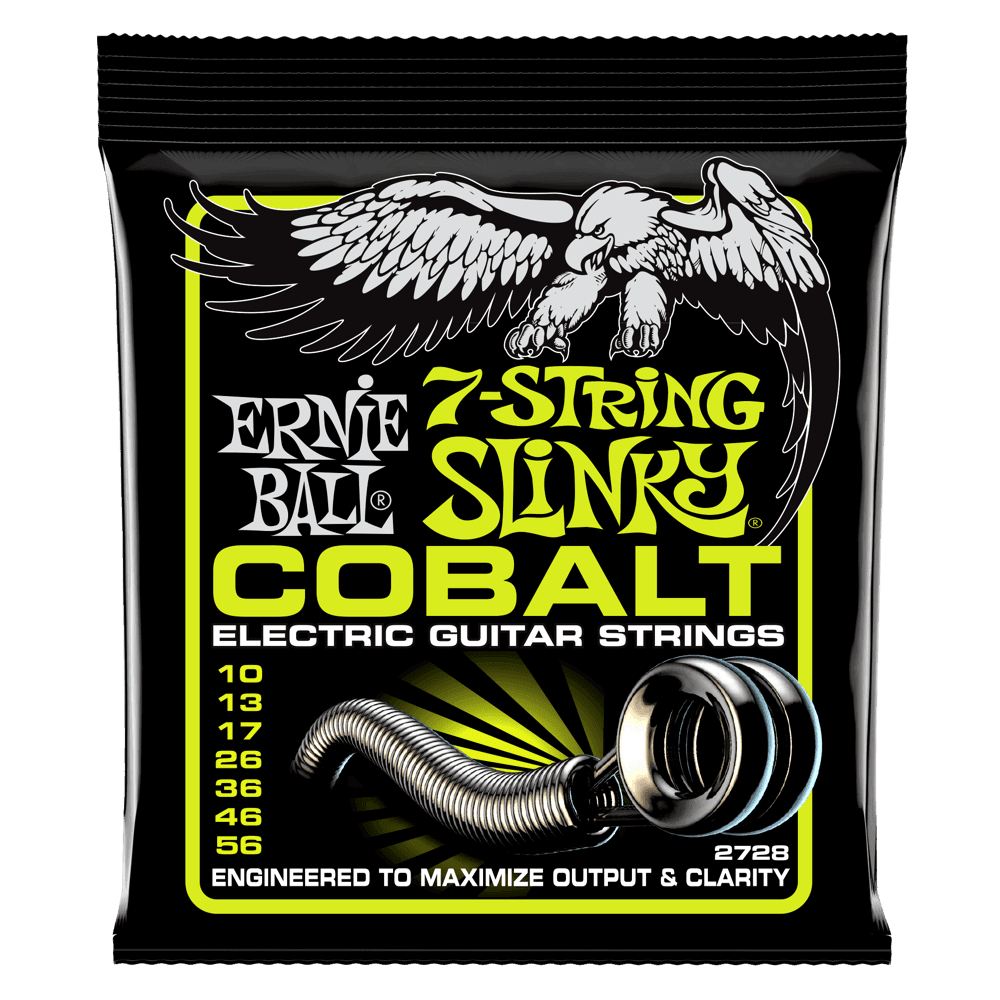
Ernie Ball 7-String Regular Slinky Cobalt (2728) is the .010–.056 set, lighter than the 2730 (.062), fit for 7-string B standard and Drop A. Jason Richardson has named this exact 10-56 gauge as his own Drop A set on Ernie Ball's Striking A Chord podcast, stepping up to the 2729 (.011–.058) for Drop G. Cobalt voicing through passive pickups: roughly 2–3 dB louder than nickel, tighter upper midrange, more present pick attack.
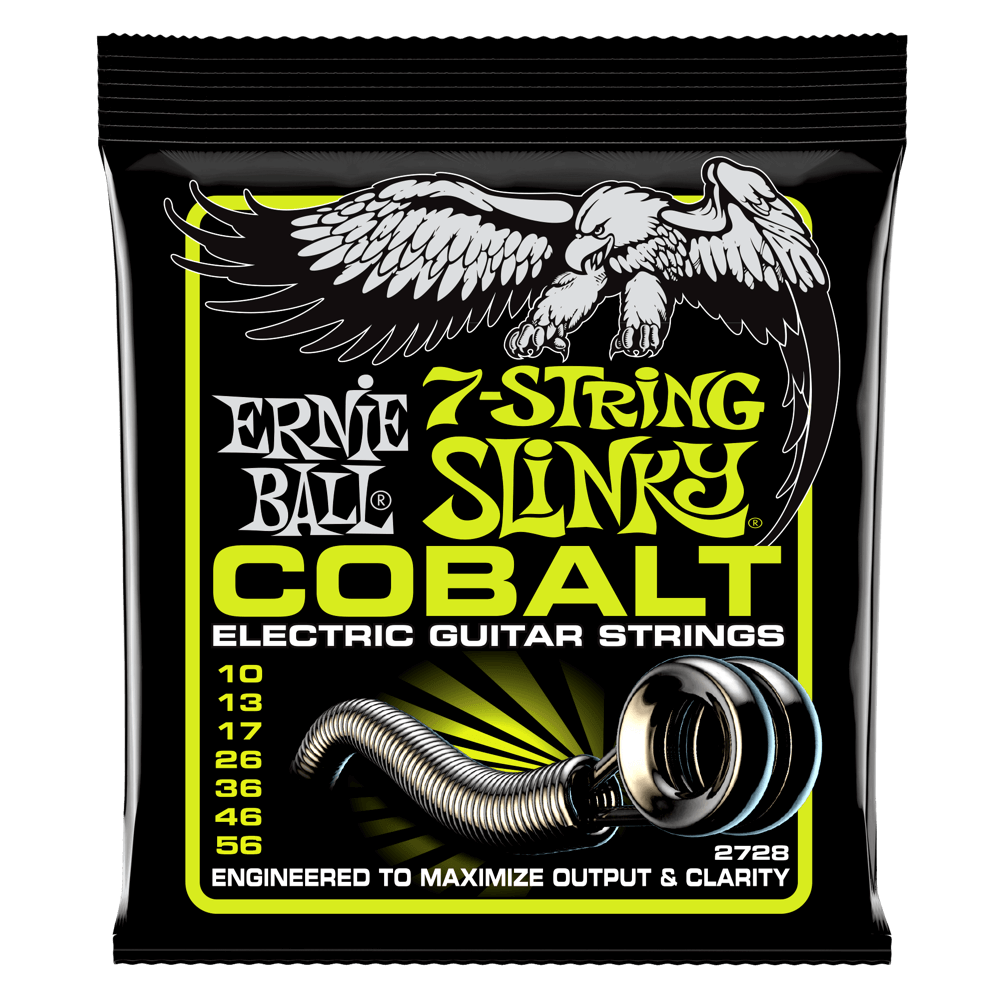
Anatomy
- SKU
- Ernie Ball 2728
- MPN
- P02728
- Gauge
- .010 – .056 (7-string Regular Slinky)
- Gauge set
- .010, .013, .017, .026, .036, .046, .056
- String count
- 7 strings
- Core wire
- Tin-plated hex steel
- Wrap wire
- Cobalt-iron alloy
- Plain strings
- Tin-plated hex-core steel (.010, .013, .017 plain)
- Coating
- None, uncoated
- Winding
- Standard roundwound
- Intended scale
- 25.5" primary
- Intended tunings
- B standard, Drop A (firm), Drop G# (marginal)
- Total tension (25.5", B standard)
- ~118 lbs across 7 strings
- Total tension (25.5", Drop A)
- ~112 lbs (low string detuned)
- Launched
- 2010s (Cobalt expansion to 7-string)
- Package
- Single pack
Tone
Voicing through a passive 7-string pickup
- Output
- 2–3 dB louder than nickel 7-string Regular Slinky. Pronounced on the wound strings; subtler on plain.
- Low string definition
- .056 cobalt at B standard tension reads tighter than nickel at the same gauge. The tradeoff vs the .062 set is looser low-end tension for faster picking response.
- Upper midrange
- More present 2–4 kHz, helps the lead voice carry against quad-tracked rhythm.
- Bend feel
- Same as 6-string Regular Slinky on top, which is the most familiar bend feel on the 7-string market.
Where this set sits in the Cobalt range
7-String Regular Slinky Cobalt is the lighter of the two stock 7-string Cobalt sets:
- 7-string light top, light bottom (lead-leaning): This set, 7-String Regular Slinky Cobalt (.010–.056).
- 7-string standard rhythm: 7-String Slinky Cobalt (.010–.062, SKU 2730).
- 7-string lighter custom (Hauch/Merrow style): .009–.062 custom Cobalt.
Who plays this set
Jason Richardson is the documented anchor user, in his own words. Asked directly about his string gauges on Ernie Ball's Striking A Chord podcast, Richardson said: "I use Ernie Ball, primarily the Cobalts... gauge wise, for a Drop A, which is just standard tuning with the low string dropped a whole step, I use 10 to 56 for that." That's this exact set, on his Ernie Ball Music Man signature 7-string (now sold as the Jason Richardson HT). For Drop G, one step lower, he steps up a gauge to the 7-String Power Slinky Cobalt (.011–.058). This is Richardson's personal string choice, not the factory spec: Music Man's own current spec sheet lists the guitar as shipping stock with nickel-wound RPS 10 Slinky.
Best for
- 7-string B standard (B-E-A-D-G-B-E) on 25.5-inch scale. Comfortable rhythm tension.
- Lead-heavy 7-string playing. Fast picking, sweep work, vibrato-driven leads.
- Solo prog-metal and instrumental metal. Where the picking hand needs the lower-tension wound strings to keep up with the lead voice.
- Players who don't tune below Drop A. The .056 low string handles Drop A; for Drop G# and below, step to 2730 (.062).
Worst for
- Drop G# rhythm work. The .056 in G# is on the soft end; rhythm players want 2730 (.062).
- 8-string territory. Ernie Ball doesn't build a Cobalt 8-string; step to the nickel-wound 8-String Slinky (EB 2625, .010–.074) instead.
- Players who quad-track heavy rhythms in Drop A or below. The .056 won't hold pick attack as cleanly under multi-take production as .062.
Install and break-in
7-string nut slots typically accommodate the .056 without filing if cut for the heavier 2730 set; coming from .062 down to .056 the slot is generously wide, no filing needed. Intonation should be reset on the low string after the gauge change.
Break-in: 30–45 minutes of play before the initial top end settles.
Verdict
7-String Regular Slinky Cobalt is the lead-friendly 7-string Cobalt for B standard and Drop A. The .056 low string keeps the rhythm side responsive without the firmer feel a .062 brings; the .010 plain top gives 6-string-style bend feel translated to 7-string. Jason Richardson has named this exact gauge as his own Drop A set, in his own words on Ernie Ball's Striking A Chord podcast, the strongest fit signal you can have short of a factory spec (his signature guitar actually ships stock with nickel RPS, not Cobalt).
If you tune to B standard / Drop A and your playing leans lead-fluid, this is the gauge. If your default is Drop G# or you primarily play heavy quad-tracked rhythm, step to 2730 instead.
Related
Related