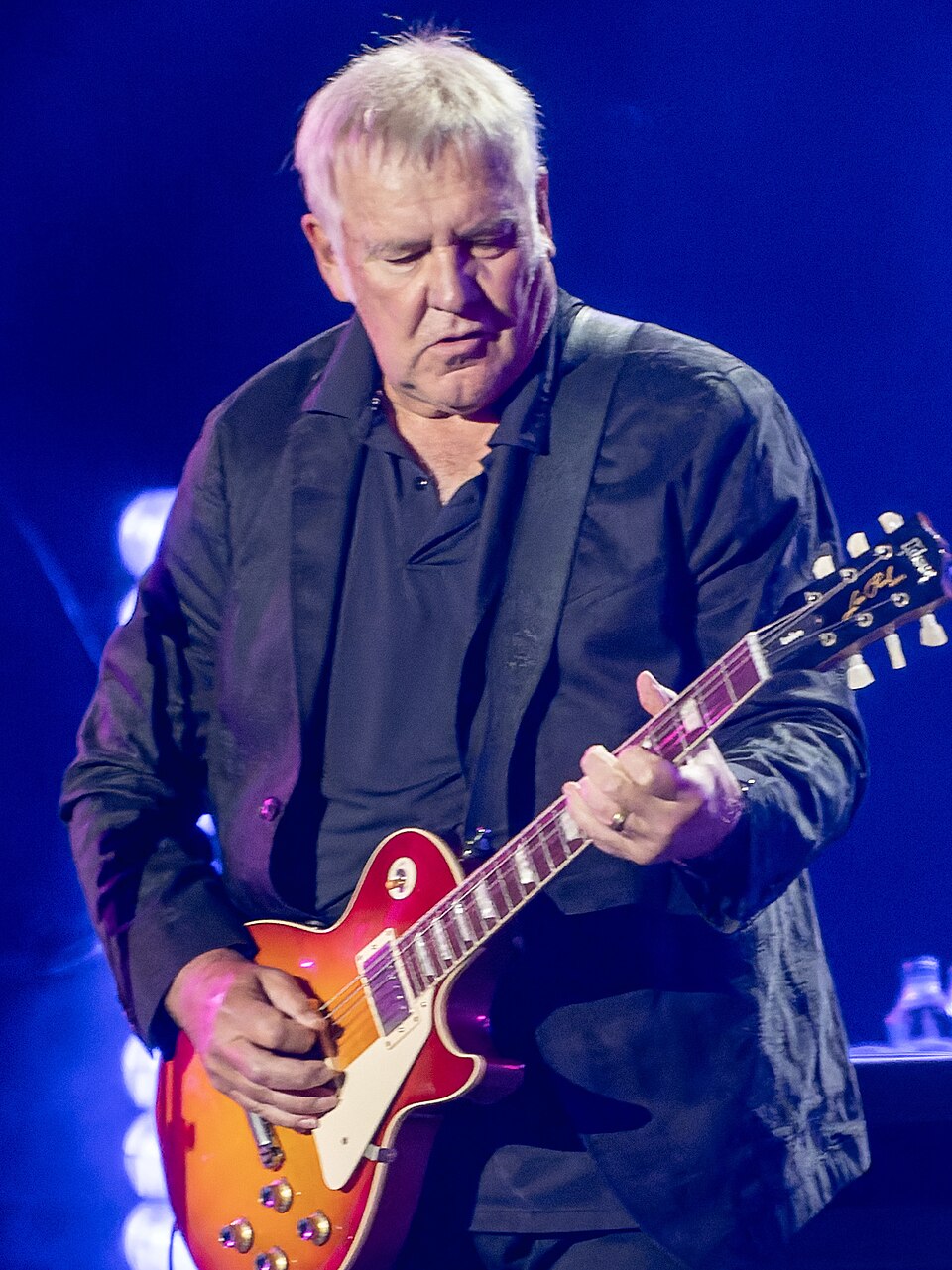
Alex Lifeson's guitar strings: the Rush gauge, sourced
Alex Lifeson's documented guitar rig: Dean Markley Blue Steel .010-.052 strings, confirmed in his own words, plus his Gibson Les Paul Axcess, ES-355, and Hughes & Kettner amps. Sourced from Premier Guitar and Guitar One, updated for Rush's 2026 Fifty Something reunion tour.
Rush · written with AI help · updated
Alex Lifeson strings his Gibson Les Paul Axcess and ES-355 with Dean Markley Blue Steel Light Top/Heavy Bottom (.010-.052), a gauge he confirmed to Guitar One magazine in 2007 after years on a lighter set. He plays through Hughes & Kettner TriAmp MKII and Coreblade amps, mostly in standard E tuning. Rush reunited in 2026 for the Fifty Something tour with new drummer Anika Nilles, their first shows since 2015.
Who Alex Lifeson is
Alex Lifeson has played guitar in Rush since he co-founded the band in Toronto in 1968, originally alongside drummer John Rutsey and bassist Jeff Jones. Geddy Lee replaced Jones within a month; Neil Peart replaced Rutsey in 1974, completing the lineup that recorded every classic Rush album from 2112 (1976) through Clockwork Angels (2012). Born Aleksandar Zivojinovic on August 27, 1953, in Fernie, British Columbia, Lifeson has long gone by the nickname "Lerxst." Geddy Lee still uses it in public, including in Rush's own 2025 tour announcement.
Rush stopped touring after the R40 tour closed at the Forum in Los Angeles on August 1, 2015. Neil Peart died in early 2020, and for years afterward Lee and Lifeson said publicly that a reunion wasn't going to happen. That changed in October 2025, when the pair announced Rush would return for a new 2026 tour, covered in detail below.
Between Rush's last tour and its return, Lifeson kept working. He released a solo album, Victor, in 1996. After Rush wound down and Peart died, he formed the supergroup Envy of None with Andy Curran, Alfio Annibalini, and Maiah Wynne, releasing a self-titled debut in 2022 and a second album, Stygian Wavz, in March 2025. Rush was inducted into the Rock and Roll Hall of Fame in 2013. Rolling Stone ranked Lifeson 98th on its list of the 100 greatest guitarists of all time.
What he plays
Mainly a Gibson Les Paul Axcess signature model strung with a heavy Dean Markley set, run through a pair of Hughes & Kettner amps.
The documented rig
- Strings
- Dean Markley Blue Steel Light Top/Heavy Bottom, .010 to .052 (model 2558). Lifeson confirmed the switch to this heavier gauge in a 2007 Guitar One interview, after years on a lighter Dean Markley set.
- Guitars
- Mainly a Gibson Les Paul Axcess in the Alex Lifeson Signature spec, plus a Gibson ES-355, a late-1960s Gibson ES-335, and a Fender '52 Telecaster reissue, documented across different eras of touring and recording.
- Amps
- A Hughes & Kettner TriAmp MKII in his own signature spec, paired with a Hughes & Kettner Coreblade, confirmed on Premier Guitar's 2011 Rig Rundown.
- Tuning
- Standard E tuning on most classic Rush material, with drop D on a handful of songs and various alternate acoustic tunings on later, more experimental material.
The Dean Markley gauge, in his own words
Most gauge claims about working guitarists are guesswork stitched together from gear-aggregator sites. Lifeson's isn't. In a June 2007 Guitar One interview conducted while Rush was promoting Snakes & Arrows, writer Mac Randall asked him directly: "Are you still using Dean Markley strings?" Lifeson's answer: "Always and forever, but I've gone to a much heavier gauge, and I think that's because I've been doing so much writing and playing on acoustic. Heavier strings feel more comfortable to me now. So I've gone to a .010-.052 gauge on most of my electrics."
That gauge range, .010 to .052, matches a real, current Dean Markley product: the Blue Steel Light Top/Heavy Bottom set, model 2558. Dean Markley's own product page lists it among the Blue Steel line's stock gauges, and B&H's spec sheet breaks down the individual strings as .010, .013, .017, .030, .042, and .052, a cryogenically treated nickel-plated wrap over a tinned hex core. It's a genuine "light top, heavy bottom" build: the top three strings sit close to a standard 10-46 set, but the wound strings jump noticeably heavier for a fuller low end.
One honest caveat: this is a dated, specific, sourced quote from 2007, not a current confirmation. Aggregator sites list other Dean Markley gauges for Lifeson at various points in his career, but none of those claims trace back to a source CYS could independently verify this round, so they're left out here rather than repeated as fact.
Why the heavier gauge fits
Lifeson's reasoning ties directly to how he was playing at the time. In the same 2007 interview, he described leaning on acoustic guitars more than on any prior Rush record while writing Snakes & Arrows, a change he credited partly to a conversation with David Gilmour about writing on acoustic first. "When you're writing a song on an acoustic guitar, you know right away whether it works or not," he said. Heavier acoustic playing tends to push a player toward heavier electric gauges too, since the hand gets used to more string tension, and Lifeson said as much: "It sounds so much better, especially when you hit those big chords."
A Light Top/Heavy Bottom set is a common way to get that heavier low-end feel without sacrificing bend-friendly top strings, which matters for a player whose parts constantly move between big open chords and fast lead lines.
Electric guitars
Signature model · Main touring guitar since the early 2010s
Gibson Les Paul Axcess Alex Lifeson Signature
His namesake Gibson model, built on the Floyd Rose-friendly Axcess platform. It became his primary stage guitar for Rush's 2012-13 Clockwork Angels tour; Gibson issued a dedicated 20th-anniversary R40 edition in June 2015, limited to 50 signed examples plus 250 unsigned.
Source: Premier Guitar: Rig Rundown, Rush's Alex Lifeson, Wikipedia.
2011 Time Machine tour
Gibson ES-355
Part of the touring arsenal his tech Scott Appleton showed off for Premier Guitar's 2011 Rig Rundown, alongside two '90s PRS models.
Late 1960s · ~60% of Snakes & Arrows
Gibson ES-335
By his own account, this vintage 335 covered roughly 60 percent of 2007's Snakes & Arrows, including the solos on "The Way the Wind Blows" and "Bravest Face." A distinct guitar from the ES-355 above, both sourced separately and not interchangeable.
Source: Guitar One, June 2007 (Rush transcript archive Power Windows).
Standby, 2011 touring rig
Fender '52 Telecaster reissue
His long-running standby Tele reissue, documented in the same 2011 Rig Rundown.
Amps
Signature model
Hughes & Kettner TriAmp MKII Alex Lifeson Signature
His own signature head, run into Steam Punk Statesman 2x12 cabinets on the 2011 Time Machine tour.
Second touring head, 2011
Hughes & Kettner Coreblade
Paired with the TriAmp MKII on the same tour. In the studio for Snakes & Arrows at Allaire, Lifeson also used a rotating cast of borrowed vintage amps, Marshalls, a Vox AC30, a Roland JC-120, an Orange, and others, per his own account of that session.
Source: Premier Guitar: Rig Rundown, Rush's Alex Lifeson, Guitar One, June 2007.
Strings
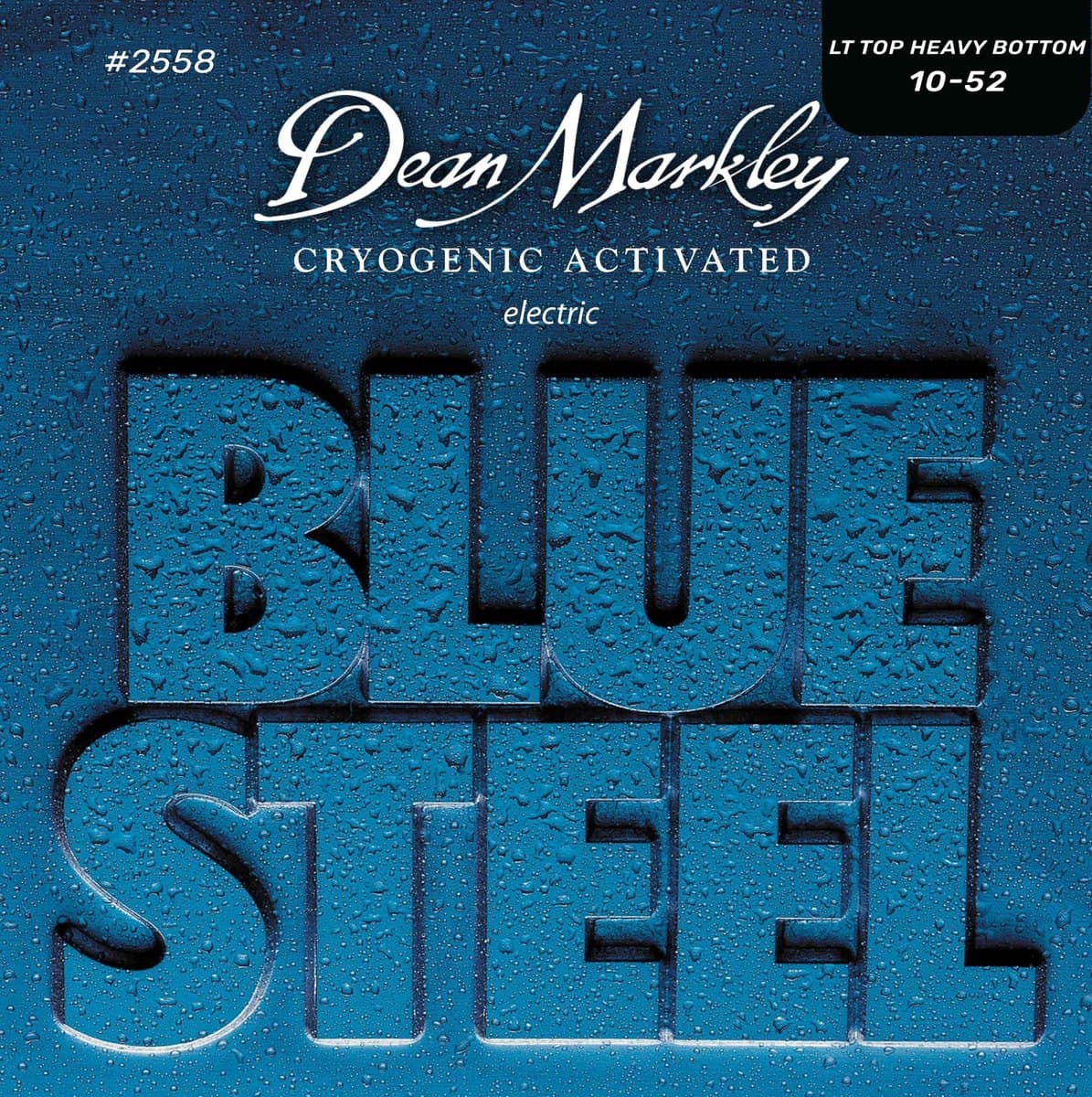
2558 Blue Steel Light Top/Heavy Bottom (.010-.052)
Why this one: The exact gauge Alex Lifeson named to Guitar One in 2007: a cryogenically treated Light Top/Heavy Bottom set with a fuller low end than a standard 10-46.
Read the full Dean Markley Blue Steel 2558 review for the full spec breakdown and how it compares to Ernie Ball's equivalent gauge. The lighter sibling in the same line is the Dean Markley Blue Steel 2552 (.009-.042), built on the same cryogenic process at a lighter gauge.
Rush's 2026 return: the Fifty Something tour
On October 5, 2025, Geddy Lee and Alex Lifeson sat down at the Rock and Roll Hall of Fame in Cleveland for what was billed as a conversation about their 2013 induction. The next morning, Rush announced it was touring again. "After all that has gone down since that last show, Alex and I have done some serious soul searching," Lee said in the band's press release, adding plainly that the two of them missed it too much to stay off the road.
The tour, called Fifty Something, is built around a 35-song rotating catalog and features German drummer Anika Nilles, previously known for touring with Jeff Beck and for her own instrumental albums. Neil Peart's widow, Carrie Nuttall-Peart, and daughter Olivia both publicly endorsed the choice, calling it a way to "honor Neil's extraordinary legacy as both a drummer and lyricist."
Shows began June 7, 2026, at the Kia Forum in Los Angeles, the same venue where Rush played its final show with Peart on August 1, 2015. What started as a 12-date, 7-city run expanded to 23 shows within days of the announcement, Rush's own site cited "incredible demand," with extra dates added in Los Angeles, Mexico City, Fort Worth, Chicago, New York, Toronto, and Cleveland. It's the first time Lee and Lifeson have toured as Rush in over a decade.