
Geddy Lee's bass strings: the Rush Jazz Bass rig, sourced
Documented bass-string gauges, brands, and tunings Geddy Lee uses with Rush on his Fender Jazz Bass and Wal basses. Rotosound Swing Bass 66 RS66LD (.045–.105). With citations.
Rush · written with AI help · updated
Geddy Lee plays Rotosound Swing Bass 66 RS66LD (.045–.105) on his Fender Jazz Bass, his primary instrument since rediscovering his 1972 Jazz in the late 1990s after years on Rickenbacker 4001 and Wal basses. Rotosound has sponsored him publicly. He used Rotosound Funkmaster FM66 (.030–.090) on his Wal basses from 1985 to 1992, a substantially lighter gauge for chord-heavy passages. Rush's catalog ran 40+ years with Lee's bass + vocals + Moog work as the band's textural foundation.
Who Geddy Lee is
Geddy Lee is the bassist, lead vocalist, and keyboardist of Rush, Canadian progressive-rock trio formed 1968 in Toronto with Lee, guitarist Alex Lifeson, and (from 1974) drummer Neil Peart. Rush's catalog from the 1974 self-titled debut through Clockwork Angels (2012) is one of the most technically demanding bodies of work in mainstream rock, and Lee's bass, vocal-melodic phrasing on a Fender Jazz, locked into Peart's polyrhythmic drum vocabulary, is the band's textural foundation. He authored Geddy Lee's Big Beautiful Book of Bass (2018), a 408-page coffee-table volume documenting his vintage bass collection.
What he plays
Rotosound Swing Bass 66 RS66LD (.045, .065, .085, .105) on his Fender Geddy Lee Jazz Bass. He's an officially-documented Rotosound user with a video endorsement on the brand's site. Stainless-steel roundwound, the brightest, most-cutting nickel-plated bass set Rotosound makes.
His historical gauge variation is documented: Rotosound Funkmaster FM66 (.030–.090) on his Wal Mk II from 1985 to 1992, a substantially lighter set chosen for the chord-voicing-heavy arrangements of the keyboard-era Rush records (Power Windows, Hold Your Fire, Presto, Roll the Bones). The return to standard gauge came with the late-1990s pivot back to the Fender Jazz Bass.
Why this fits the rig
A Fender Jazz Bass with stainless-steel roundwounds is one of the brightest possible bass voicings, the dual single-coil J-style pickups are voiced for top-end clarity in a way the P-Bass split-coil isn't. That brightness is non-negotiable for Lee's role in Rush: dense progressive arrangements with two melodic instruments competing for spectral space, plus Lee's high-register vocal lines, mean the bass has to cut through midrange clutter without occupying it. Lighter or warmer sets, flatwounds, nickel rounds, lighter gauges, disappear in that context.
The .045–.105 standard gauge gives him meaningful tension on the low E (the foundation of YYZ, Tom Sawyer, the entire Moving Pictures catalog) without sacrificing the bend-and-hammer-on feel his lead-bass vocabulary depends on.
Further reading and listening
Go deeper on the story and the craft. Books and Audible audiobooks on Amazon, so you can read or listen.
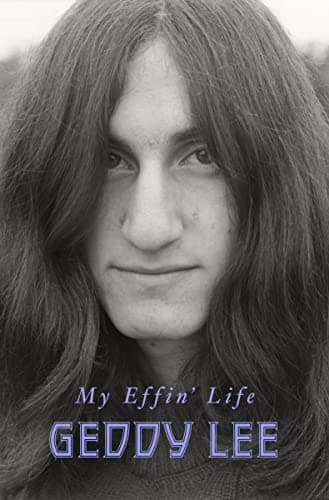
My Effin' Life
by Geddy Lee
Read by the author
Geddy Lee's memoir, Rush from the inside. The audiobook is self-narrated with Alex Lifeson and two exclusive songs.