Ernie Ball Slash Signature (.011–.048): Slash's real production set, decoded
Written with AI help · Updated
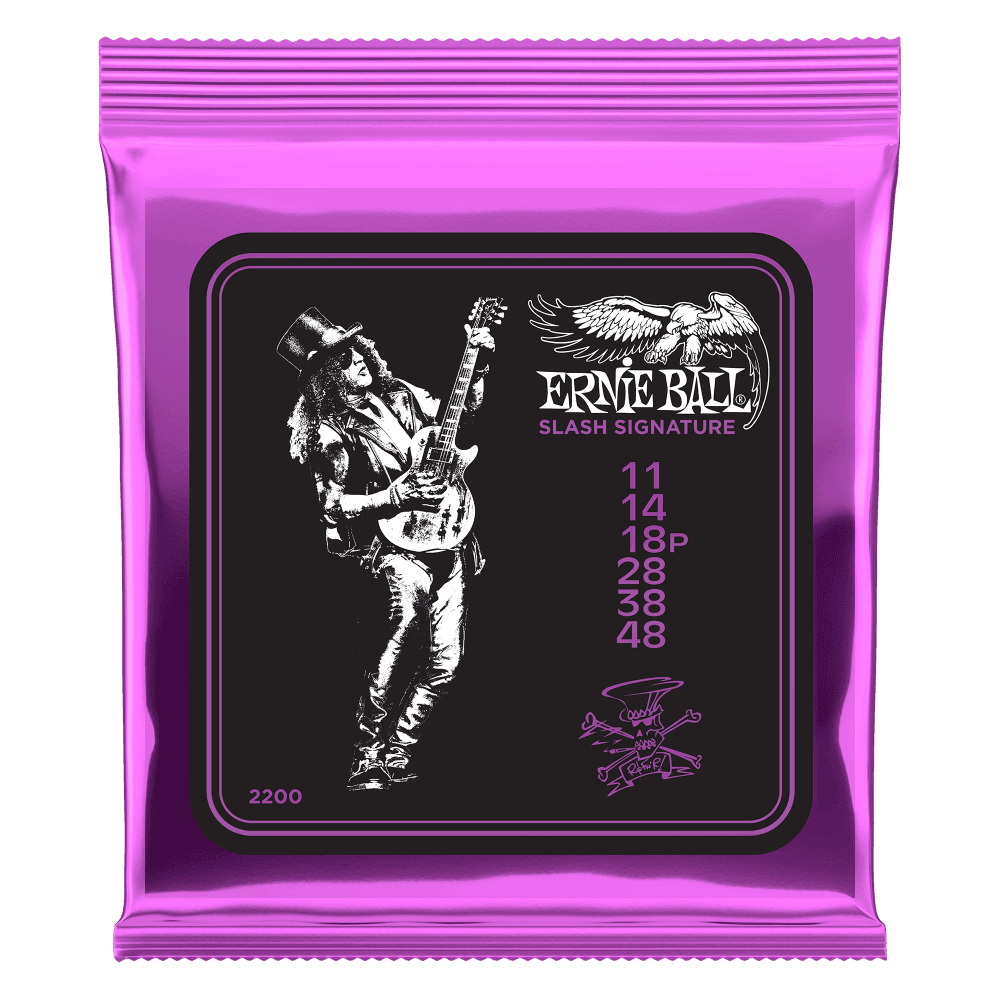
The Ernie Ball Slash Signature is Slash's production set, gauge .011 to .048. It pairs a Paradigm core wire with a nickel-plated steel wrap and an Everlast nanotreatment for corrosion resistance, plus heavier brass-reinforced plain strings built for the tuning stability of his Tune-O-Matic Les Pauls. It is the durable, long-life version of his documented Power Slinky gauge, voiced for hard rock in Eb standard.
What this set is
The Ernie Ball Slash Signature is Slash's production string set, gauge .011 to .048. Ernie Ball calls it the culmination of more than three decades of work with Slash, aimed at one goal: more durability and tuning stability without changing the tone or feel he already had.
It started as a limited edition and came back by popular demand. Today it sells as a standard single pack (SKU P02200), with the original three-pack tin still around as P03820.
The build is the story. This is the .011 to .048 Power Slinky gauge Slash has played for years, rebuilt on Ernie Ball's Paradigm durability platform: a reinforced Paradigm core wire, a nickel-plated steel wrap, and an Everlast nanotreatment on the wound strings. The plain strings add heavier brass reinforcement at the ball ends, tuned specifically for the Tune-O-Matic bridges on his Les Pauls.
Anatomy
- Model
- Slash Signature Set
- Signature artist
- Slash (Guns N' Roses)
- Gauge
- .011 – .048 (Power Slinky gauge)
- Gauge set
- .011, .014, .018p, .028, .038, .048
- String count
- 6 strings
- Core wire
- Paradigm reinforced high-carbon steel
- Wrap wire
- Nickel-plated steel
- Wound-string treatment
- Everlast nanotreatment
- Plain strings
- Heavier brass reinforcement at the ball ends
- Built for
- Tune-O-Matic bridges (his Les Pauls)
- Intended tunings
- Eb standard, E standard
- Part number
- P02200 (single), P03820 (3-pack)
- Made in
- United States (Ernie Ball, Coachella, CA)
What the Paradigm build actually changes
Start with what does not change: the tone. A Paradigm core wound with nickel-plated steel sounds like a nickel-wound Ernie Ball set, because that is what it is. If you already love the warm, slightly compressed voice of a Slinky on a humbucker, this set keeps it.
What changes is how long that voice lasts and how stable it stays. The Everlast nanotreatment is a surface treatment, not a thick polymer skin. It repels the oils, sweat, and grime that kill a fresh set, so the strings hold their top end longer than an untreated nickel string. Because it is a treatment rather than a heavy coating, it does not deaden the attack the way some coated strings can.
The reinforced core and the heavier brass at the plain-string ball ends are the tuning-stability half. Plain strings are the ones that slip and stretch most, especially over a Tune-O-Matic saddle and through a Les Paul headstock. Beefing up the ball-end anchor is a real answer to that, not a marketing line.
The trade is price. This sits a tier above a plain Power Slinky for the same gauge and tone. You are buying longevity and stability, so the value depends on how hard you play and how often you would otherwise restring.
Compared to the .011–.048 alternatives
Every set here is the same .011 to .048 gauge. The choice is about construction, not gauge.
| Slash Signature | Power Slinky 2220 | Power Slinky RPS 2242 | Power Slinky Cobalt | |
|---|---|---|---|---|
| Gauge | .011 – .048 | .011 – .048 | .011 – .048 | .011 – .048 |
| Core wire | Paradigm (reinforced) | Standard hex | Standard hex | Standard hex |
| Wrap wire | Nickel-plated steel | Nickel-plated steel | Nickel-plated steel | Cobalt |
| Treatment | Everlast nanotreatment | None | None | None |
| Plain ends | Heavier brass reinforced | Standard | RPS reinforced | Standard |
| Headline trait | Durability + stability | Value baseline | Tuning stability | Hotter output |
| Price tier | $$ | $ | $ | $$ |
The closest sibling by feel is the plain Power Slinky 2220: same gauge, same nickel voice, none of the durability tech. If you restring often and want the cheapest path to Slash's gauge, that is the one. If you want only the tuning-stability half without the full Paradigm treatment, the Power Slinky RPS 2242 adds reinforced plain strings at the lower price. The Power Slinky Cobalt is the one with a genuinely different voice: a cobalt wrap that drives a passive humbucker hotter, and the set Slash helped launch as a 2012 beta tester.
Slash Signature vs Papa Het
Ernie Ball runs two Paradigm-core signature sets aimed at hard-rock and metal players, and they are easy to confuse. They are not the same set.
The Papa Het's Hardwired Master Core set, James Hetfield's signature, is .011 to .050 with an uncoated, higher core-to-wrap ratio for a stiffer, more aggressive downpicking feel. The Slash Signature is .011 to .048 with the full Everlast nanotreatment for longevity, and a standard core-to-wrap ratio that keeps the warmer, looser classic-rock feel. Hetfield's set is tuned for tight thrash rhythm. Slash's is tuned for vintage-voiced Les Paul tone that survives a long tour.
Best for
Hard-rock and classic-rock players who run .011 gauge on a Les Paul or other humbucker guitar in Eb standard, and who want their strings to last and stay in tune through hard playing. Anyone chasing Slash's documented tone specifically, since this is his actual production set. Touring and gigging players who restring less often than they should and want corrosion resistance built in.
Worst for
Drop-tuned and metal players who need a tighter low end than a .048 low E gives below Drop D. Bend-light budget players who restring weekly anyway and would not get value from the durability tech, the plain Power Slinky 2220 is the cheaper route to the same gauge and tone. Players who want a brighter, hotter, more modern voice should look at the cobalt-wrapped sibling instead.
Verdict
The Slash Signature is not a relabeled Power Slinky with a famous name on the packet. The Paradigm core, the Everlast nanotreatment, and the heavier reinforced plain ends are real, deliberate changes, and they all point at the same target: keep Slash's existing .011 to .048 nickel tone, make it last longer, and make it hold tune on a Tune-O-Matic Les Pauls. For classic-rock and hard-rock players in Eb standard who already love a Slinky and want a more durable version, it earns its premium. Players who restring constantly, or who want a tighter low end or a hotter voice, have better-matched options in the same family.
Related
Related