Rage Against the Machine, gear encyclopedia: Tom Morello's guitar, Tim Commerford's bass, Brad Wilk's drums
The complete Rage Against the Machine gear encyclopedia. Documented strings, guitars, basses, drums, and cymbals for Tom Morello, Tim Commerford, and Brad Wilk, with primary-source citations from the 1992 debut through the band's 2024 breakup announcement.
Written with AI help · Updated
Rage Against the Machine formed in Los Angeles in 1991: Zack de la Rocha (vocals), Tom Morello (guitar), Tim Commerford (bass), Brad Wilk (drums). Morello splits Ernie Ball Hybrid Slinky (.009–.046) and Ernie Ball Regular Slinky (.010–.046) across his guitars. Commerford strings his Music Man StingRay with Ernie Ball Regular Slinky Bass (.050–.105). Wilk plays a Ludwig kit with Paiste cymbals. Two Grammys, a 2023 Rock Hall induction, and 16+ million records sold.
Band members(3)
At a glance
Role
Active
Affiliations
- Epic Records (1991–2000, 2007–2011, 2019–2024)
- Rock and Roll Hall of Fame (inducted 2023)
- Two Grammy Awards, six nominations
- 16+ million records sold worldwide (as of 2010)
Notable credits
- Rage Against the Machine (1992)
- Evil Empire (1996)
- The Battle of Los Angeles (1999)
- Renegades (2000)
- Audioslave, with Chris Cornell (2001–2007, same rhythm section)
The band, decoded
Rage Against the Machine formed in Los Angeles in 1991. Guitarist Tom Morello's previous band, Lock Up, had just broken up when its former drummer, Jon Knox, encouraged Morello to jam with bassist Tim Commerford and vocalist Zack de la Rocha. Morello then recruited drummer Brad Wilk, who had separately auditioned for Lock Up and for the band that became Pearl Jam. They named themselves after a song title de la Rocha had written for his earlier hardcore band, Inside Out. The group signed to Epic Records; Morello later said, "Epic agreed to everything we asked, and they've followed through... We never saw an ideological conflict as long as we maintained creative control."
The band's arc runs in three distinct chapters. The original run (1991 to 2000) produced three studio albums and the covers record Renegades before Zack de la Rocha's October 2000 departure. The reunion era (2007 to 2011) followed a Coachella comeback show and steady festival touring. The long-delayed third act (2019 to 2024) was supposed to be a full reunion tour, announced in 2019 and pushed to 2022 by the COVID-19 pandemic, but it collapsed when de la Rocha tore his Achilles tendon onstage in July 2022. Brad Wilk confirmed the band's third breakup on January 3, 2024.
This page is the gear encyclopedia for the band: documented strings, guitars, basses, drums, and cymbals for Morello, Commerford, and Wilk, with primary-source citations. Deeper per-member profiles are linked throughout, along with Ernie Ball Music Man's own signature-bass pages and Paiste's own artist roster listing.
Discography, album by album
From the 1992 debut to the 2024 breakup
- Rage Against the Machine (1992, Epic Records)
- The self-titled debut, released November 1992, produced by Garth Richardson. Cover art uses Malcolm Browne's Pulitzer-winning photograph of Thich Quang Duc's 1963 self-immolation. Slow initial sales (about 75,000 copies) took off after the band's 1993 Lollapalooza slot, reaching 400,000 by year end and 1 million US / 3 million worldwide by April 1996. Certified triple platinum by the RIAA in May 2000; ranked #221 on Rolling Stone's 2020 list of the 500 Greatest Albums. Tim Commerford played the same pawn-shop StingRay on this record that he'd bought around age 18.
- Evil Empire (1996, Epic Records)
- Released April 16, 1996, produced by Brendan O'Brien after the band briefly split over musical-direction disagreements during the sessions. Debuted at number one on the Billboard 200 with 249,000 first-week copies; later certified triple platinum. The band's Saturday Night Live performance that April was cut from two songs to one after they tried to hang inverted American flags from their amps in protest of guest host Steve Forbes.
- The Battle of Los Angeles (1999, Epic Records)
- Released November 2, 1999, produced and mixed by Brendan O'Brien. Debuted at number one with 450,000 first-week copies and was certified double platinum. 'Guerrilla Radio' won the Best Hard Rock Performance Grammy in 2001; the album itself was nominated for Best Rock Album. 'Wake Up' appeared on The Matrix soundtrack the same year.
- Renegades (2000, Epic Records)
- A covers album spanning Bob Dylan, Bruce Springsteen, the Rolling Stones, the MC5, Cypress Hill, and Minor Threat, among others. Certified platinum about a month after release. Zack de la Rocha announced his departure on October 18, 2000, citing a decision-making process that had 'completely failed,' and the band disbanded before Renegades finished its chart run.
- Audioslave interlude (2001–2007)
- Morello, Commerford, and Wilk stayed together after the split and, on producer Rick Rubin's suggestion, teamed with former Soundgarden vocalist Chris Cornell. Audioslave released three albums between 2002 and 2006; Out of Exile (2005) debuted at number one. The band dissolved in February 2007 when Cornell cited irresolvable personality conflicts.
- Reunion, hiatus, and the third breakup (2007–2024)
- RATM reunited at Coachella in 2007 and toured on and off through 2011. A reunion tour announced in 2019 was delayed to 2022 by the COVID-19 pandemic, then cut short when Zack de la Rocha tore his Achilles tendon four songs into a July 11, 2022 show in Chicago. The 2022 European dates and the planned 2023 North American tour were both cancelled. Brad Wilk confirmed on January 3, 2024 that the band would not tour or perform again.
Tom Morello's signature gear
The two guitars
- Arm the Homeless
- A hand-painted, Performance-built Strat-style instrument played across the entire RATM catalog. EMG humbucker pickups, a kill-switch toggle wired for his stutter effects, and an Ibanez Edge locking tremolo. One of the most recognizable stage guitars of the 1990s.
- Soul Power / Fender signature Stratocaster
- A black Stratocaster with a Seymour Duncan Hot Rails bridge humbucker and the same kill-switch toggle. The basis for the Fender Tom Morello Soul Power Signature Stratocaster, in continuous production since 2017.
Strings
- Ernie Ball Hybrid Slinky (.009–.046)
- His tremolo guitars, Arm the Homeless and the Soul Power Strat. Documented in his Premier Guitar Rig Rundown.
- Ernie Ball Regular Slinky (.010–.046)
- His non-trem 1982 Telecaster, 'Sendero Luminoso.' The heavier gauge is chosen specifically to match the string tension of his Hybrid Slinky-strung tremolo guitars.
Morello's lead vocabulary, kill-switch stutters, tremolo-arm pitch dives, and scratch effects, runs through a DigiTech Whammy, a Dunlop Cry Baby wah, and a Boss delay into Marshall tube amplification. The Hot Rails humbucker's higher output drives the Marshall front end into clean, controllable saturation, which is why "Bulls on Parade" and "Killing in the Name" read as aggressive without sounding like a conventional high-gain rock tone. Drop D and Drop C dominate the RATM and Audioslave catalogs, and Ernie Ball Hybrid Slinky (.009 to .046) stays in tune under the Ibanez Edge through aggressive trem use.
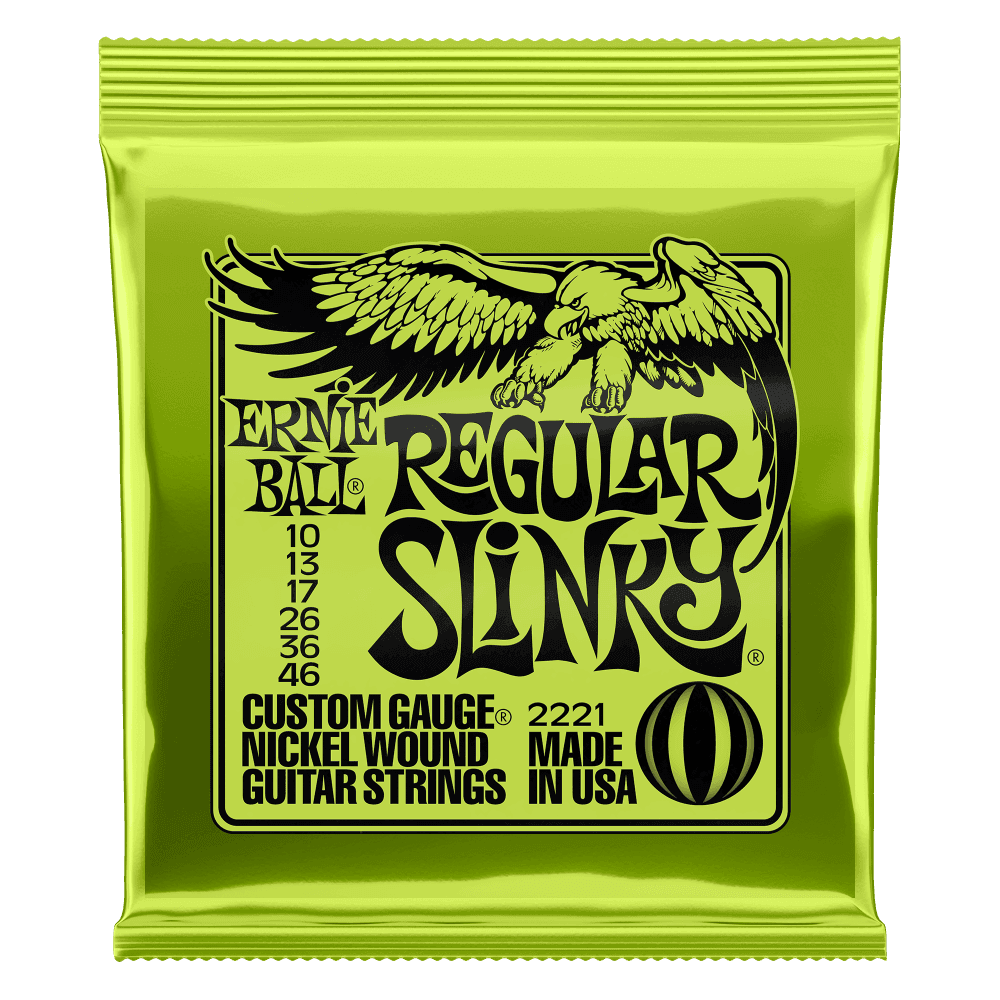
Regular Slinky (.010–.046)
Why this one: Tom Morello's non-trem Telecaster gauge, chosen to match tension with the .009 Ernie Ball Hybrid Slinky on his tremolo guitars. The RATM and Audioslave default for Drop D and Drop C.
Tim Commerford's signature gear
The bass
- Ernie Ball Music Man StingRay
- Bought secondhand at a pawn shop around age 18, the same StingRay he played on the 1992 debut. He has cycled through other basses at points since, but Premier Guitar's 2016 Rig Rundown found him back on a fleet of stock StingRays, and Ernie Ball Music Man now lists him among its artists.
- Signature StingRay, two generations
- Two limited runs of 50 units per finish, in 2021 and 2024, built around his adjustable thumb rest ('the curve') and a string-through-body bridge with mute pads.
Strings
- Ernie Ball Regular Slinky Bass (.050–.105)
- Confirmed by name in both Premier Guitar's Rig Rundown and Ernie Ball Music Man's own recap of it. Nickel-plated steel roundwound, long scale.
Commerford plays fingerstyle exclusively and doesn't use a pick. With Morello's guitar often busy with kill-switch stutters and Whammy dives, a bright nickel roundwound bass string gives Commerford's basslines enough top-end definition to function as a second lead voice instead of disappearing under the noise, especially under de la Rocha's rapid, rap-cadence vocal phrasing.
Regular Slinky Bass (.050–.105)
Why this one: Tim Commerford's own documented bass strings on his Ernie Ball Music Man StingRay: nickel roundwound at .050 to .105, long scale. Bright enough to cut through Morello's kill-switch and Whammy textures without a pick.
Brad Wilk's signature gear
Kit, cymbals, sticks
- Ludwig drum kit
- Joined Ludwig's artist roster in July 2022 after posting photos of his vintage amber Ludwig Vistalite collection; played Gretsch throughout the classic RATM, Audioslave, and Prophets of Rage years before that.
- Paiste cymbals
- Paiste artist since February 2003. Documented setup: a 14-inch Signature Reflector Heavy Full Hi-Hat, 18 and 19-inch Signature Power Crash, and a discontinued 21-inch Signature Dry Heavy Ride.
- Vater 1A drumsticks
- Joined Vater's artist roster in 2024. Plays the stock 1A, hickory, 16-3/4 inch, acorn tip, with Vater Grip Tape, plus the Power 5B Acorn for lighter passages. Not a personalized signature model.
The Paiste Signature Power Crash 18-inch anchors his documented live setup alongside the hi-hat and ride. Buy the Paiste Signature Power Crash 18-inch, or read the full review below.
The Rage Against the Machine sound
For anyone chasing the RATM sound at home, the signal chain stays consistent across the catalog:
- Guitar. Strat or Tele-style single coils, or the Hot Rails humbucker on the Soul Power Strat. Ernie Ball Hybrid Slinky (.009–.046) on tremolo guitars or Ernie Ball Regular Slinky (.010–.046) on non-trem guitars. Drop D or Drop C.
- Guitar effects. A DigiTech Whammy for pitch-shift dives, a kill-switch toggle for stutter effects, a Dunlop Cry Baby wah, a Boss delay.
- Guitar amp. Marshall tube amplification, driven into saturation by the Hot Rails' higher output on the Soul Power Strat.
- Bass. Ernie Ball Music Man StingRay, played fingerstyle only, strung with Ernie Ball Regular Slinky Bass (.050–.105).
- Drums. Ludwig kit today (Gretsch historically), Paiste cymbals since 2003, a hip-hop-influenced pocket that leaves room for Morello's noise and de la Rocha's rapid vocal cadence.
The sound isn't a pedalboard trick. It's a Marshall-driven single-coil-or-Hot-Rails guitar doing unconventional things (kill-switch, Whammy, tremolo arm) over a StingRay bass that has to carry the riff information while the guitar is off being weird, anchored by a drummer who leaves space instead of filling it.
Where to start listening
- If you're new to RATM
- Start with the 1992 debut. Raw, unpolished, Garth Richardson at the boards. The blueprint for the entire rap-metal genre that followed.
- If you want the polished peak
- The Battle of Los Angeles (1999). Brendan O'Brien production, the Grammy-winning 'Guerrilla Radio,' the tightest song-for-song record in the catalog.
- If you want the deep cut
- Evil Empire (1996). More hip-hop influence, the SNL flag-protest era, 'Bulls on Parade.'
- If you're curious about the covers record
- Renegades (2000). Recorded and released right as the original lineup split; the closest thing to a farewell statement the classic lineup made.