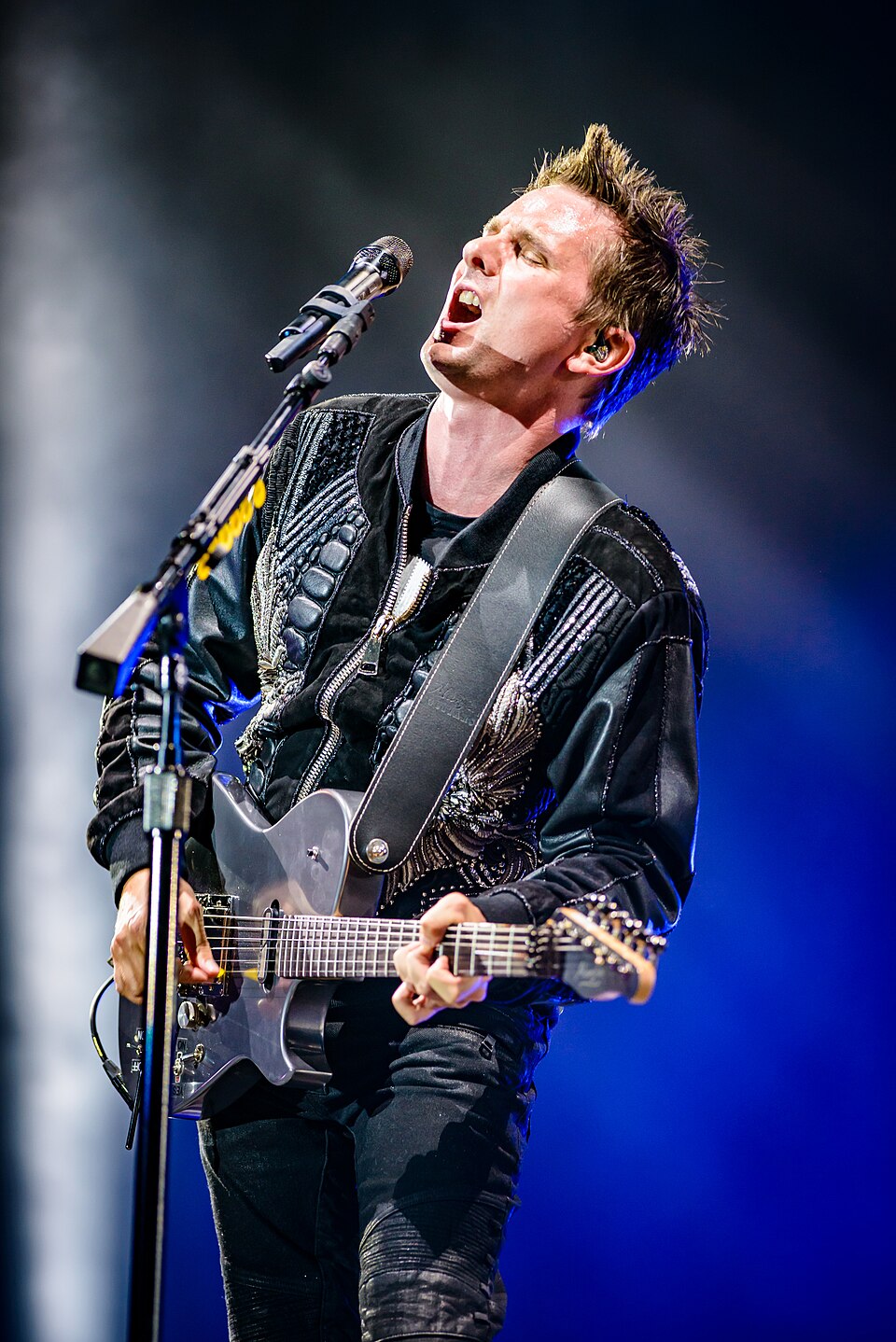
Matt Bellamy's guitar strings: the Muse rig, sourced
Documented string gauges and signature gear Matt Bellamy uses with Muse: Ernie Ball Power Slinky (.011–.048) per Ernie Ball's own artist blog, his Manson MB-1 signature guitar with a built-in MIDI touchpad and Korg Kaoss Pad, and the Diezel VH4 to Kemper/Axe-FX rig behind Muse's sound. With citations.
Muse · written with AI help · updated
Matt Bellamy's Ernie Ball blog page names him a documented Ernie Ball artist and states that Muse play Power Slinky (.011–.048) on guitar. His main instrument is the Manson MB-1, a signature model he co-designed with Hugh Manson with a built-in MIDI touchpad that controls a Korg Kaoss Pad, a Fernandes Sustainer for infinite sustain, and a kill switch for rhythmic stutters. He bought a majority stake in Manson Guitar Works in 2019.
Who Matt Bellamy is
Matthew James Bellamy was born June 9, 1978, in Cambridge, England. His family moved to Teignmouth, Devon, where he started piano at six and guitar at eleven. At Teignmouth Community School he played in a run of earlier bands, including one called Gothic Plague, with schoolmate Dominic Howard on drums. When other members left, Bellamy and Howard recruited bassist Chris Wolstenholme. In 1994, performing as Rocket Baby Dolls, the trio won their school's Battle of the Bands contest, a result serious enough that they renamed themselves Muse and started taking the band seriously.
Muse released their debut album, Showbiz, in 1999. The catalog since, Origin of Symmetry (2001), Absolution (2003), Black Holes and Revelations (2006), The Resistance (2009), The 2nd Law (2012), Drones (2015), Simulation Theory (2018), and Will of the People (2022), has sold more than 30 million records worldwide and won two Grammy Awards for Best Rock Album, for The Resistance and Drones. In June 2007 Muse became the first band to sell out the newly built Wembley Stadium.
Bellamy writes the songs, sings lead in a wide tenor range, and plays the guitar and keyboard parts underneath it. Total Guitar named him Guitarist of the Decade in its January 2010 issue; a 2010 BBC Radio 6 Music survey rated him the third-best guitarist of the previous 30 years. He's arguably just as well known for building his own guitars as for playing them: since the early 2000s he's worked with Devon luthier Hugh Manson on a run of heavily modified signature instruments, and in 2019 he bought a majority stake in Manson Guitar Works itself.
What he plays
Ernie Ball's own blog names him directly, "lead-singer and Ernie Ball artist Matt Bellamy", and states in the same post that Muse play Power Slinky on guitar. His main stage instrument is the Manson MB-1, an instrument with more in common with a small synthesizer rig than a stock electric: a built-in MIDI touchpad controls an outboard Korg Kaoss Pad, a Fernandes Sustainer drives infinite feedback, and a kill switch cuts the signal to ground for rhythmic stutters.
The current rig, sourced
- Strings
- Ernie Ball Power Slinky (.011–.048), confirmed on Ernie Ball's own blog. A widely repeated custom-gauge claim (.010 to a .060 low E) traces to an uncited MuseWiki entry marked "reference needed," so it's flagged here rather than reported as fact.
- Main guitar
- Manson MB-1 signature, co-designed with Hugh Manson. Built-in Fernandes Sustainer, kill switch, and a MIDI touchpad controlling a Korg Kaoss Pad.
- Main amp history
- MIDI-controlled Diezel VH4 for most of Muse's career, confirmed in Bellamy's own words from a 2003 interview. Vox AC-30 and Marshall heads also documented. Since 2013 he's run a Kemper Profiler and Fractal Axe-FX II instead of a traditional amp live.
- Company
- Bellamy bought a majority stake in Manson Guitar Works in 2019, two decades after becoming its best-known signature artist.
The Manson relationship: from the Delorean to the MB-1
Bellamy's first Manson collaboration came right after Showbiz broke in 1999. He wanted a Telecaster body wired with Gibson-style electronics, and the result was the DL-1, nicknamed "Delorean" for the aluminium body covering that mimics the time machine from Back to the Future. It carries a Seymour Duncan neck P90, a Kent Armstrong Motherbucker bridge pickup, a Roland GK-2a MIDI pickup, and a built-in Z.Vex Fuzz Factory, MXR Phase 90, and Graphtech Ghost acoustic preamp, all wired into the guitar's own circuitry. Bellamy hasn't played it live since 2005, but its silhouette became the template for nearly every signature Manson that followed.
The Bomber came next for the Absolution and Black Holes and Revelations touring cycles: an air-brushed chrome body embossed with rivets copied from a WWII-era Spitfire, an Ibanez neck, and a DigiTech Whammy controller built into the rear cavity. In 2007 Bellamy debuted the Red Glitter, sharing the Delorean's body shape but adding the two features that would define his sound for the next decade: a Fernandes Sustainer for infinite feedback, and an X-Y MIDI touchscreen for the Korg Kaoss Pad. The Red Glitter was destroyed after years of on-stage abuse in 2010. Its near-identical replacement became the commercially available Manson MB-1, the guitar Guitar World profiled in 2011 as Bellamy's "secret weapon."
Manson's own artist page today lists four current official signature models bearing his name: the MB-1, MB-1S, DL-1, and MB-2E. A 2022 blog post from the company details a limited MB-2 run (the original MB-1's black finish, twin hand-wound P90 pickups that combine into a "humbucker" mode, and a Sustainiac driver) alongside a DL-2 built around the Fuzz Factory and Phase 90 circuitry from the original Delorean. Mixdown Magazine's gear rundown counts roughly 30 different Manson variations across Bellamy's career, including 7-strings, a double-neck, and a genuine playable keytar.
Why this fits the rig
Muse has spent most of its career as a three-piece: guitar, bass, drums, with Bellamy singing lead on top. A conventional guitar rig can't cover synth pads, pitch-shifted harmonies, and glitch textures on its own, not without a fourth touring member. Building the MIDI controller and effects loop directly into the guitar body solves that problem at the source: Bellamy triggers a Korg Kaoss Pad sweep or a Digitech Whammy harmony with his picking hand mid-riff, without reaching for a pedalboard or handing the part to a keyboardist.
The Diezel VH4's MIDI switching plays the same role on the amp side. In his own words from the Absolution era, Bellamy ran the Diezel head with a Line 6 Echo Pro sitting parallel to it, "so when I hit my MIDI foot-controller the amp brings it into the loop," keeping the guitar-to-amp signal clean until an effect is deliberately switched in. That's a live-performance answer to a studio problem: how to get one guitar to sound like several different instruments across one arena set, without carrying several different rigs to do it.
Style signatures
Three things across Muse's catalog that trace back to Bellamy specifically:
-
MIDI as a compositional tool, not a studio trick. Most guitarists who use MIDI pickups do it to double a part with a synth in the studio. Bellamy built the controller into the instrument itself and plays it live, mid-song, as a fourth voice. The Kaoss Pad touchpad solos on "Supermassive Black Hole" are a performance element, not a production overdub.
-
A kill switch used as a rhythm instrument. The MB-1's toggle kill switch grounds the signal instead of the pickup, cutting the sound dead when flipped. Guitar World's 2011 profile ties Bellamy's use of it directly to Tom Morello's rhythmic stutter technique, turning a mute switch into a percussive part of the arrangement rather than just a way to silence the guitar between songs.
-
Drop D reserved for specific, heavier songs rather than a default tuning. In his own words, most of Absolution is in standard tuning, with Drop D saved for "Stockholm Syndrome" and a brief dip to Db at the end of "Blackout." That selectivity fits a catalog built more on dynamic range, quiet verse to enormous chorus, than on a single down-tuned wall of guitar.
Electric guitars
Sourced from Guitar World's 2011 MB-1 feature, Mixdown Magazine's gear rundown, Manson Guitar Works' own artist and product pages, and Wikipedia.
Current main signature · ~$5,000 at 2011 launch
Manson MB-1
Red glitter finish, custom Manson MBK-2 humbucker bridge pickup, a built-in Fernandes Sustainer for infinite sustain and feedback, a kill switch for rhythmic stutters, and a MIDI touchpad that controls an outboard Korg Kaoss Pad. Co-designed with luthier Hugh Manson.
Source: Guitar World, 2011, Manson Guitar Works artist page.
Debuted 2007 · Destroyed 2010
Manson Red Glitter
Shares the Delorean's body shape. First guitar to combine the Fernandes Sustainer with an X-Y MIDI touchscreen for the Korg Kaoss Pad. Destroyed after years of on-stage abuse; its near-identical replacement went into production as the MB-1.
Source: Mixdown Magazine gear rundown.
Built 1999-2000 · Unused live since 2005
Manson DL-1 "Delorean"
A Telecaster-body, Gibson-electronics riff machine wrapped in aluminium to mimic the DeLorean time machine. Seymour Duncan neck P90, Kent Armstrong Motherbucker bridge pickup, Roland GK-2a MIDI pickup, plus a built-in Z.Vex Fuzz Factory, MXR Phase 90, and Graphtech Ghost preamp. The blueprint for nearly every Manson signature since.
Source: Mixdown Magazine gear rundown.
Absolution + Black Holes and Revelations touring
Manson Bomber
Air-brushed chrome body embossed with rivets from a WWII-era Spitfire. Ibanez neck, Rio Grande Jazzbar neck and BKP Nailbomb bridge pickups, a MIDI strip controller from an old Roland synth, and a DigiTech Whammy controller built into the rear cavity.
Source: Mixdown Magazine gear rundown.
Purchased 2020 · Jeff Buckley's recording guitar
1983 Fender Telecaster ("Grace")
The Telecaster Jeff Buckley used to record Grace (1994). Bellamy bought it in 2020, used it to record a song with the Jaded Hearts Club, and said at the time he planned to bring it into the next Muse album sessions.
Source: Wikipedia.
Documented in Premier Guitar's gear roundup
Gibson SG Standard
Listed alongside his amps and pedals in Premier Guitar's gear feature. A simpler, off-the-shelf counterpoint to the heavily modified Manson instruments that otherwise dominate his stage rig.
Source: Premier Guitar, 2019.
Amps
Main amp for most of Muse's career · MIDI-controlled
Diezel VH4
In his own words on recording Absolution: "I went through a lot of different cabs and heads but ended up using a Diezel head with a Soldano cabinet. It was the best sound, so I used that on everything. And I'll be using that exact set-up live as well." Run with a Line 6 Echo Pro parallel to the amp so the guitar signal stays clean until a MIDI foot-controller switches an effect into the loop.
Source: Total Guitar, December 2003, corroborated by Mixdown Magazine.
Documented career-long amp
Vox AC-30
A vintage AC-30 head is named as one of Bellamy's main amps for the majority of Muse's recording and touring history, alongside the Diezel VH4 and assorted Marshall heads including the DSL100 and 1959HW100.
Source: Mixdown Magazine gear rundown, Premier Guitar, 2019.
Live rig since the 2nd Law tour, 2013
Kemper Profiler + Fractal Axe-FX II
Bellamy stopped using traditional guitar amplifiers live starting with the 2nd Law world tour, running a Kemper Profiling Amplifier and a Fractal Audio Systems Axe-FX rack unit instead to digitize his guitar signal for the road.
Source: Mixdown Magazine gear rundown.
Effects
Controlled via a built-in guitar touchpad
Korg Kaoss Pad
An effects sampler with filters, phasers, and delays. Bellamy triggers it live through a touch-controlled MIDI pad built into his Manson guitars rather than a stompbox on the floor. The Guardian called him "undoubtedly the Kaoss rock star."
Source: Guitar World, 2011, Wikipedia.
Built into the DL-2 signature circuit
Z.Vex Fuzz Factory + MXR Phase 90
A Z-Vex USA custom Manson Fuzz Factory circuit and an MXR Phase 90 circuit are wired directly into the DL-2 signature guitar's own electronics. Mixdown separately documents two standalone Z.Vex Fuzz Factory units in Bellamy's outboard rack during The Resistance touring era.
Source: Manson Guitar Works, 2022, Mixdown Magazine.
Documented in Premier Guitar's gear roundup
DigiTech Whammy
A long-running part of Bellamy's rack across multiple eras, from a built-in Whammy controller in the Bomber guitar's rear cavity to a standalone DigiTech Whammy 5 listed in Premier Guitar's 2019 gear feature.
Source: Mixdown Magazine, Premier Guitar, 2019.
Strings
Confirmed on Ernie Ball's own blog
Ernie Ball Power Slinky (.011–.048)
Ernie Ball's blog names Bellamy directly as "lead-singer and Ernie Ball artist" and states in the same post that Muse play Power Slinky, Paradigm 80/20 Medium-Light Acoustic, and Bass Hybrid Slinky. The post credits the band collectively rather than naming which member plays which set: the electric Power Slinky claim is attributed to Bellamy here as guitarist, while the bass set most plausibly belongs to bassist Chris Wolstenholme, a reasonable inference from Muse's lineup rather than something the source states directly.
Unconfirmed, widely repeated
Custom .010–.060 gauge (fan claim)
A specific gauge (.010, .013, .017, .026, .036, .060 low E) circulates widely across gear sites, but MuseWiki's own Strings page, the apparent origin of the figure, marks it "Reference needed!" No dated interview or manufacturer page backs the exact numbers, so this page treats it as an unconfirmed claim rather than a documented spec.
Picks
Sold directly by his own company
Manson Guitar Works Tortex Matthew Bellamy Signature (.73mm)
Tortex construction, yellow finish, 0.73mm gauge, with his signature on one side and the Manson Guitar Works logo on the other. Sold through Manson's own UK store. The closest widely available Amazon equivalent is the same generic Tortex .73mm yellow construction under the Dunlop name.
If you want this rig
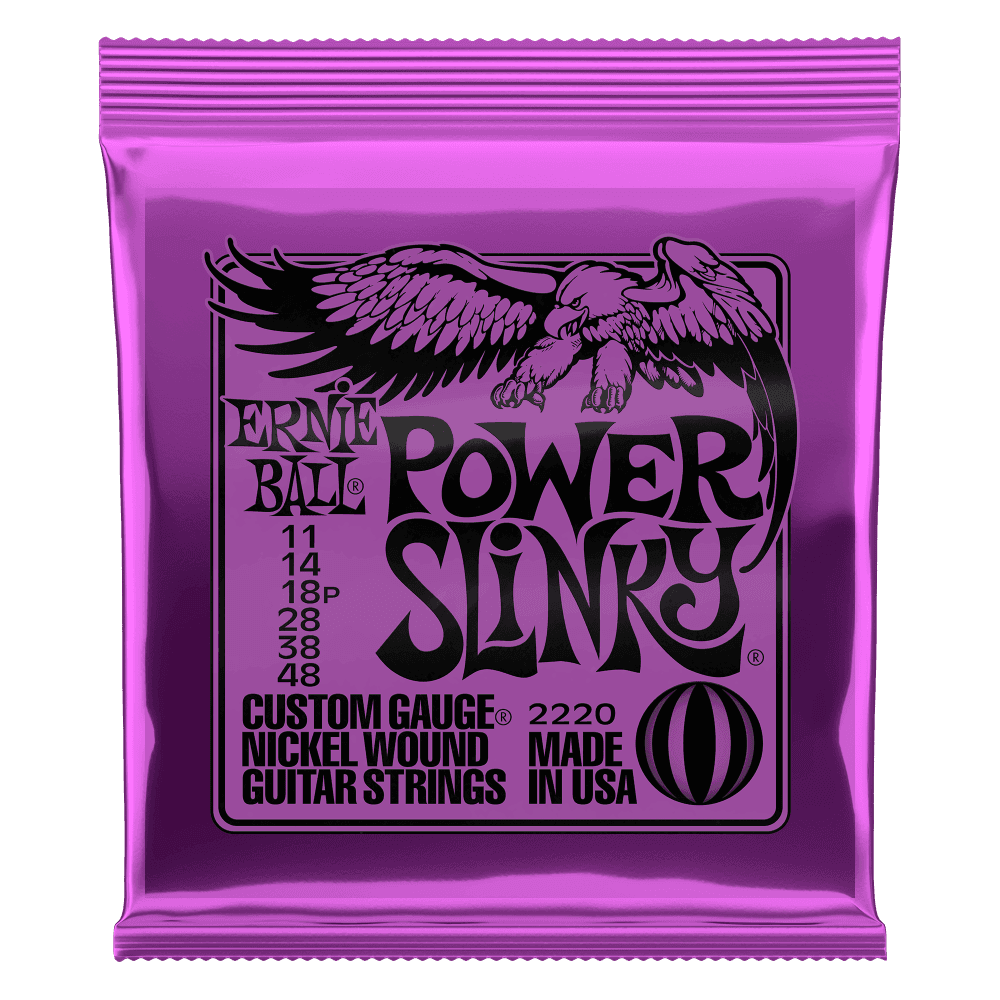
Power Slinky 2220 (.011–.048)
Why this one: Ernie Ball's own blog names this as the set Muse play on guitar. One step up from Regular Slinky, with the extra tension to keep Drop D songs like Stockholm Syndrome from feeling rubbery under a heavy attack.