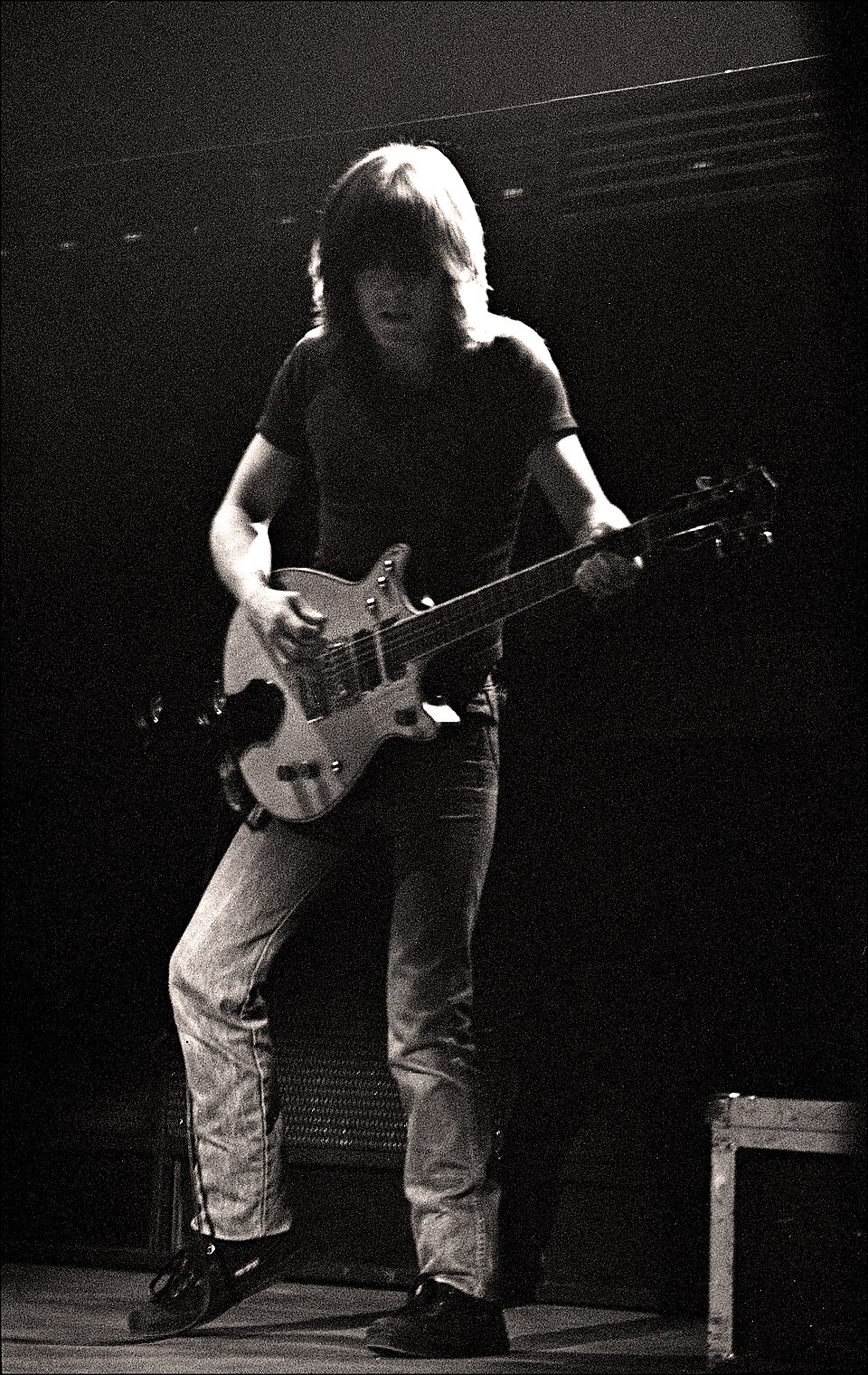
Malcolm Young's guitar strings: the AC/DC rhythm rig, sourced
The unusually heavy Gibson string gauge Malcolm Young played on 'The Beast,' his 1963 Gretsch Jet Firebird, plus the Marshall amp and stripped-down signal chain behind AC/DC's rhythm tone. Ground Guitar, Guitar Player, and Guitar World sourced.
AC/DC · written with AI help · updated
Malcolm Young strung his 1963 Gretsch Jet Firebird, 'The Beast,' with an unusually heavy Gibson set built around a wound G string: Ground Guitar's breakdown gives .012, .016, .025 (wound), .034, .044, .056; Guitar Player's own lesson on his technique cites .012 to .058. Both sources agree he ran it in standard tuning, not the drop tuning most players reserve for that gauge, and that the set is discontinued today with no current retailer listing.
Who Malcolm Young is
Malcolm Young was born on January 6, 1953 in Glasgow, Scotland, and moved to Sydney, Australia with his family in 1963. Ten years later, at 20, he formed AC/DC with his younger brother Angus, taking rhythm guitar himself and handing Angus the lead role and the schoolboy uniform. He was also a songwriter and backing vocalist, and by his brother's own account, the band's real foundation. "Mal's the band's foundation," Angus has said. "He's rock solid and he pumps it along with the power of a machine."
Malcolm was a member of AC/DC from its 1973 formation until his 2014 retirement, missing most of the 1988 Blow Up Your Video World Tour for alcohol treatment before returning. He was diagnosed with dementia in 2014 and retired from the band that September, replaced permanently by his nephew Stevie Young. Malcolm died on November 18, 2017, at age 64. AC/DC was inducted into the Rock and Roll Hall of Fame in 2003, and Rolling Stone ranked Malcolm and Angus jointly the 38th-best guitarists of all time in 2023.
What he played
An unusually heavy Gibson set on a stripped-down 1963 Gretsch Jet Firebird, run straight into a 1971 Marshall Super Bass with the guitar's tone controls bypassed entirely.
The documented rig, sourced
- Strings
- A heavy Gibson set with a wound G. Ground Guitar gives .012, .016, .025 (wound), .034, .044, .056; Guitar Player separately cites .012 to .058. Discontinued for years, no current listing.
- Main guitar
- 1963 Gretsch G6131 Jet Firebird, nicknamed "The Beast." Stripped to bare wood, down to a single bridge Filter'Tron with every tone control bypassed.
- Amp
- 1971 Marshall Super Bass, a 100-watt head built originally for bass. "If those amps are on 3, that's a loud night for me," Malcolm told Guitar Player.
- Tuning and role
- Standard E tuning, rhythm guitar only, across AC/DC's entire studio catalog from High Voltage (1976) through his 2014 retirement.
The exact Gibson set is long discontinued. If you want to try a similarly heavy gauge in standard tuning, Ernie Ball's Not Even Slinky Cobalt (.012–.056) matches the outer gauges, though it's cobalt-wrapped rather than plain nickel: Buy on Amazon.
The Gibson strings, and the wound-G detail
Malcolm's most-documented string set comes from Ground Guitar's archive, which describes "a pretty heavy set of Gibson guitar strings, where four of the six strings were wound," gauged .012, .016, .025 (wound), .034, .044, and .056. Guitar Player's own technique lesson on his style independently confirms the shape of that set, "huge .012-.058-gauged Gibson strings (including a wound G)," but gives a heavier top-line number on the low E. Both accounts agree on what matters most: a heavy, pure nickel wound set, and a wound G string, the detail worth pausing on.
Most guitar sets, heavy or light, keep a plain third string and only wind the bottom three. Winding the G as well trades some brightness for durability and a rounder tone under a hard right hand, exactly the kind of tradeoff a rhythm-only player who never bent that string would make without a second thought.
Ground Guitar itself hedges the exact model name with "apparently," its way of flagging that the claim comes from period photos and secondhand accounts rather than a tech's own equipment list or a store receipt, the kind of harder evidence that pins down, say, Kurt Cobain's Dean Markley sets. Whatever the precise Gibson catalog number, the gauge and the wound-G detail are consistent across every account of Malcolm's rig, and the set has been out of production for years with no current retailer listing anywhere.
Why the heavy gauge and stripped-down rig worked
Malcolm's whole signal chain optimized for one job: hold a riff down, all night, without drifting out of tune or getting buried by Angus's leads and a wall of Marshalls. The heavier gauge helps with the first problem. Thicker strings resist the small pitch shifts a hard-strumming rhythm player can induce over a two-hour set, and the low string's extra mass adds low-end weight that a lighter gauge doesn't carry at the same tension.
The Beast's construction helps with the second. Guitar Player calls it a "semihollow" guitar, and a semihollow body resonates more than a solid slab. With the neck and middle pickups gone, the guitar's entire output comes from one Filter'Tron at the bridge with no tone control to thin it out: pickup, volume, output, nothing else in the way. Guitar World's own read on the rig calls the signal path "renowned for simplicity," crediting the Filter'Tron's clarity and headroom over a full humbucker for a balanced, present rhythm tone that sits under Angus's leads instead of fighting them.
None of this is subtle gear-nerd optimization. It's the same instinct behind Angus's own bare-bones rig, one guitar type, one amp type, almost no pedals, aimed at a different job. Angus needed headroom for bends and solos; Malcolm needed a rhythm tone that would hold up, night after night, without drawing attention to itself.
Style signatures
Three things about Malcolm's playing, mostly in his own bandmate's words.
-
He gave up leads on purpose. Early on, Malcolm played some lead guitar himself, until he told Angus, "No, you take the solos. I'll just bang away back here." Everything about his rig, from the heavy strings to the stripped-down Gretsch, follows from that one decision.
-
Rhythm as the riff, not the backdrop. Angus has said Malcolm "actually plays rhythms. He just doesn't make a noise; he works them out, and he knows when not to play." The intro riff behind "For Those About to Rock" changes bar to bar rather than looping, the difference between a riff and a vamp.
-
The reputation problem of being the rhythm guy. Angus has called Malcolm's playing more unique than his own, "with that raw, natural sound," and said flatly, "Mal's the band's foundation." That's a rare thing for a lead guitarist to say about a rhythm player, and it lines up with a rig built around one job: hold the riff down, exactly, every night, for four decades.
Electric guitars
The core electric stable, sourced from Ground Guitar's archive, Guitar World, and TheStoryInst.com.
Main guitar since 1973 · Stripped down over decades
1963 Gretsch G6131 Jet Firebird ("The Beast")
Handed down by his older brother George Young and Harry Vanda of the Easybeats, arriving already modified with a Gibson humbucker wedged between two stock Filter'Trons. Around 1976-77 Malcolm pulled the humbucker and the neck pickup, leaving a single bridge Filter'Tron, then stripped the original red finish to bare wood the following year. He swapped the stock Burns tailpiece for a Schaller Bad Ass bridge, later reinstalling the original hardware around 2000.
Source: Ground Guitar; Guitar World; TheStoryInst.com.
Back in Black and For Those About to Rock tours, 1980-82
1959 Gretsch 6137 White Falcon
Malcolm's stand-in for The Beast across two of AC/DC's biggest album cycles, with occasional use later on the Black Ice tour. Ground Guitar's account says a repair job changed its sound enough that Malcolm let it go; it sold at auction and later appeared in a Hard Rock Cafe feature video.
Source: Ground Guitar.
Backup, built circa 1977 · Powerage and Highway to Hell tours
JayDee Jet "White Arrow"
A close replica of The Beast, same stop-tail bridge, same two-Filter'Tron layout, built as a touring backup so Malcolm's number-one guitar didn't have to survive every night on the road. JayDee's own site says the shop built at least three guitars for Malcolm across his career.
Source: Ground Guitar.
Early years, circa 1975 · Bought as a stopgap
1973 Gibson L6-S
Bought from a Sydney shop in early 1975 while The Beast was in for a headstock repair, according to former AC/DC bassist Mark Evans's own account. Modified into a double-cutaway shape in 1976 to look more like the Gretsch, with the neck humbucker removed.
Source: Ground Guitar, quoting Mark Evans via Australian Musician.
One-off · Rolling Stones guest appearance, 2003
Duesenberg Starplayer TV (Gold Leaf)
Played once, guesting on stage with the Rolling Stones for a cover of "Rock Me, Baby" in 2003. The gold-leaf finish predates Duesenberg's own 25th Anniversary reissue of the same look by 17 years, so this was most likely a one-off custom rather than a guitar Malcolm owned.
Source: Ground Guitar.
"Are You Ready" music video, c. 1990-92
Gretsch 6121 Chet Atkins
A mostly stock solid-body Gretsch, minus the pickguard Malcolm removed from nearly every Gretsch he owned. One of the few guitars in his collection that wasn't a direct Jet Firebird variant.
Source: Ground Guitar.
A handful of other guitars pass through the record too: a blonde Fender Telecaster on the 1977 tour, a Gretsch White Falcon Jr repainted black in 2001, and at least one more JayDee Jet Custom built as an early-1980s backup, all sourced to the same Ground Guitar archive.
Amps
Main amp since AC/DC's earliest records
1971 Marshall Super Bass 100
A 100-watt head originally designed for bass, repurposed for its extra clean headroom at volume, useful for a rhythm tone that has to stay articulate under a hard strum. He also owned Super Bass heads from other years, including 1976 and 1991 models, per Marshall's own site.
Source: Ground Guitar; Guitar World.
Mid-1990s to around 2015
Wizard ARD and Modern Classic
Built by longtime AC/DC amp tech Rick St. Pierre. Both Young brothers ran Wizard amps through this stretch, corroborated independently on Angus Young's own CYS profile.
Source: Ground Guitar.
Ground Guitar also flags a popular online claim that Malcolm switched to a 1960s Marshall JTM45/100 during the Ballbreaker era, but says it hasn't found an interview where Malcolm confirms this directly, so treat that one as unconfirmed rather than settled fact.
Strings
The documented set, why sources disagree slightly on its exact gauge, and the closest thing you can buy today.
Documented via Ground Guitar and Guitar Player · Discontinued
Gibson heavy set, wound G (.012–.056 or .012–.058 by source)
A pure nickel wound set with an unusual wound third. Ground Guitar's own listing says the exact set is no longer available anywhere it can find.
Source: Ground Guitar; Guitar Player.
Closest modern gauge match · Not the same brand or material
Ernie Ball Not Even Slinky Cobalt (.012–.056)
The nearest thing you can buy today with the same outer gauges. It's cobalt-wrapped, not plain nickel, and Ernie Ball's own line pitches it at drop tunings, not the standard tuning Malcolm actually used it in. If you want the heavy-gauge feel without the wound third, this is the practical substitute.
| Gibson heavy set (documented, discontinued) | Ernie Ball Not Even Slinky Cobalt (closest modern gauge) | |
|---|---|---|
| Gauges | .012 · .016 · .025w · .034 · .044 · .056–.058 | .012 · .016 · .024 · .032 · .044 · .056 |
| Wrap material | Plain nickel | Cobalt-iron alloy |
| Wound strings | 4 of 6, including the G | 3 of 6 (E, A, D) |
| Built for | Standard E tuning, by Malcolm's own use | Drop C, Drop B, or C standard, per Ernie Ball |
| Availability | Discontinued, no current retailer listing | In production, widely stocked |
CYS's own review of that modern set notes that .012-.056 produces 70-plus pounds of tension in standard tuning on a 25.5-inch scale, stiff enough that it's recommended mainly for Drop C, Drop B, or C standard instead. Gretsch Jet-body guitars run a shorter scale than that, so Malcolm's actual tension was somewhat lower, but the direction is the same: he ran a gauge most players reserve for detuned rhythm work, in standard E, for decades. That's the whole story of his rig in one data point: durability and low-end weight over comfort.
Picks
Documented via Ground Guitar
Fender Extra Heavy
1.3mm (.050 inch), typically celluloid. The same pick gauge his brother Angus has favored.
Source: Ground Guitar.
If you want this rig
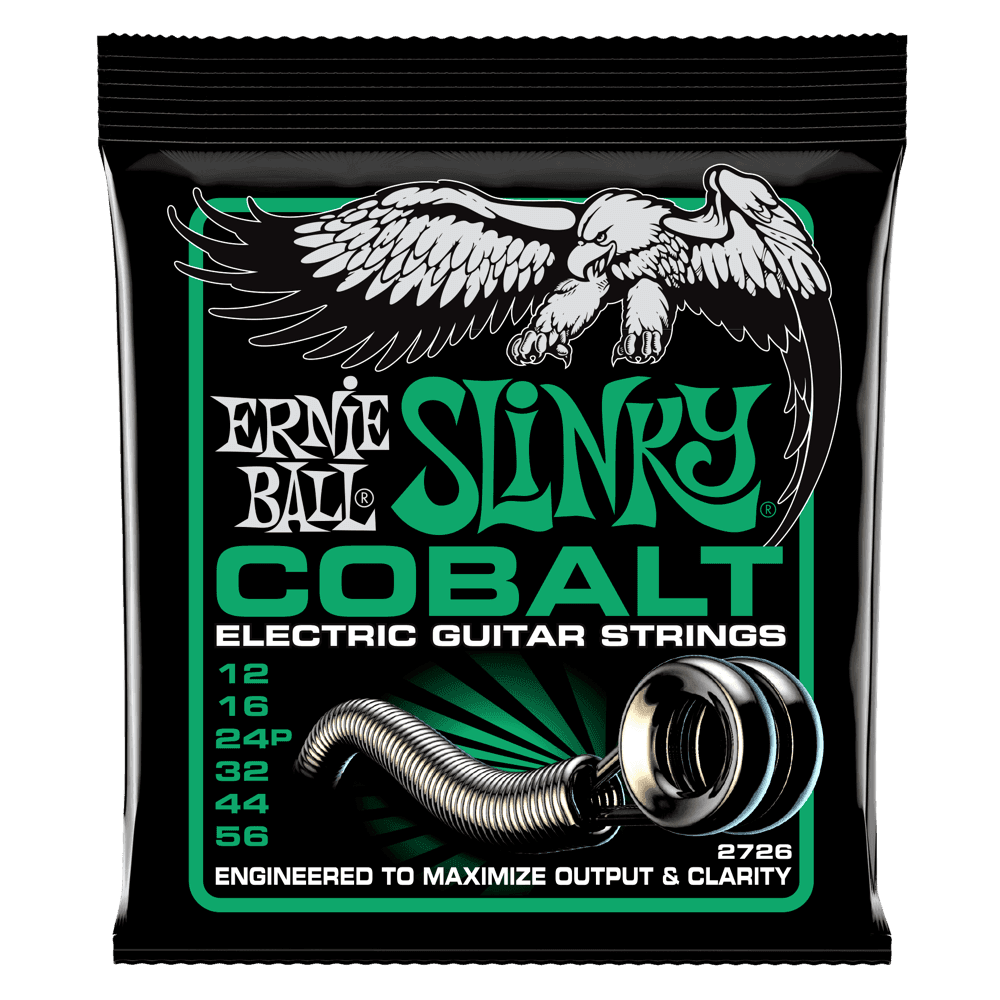
Not Even Slinky Cobalt (.012–.056)
Why this one: Malcolm's own Gibson set is discontinued with no current listing. This is the closest widely available set by raw gauge, .012-.056 outer strings, though it's cobalt-wrapped rather than plain nickel and built with drop tunings in mind rather than the standard tuning Malcolm actually used it in.