Kurt Cobain's guitar strings: the Nirvana rig, sourced
Documented string gauges and guitars Kurt Cobain played in Nirvana: Dean Markley 2504 Light Top/Heavy Bottom (.010–.052), the Fender Mustang and Jaguar, and the Jag-Stang he co-designed. Receipt-sourced.
Nirvana · written with AI help · updated
Kurt Cobain's most-documented string set was Dean Markley 2504 Light Top/Heavy Bottom (.010-.052), confirmed by a 1990 store receipt and his guitar tech's own gear notes. He also bought Dean Markley's lighter 2502 (.009-.042) at least once. Both are discontinued today; Dean Markley's current Blue Steel Light Top/Heavy Bottom (.010-.052) is the closest same-brand replacement. His guitars were budget Fender Mustangs and Jaguars, plus the Jag-Stang he co-designed with Fender's Custom Shop.
Who Kurt Cobain is
Kurt Cobain was the founding guitarist, lead vocalist, and primary songwriter of Nirvana, the band he started in Aberdeen, Washington in 1987 with bassist Krist Novoselic. Drummer Dave Grohl joined in 1990, completing the lineup that recorded Nevermind (1991) and In Utero (1993). Nirvana's commercial breakthrough is widely credited with pushing grunge and alternative rock into the mainstream, and Cobain became, whether he wanted the job or not, the reluctant face of that shift. He died in April 1994 at age 27.
He wrote quiet-loud-quiet songs built on simple, powerful chord shapes, and he played them on some of the cheapest guitars Fender ever made. That combination, unglamorous gear pushed through a short pedal chain, is a big part of why Nirvana's records still sound raw instead of polished.
What he played
Dean Markley 2504 Light Top/Heavy Bottom strings (.010–.052) on Fender Mustangs and Jaguars, mostly in standard tuning, through a short pedal chain built around a Boss DS-1 distortion and an Electro-Harmonix Small Clone chorus.
The documented rig, sourced
- Strings
- Dean Markley 2504 Light Top/Heavy Bottom (.010–.052), confirmed by a 1990 store receipt and his tech's own gear notes. Long discontinued; Dean Markley's current Blue Steel LTHB (.010–.052) is the closest same-brand match.
- Main guitars
- 1969 Fender Competition Mustang (Lake Placid Blue) and a heavily modified 1965 Fender Jaguar, both cheap-by-design Fender models he preferred over anything more expensive.
- Self-designed signature
- Fender Jag-Stang, a Mustang/Jaguar hybrid he sketched himself in 1993. Fender's Custom Shop built it; the production version reached stores in January 1996, after his death.
- Amp and pedals
- Mesa/Boogie Studio preamp and Fender Bassman on Nevermind, plus a Boss DS-1 distortion and Electro-Harmonix Small Clone chorus, the source of the Come As You Are tone.
The exact 2504 and its lighter 2502 sibling are both long discontinued. Dean Markley's current Blue Steel Light Top/Heavy Bottom (.010–.052, SKU 2558) is the closest same-brand replacement: Buy on Amazon.
The Dean Markley strings, and the piano wire myth
Cobain's most-documented set is Dean Markley's 2504, a Light Top/Heavy Bottom design gauged .010, .013, .017, .030, .042, .052. A receipt from Music 6000, a shop in Lacey, Washington, dated July 18, 1990, shows him buying that exact set. His guitar tech at the time, Earnie Bailey, wrote in a 1996 equipment rundown that Cobain "used .010-.052 Dean Markley's (the red pack)," matching the packaging shown on that receipt. A second, undated receipt from the same shop shows Cobain also buying Dean Markley's lighter 2502 set (.009–.042) at some point, though there is no other evidence it was ever his main gauge.
The stranger claim comes from a January 1992 Musician magazine interview, where Cobain said this about his strings:
I use piano wire for guitar strings, 'cause it's a lot thicker. I buy it in bulk, in these big long tubes, and just cut it to the length of the guitar. They're thicker than the thickest guitar gauge that's available. I don't know what the thickness of 'em is anymore, I can't remember. I use a really thick E string, and then a smaller size A. A few of the others are guitar strings, I think I use Dean Markley because they're the cheapest.
Guitar historians, including the archive site Ground Guitar, treat this as an exaggeration that calcified into legend: piano wire does not fit standard tuning machines or nuts, and a heavier-than-average Dean Markley set achieves nearly the same low-string thump without the hassle. The receipt evidence backs the simpler explanation.
Both the 2504 and 2502 have been out of production for years. If you want the same light-top/heavy-bottom concept today, Dean Markley's Blue Steel line still makes an LTHB 10–52 set (SKU 2558), cryogenically treated rather than plain nickel, but the same gauge layout.
Why the cheap Fender rig worked
Cobain was not chasing boutique tone. Mustangs and Jaguars were the cheapest guitars in Fender's lineup through the 1960s and 70s, short-scale and comparatively unstable at the bridge, and considered student-grade instruments by working guitarists of his generation. He liked them anyway. "Out of all the guitars in the whole world, the Fender Mustang is my favorite," he told Guitar World in 1992, in the same interview where he complained about how hard Mustangs are to keep in tune.
The heavy-bottom Dean Markley gauge did real work here. A .052 low E under standard tuning carries more low-end thump than the .046 most rock players ran at the time, which matters on a guitar with a shorter 24-inch scale where lighter gauges can already feel loose. The .010 high E stayed light enough for the bends and single-note runs scattered through songs like "Come As You Are," so the set solved two problems, thin scale-length low end and playable high strings, with one gauge choice.
The rest of the sound came from restraint, not sophistication: one or two pedals at a time, a handful of amps swapped session to session, and a Small Clone chorus that producer Butch Vig has said he is still not sure how much made it to tape versus how much got added at mixdown. Nirvana's engineering was simple by design. The strings were one of the few constants underneath it.
Style signatures
Three things across Nirvana's catalog you can identify as Cobain's:
-
Loud-quiet-loud dynamics. Verses that barely move, choruses that detonate. The contrast that drives "Smells Like Teen Spirit" and the album sequencing on Nevermind became the most widely copied songwriting trick of the decade that followed.
-
Self-described non-technician. Cobain called himself "the anti-guitar hero" when Fender asked to put his name on the Jag-Stang, adding that he could barely play the things himself. His solos are short, melodic fragments rather than displays, closer to a second vocal line than a guitar showcase.
-
Guitars as disposable props. He bought a run of cheap Stratocasters and Japanese Strat-style copies specifically to destroy on stage, most famously the black Strat smashed at the end of "Endless, Nameless." That was a deliberate, budget-conscious extension of the band's anti-spectacle stance: wreck a guitar that cost a couple hundred dollars, not a vintage one.
Electric guitars
The core electric stable, sourced from Guitar.com's Nevermind gear feature, Mixdown's rundown, Fender's own Jag-Stang history, and Ground Guitar's archive.
Acquired circa 1990-91 · Left-handed · Lake Placid Blue
1969 Fender Competition Mustang
His most-photographed guitar, played left-handed with its competition racing stripes intact, mostly stock through its documented recording life. It later sold at auction for a reported $4.5 million.
Source: Guitar.com: the humble gear used by Kurt Cobain on Nevermind.
1965 · Sunburst · Heavily modded
Fender Jaguar
Neck DiMarzio PAF humbucker, bridge DiMarzio Super Distortion humbucker, swapped for a Seymour Duncan JB ahead of the 1993–94 In Utero tour. Schaller bridge and a single Gibson-style toggle in place of the stock phase switches. One of his most-used studio and live guitars.
Source: Guitar.com: the humble gear used by Kurt Cobain on Nevermind.
Designed 1993 · Fender Custom Shop · Released January 1996
Fender Jag-Stang
Cobain's own design: he photographed a Mustang and a Jaguar, cut the Polaroids in half, and asked Fender to build the mashup. Custom Shop builder Larry Brooks built a prototype, Cobain sent it back with notes, and Fender built a second version he used on a handful of European dates in early 1994, his last tour.
Source: Fender: Cobain's Brainstorm, the Jigsaw Story of the Jag-Stang.
Acoustic guitars
Gifted 1991 · Later returned to its owner
1953 Martin D-18 ("Grandpa")
Given to Cobain by his then-girlfriend Mary Lou Lord before the Nevermind tour. He carried it through the first part of that US tour; after their relationship ended, he returned it to her. The same guitar later passed through Elliott Smith's hands too.
Bought late 1993 · MTV Unplugged
1958/59 Martin D-18E
His own purchase, stock DeArmond pickup swapped for a Bartolini 3AV. Played at the November 1993 MTV Unplugged in New York taping, the performance most associated with Cobain's acoustic side. Sold at auction in 2020 for a reported US$6 million.
Bought 1989 · Junk-shop guitar · Strung as a 6-string
Harmony Stella H912 12-string
Bought secondhand for around $20 to $30 depending on the account, with several of its strings removed and the rest never replaced. Used on "Polly" and "Something in the Way" from Nevermind, tuned down a step and a half from standard. Cobain said he never bothered changing the strings and used duct tape to hold the tuning keys in place.
Source: Guitar.com, Mixdown Magazine.
Amps
In Utero sessions · MTV Unplugged
Fender Twin Reverb (1960s)
His preferred recording amp for In Utero and the Unplugged taping. A similar Twin Reverb reportedly saw use on Bleach as well, though it is unclear if it was the same physical unit.
Nevermind verses · Touring rig
Mesa/Boogie Studio Preamp + Crown Power Base 2
Bought just before the Nevermind sessions and used on both the album and the tour that followed. The Crown power amp was later swapped for a Crest 4801, which paired better with the Mesa preamp.
Source: Ground Guitar: what gear did Kurt Cobain use on Nevermind.
Nevermind choruses · Clean overdubs
Fender Bassman + Vox AC30
Producer Butch Vig's own account names both: the Bassman handled bigger, more saturated parts, and the AC30 covered the clean, chiming overdubs on the album.
Source: Guitar.com: the humble gear used by Kurt Cobain on Nevermind.
Live rig · 2 to 8 cabinets depending on the room
Marshall 1960A / 1960AC cabinets
Loaded with Celestion G12M Greenbacks or Vintage 30 speakers depending on the show. Cobain reportedly disliked Marshall as a brand and covered the amp logos with gaffer tape.
Effects
Used since early 1990 · Nevermind and its tour
Electro-Harmonix Small Clone
The watery chorus behind "Come As You Are" and the pre-chorus buildup on "Smells Like Teen Spirit." Producer Butch Vig has confirmed both uses directly.
Main Nevermind distortion · Later swapped for the DS-2
Boss DS-1 Distortion
Tone knob near 10 o'clock, distortion around 4, level maxed. He called it the Roland EF-1 in interviews and said he went through about five a tour. Switched to the Boss DS-2 Turbo Distortion after Nevermind.
Source: Ground Guitar: what gear did Kurt Cobain use on Nevermind.
"Lithium"
Electro-Harmonix Big Muff Pi
Used for the darker, fuzzed-out tone on "Lithium," per Ground Guitar's song-by-song breakdown of the Nevermind sessions.
Source: Ground Guitar: what gear did Kurt Cobain use on Nevermind.
Strings
The historical set, and the closest thing you can buy today.
Documented 1990-1994 · Discontinued
Dean Markley 2504 Light Top/Heavy Bottom (.010–.052)
His most-documented set: a July 18, 1990 receipt and his tech's own 1996 equipment notes both point to this exact gauge. Long out of production, with no current retailer listing.
Current production · Closest same-brand match
Dean Markley Blue Steel LTHB (.010–.052)
Same Light Top/Heavy Bottom gauge layout as the discontinued 2504. Cryogenically treated steel instead of plain nickel, Dean Markley's current take on the same idea.
Picks
Most-used gauge
Dunlop Tortex Standard .60mm (Orange)
His most-documented pick gauge, per Ground Guitar's gear archive and Mixdown's rundown of his rig.
If you want this rig
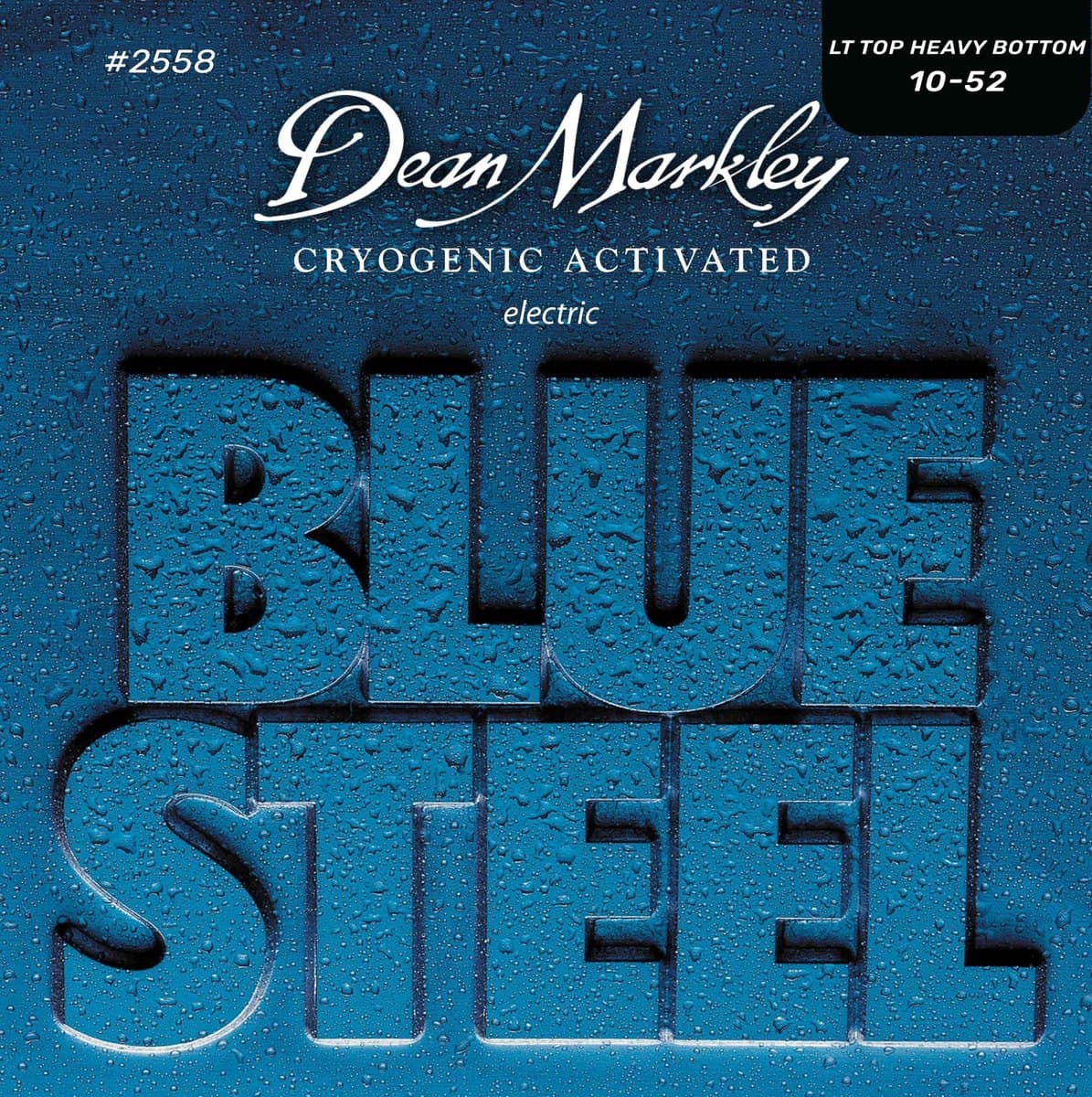
Blue Steel Light Top/Heavy Bottom (.010–.052)
Why this one: The closest current Dean Markley equivalent to Cobain's discontinued 2504: the same Light Top/Heavy Bottom gauge layout, cryogenically treated steel instead of the original's plain nickel wrap.