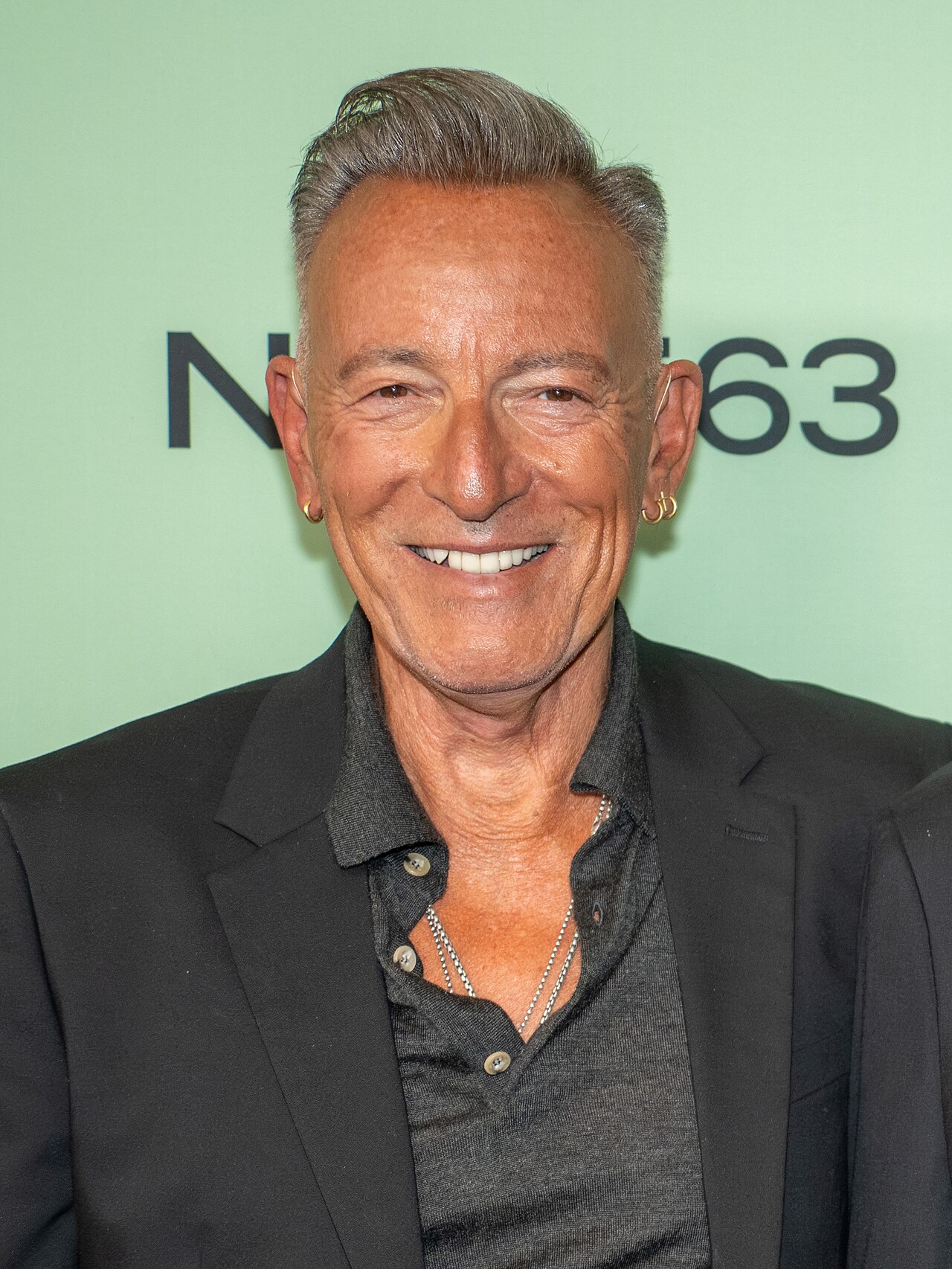
Bruce Springsteen's guitars and gear: the Mutt, the E Street Band rig, sourced
Documented guitars, amps, and rig details for Bruce Springsteen: the $180 Fender 'Mutt' Esquire/Telecaster from Born to Run, his Gibson SJ-200 acoustic, and the amps behind five decades of E Street Band shows. With citations.
E Street Band · written with AI help · updated
Bruce Springsteen's signature instrument is 'the Mutt,' a 1953-54 Fender with a Telecaster body and an Esquire neck he bought for $180 (he has also quoted $185 himself) from New Jersey luthier Phil Petillo in 1972. It is the guitar on the Born to Run cover. He retired it from full-time touring in the mid-2000s and now plays exact clones live, still recording with the original and bringing it out for occasions like the 2009 Super Bowl halftime show. His main acoustic is a 1958 Gibson SJ-200, used on Nebraska (1982) and gifted by E Street Band crew; he also plays a Takamine EF341SC live. Springsteen has never publicly documented his own string gauge or brand.
Who Bruce Springsteen is
Bruce Springsteen, born September 23, 1949, in Freehold, New Jersey, has fronted the E Street Band since 1972. Twenty-one studio albums across six decades run from Born to Run (1975) through Darkness on the Edge of Town (1978), Nebraska (1982), and Born in the U.S.A. (1984), and into a catalog few rock songwriters can match for sheer working-class narrative range. He's not a technical guitarist in the shred sense. He's a rhythm player first, and one of the best: hard, direct, and percussive, closer in function to a drummer's pulse than a lead player's showcase.
The E Street Band's live reputation is built on stamina as much as songwriting. Three-and-a-half-hour shows are routine, and the 2023-2025 tour grossed close to $730 million worldwide, the highest-grossing tour of Springsteen's career and one of the top ten highest-grossing tours ever. Founding saxophonist Clarence Clemons, one of the band's most identifiable members, died in 2011.
What he plays
A hybrid Fender he calls "the Mutt" on electric, a 1958 Gibson SJ-200 and a Takamine EF341SC on acoustic, and Fender Bassman and Twin Reverb amps that stay out of the way of the guitar's own tone.
The rig, sourced
- Strings
- Not documented. Springsteen has never detailed his personal gauge or brand in a Fender, Gibson, or Rock and Roll Hall of Fame interview CYS could find.
- Main electric
- "The Mutt": a 1953-54 Fender with a Telecaster body and an Esquire neck, bought for $180-185 in 1972 from luthier Phil Petillo. The Born to Run cover guitar.
- Acoustics
- 1958 Gibson SJ-200 (Nebraska, 1982) and a Takamine EF341SC for live shows.
- Amps
- Fender Bassman and Twin Reverb for clean headroom, with an occasional Matchless DC-30 for bigger, more rock-leaning shows.
The Mutt: the guitar that became as famous as the songs
Springsteen's techs date the guitar to 1953 or 1954: a mismatched instrument with a Telecaster body and an Esquire neck. He bought it in 1972, shortly after signing with Columbia Records, from New Jersey luthier Phil Petillo. Per Fender's own account of the guitar's history, it had already been modified once before it reached him: originally owned by a record company and wired with four pickups so session players could bill four times over for one part, which meant extra wood was routed out beneath the pickguard, leaving the body noticeably lighter. Petillo then added his own hot-wound single-coil pickups, his patented triangular Petillo Precision Frets, and a titanium six-saddle bridge.
Springsteen has quoted two different prices for it over the years, both in his own words. Fender's own history puts it at $180. In a 2021 appearance on The Late Show, he told Stephen Colbert he paid $185 "on Highway 34, I think, in Belmar, New Jersey." Either figure is a remarkable price for the instrument that ended up on the cover of Born to Run and, by extension, one of the most photographed guitars in rock.
"I wanted a Telecaster because I had played a Telecaster when I was younger," Springsteen told the Rock and Roll Hall of Fame, per Fender's article. "It was a versatile instrument. It was a light instrument. I wasn't playing heavy rock and roll anymore. I was playing something that was tilting more to soul music, and so I wanted a guitar that could handle the funk and that feeling." He eventually retired it from full-time road duty in favor of exact clones, but he still records with the original and has brought it out for occasions like the Super Bowl XLIII halftime show in 2009. "This feels like my arm," he told Colbert. "If I have this guitar, it's like I don't have anything on."
Why this fits the rig
The Mutt's history explains its tone as much as its story does. The four-pickup routing that came before Springsteen owned it left the body hollowed out under the pickguard, which is exactly the kind of accidental weight-saving that turns into a decades-long touring advantage: a lighter guitar is a kinder guitar across a three-and-a-half-hour show. Petillo's hot-wound single coils and titanium bridge push the output and attack higher than a stock Esquire's, giving Springsteen's rhythm strumming the "crisp, raw, assertive" cut that Gearnews.com's rundown of his gear describes, enough to drive a full E Street Band arrangement (piano, sax, glockenspiel, second guitar) without leaning on pedals to get heard.
The amp side backs the same idea. Fender Bassman and Twin Reverb are clean-headroom platforms, not gain machines. They let the Telecaster's own natural brightness do the work, which fits a player whose stated goal was always a "versatile, light instrument" rather than a wall of tone-shaping gear.
Style signatures
Three things that separate Springsteen's guitar playing from his more virtuosic classic-rock contemporaries:
-
Rhythm as the engine, not the foundation. Per Gearnews.com, "he acts like an engine that propels the songs forward, classically the role of the drummer." Springsteen's chords aren't a backdrop for a lead player to sit on top of. On most E Street Band arrangements, his right hand is doing the job a drummer's kick-and-snare pattern would do in a leaner rock band.
-
Minimalism over virtuosity. Springsteen rarely takes long solos, and for most of his career his live pedalboard has stayed close to empty. Albums like Darkness on the Edge of Town and Nebraska get their power from restraint, not from technical display.
-
The guitar as a visual symbol. The Mutt's worn, road-battered look, generic four-pickup routing turned into a lightweight, one-of-a-kind body, became as recognizable as any signature-model instrument, without Springsteen ever putting his name on a production model.
Electric guitars
Acquired 1972 · Nickname "the Mutt" · $180-185
1953-54 Fender Telecaster body / Esquire neck
Bought from New Jersey luthier Phil Petillo shortly after Springsteen signed with Columbia Records. Petillo fitted hot-wound single-coil pickups, his own triangular Precision Frets, and a titanium six-saddle bridge. The guitar on the Born to Run cover, retired from full-time road use in the mid-2000s in favor of exact clones; Springsteen still records with the original.
Source: Fender, Iconic Mods: Springsteen's 'Boss' 1950s Esquire; MusicRadar, 2021.
Gearnews.com's rundown of Springsteen's gear also reports a Fender Stratocaster used mainly on the 1980s Born in the U.S.A. tour and a Gibson Les Paul reached for in the studio for a fuller, more sustain-rich tone. CYS has not independently corroborated either claim beyond that one source, so they're noted here rather than given their own cards.
Acoustic guitars
1958 model · Gift from E Street Band crew
Gibson SJ-200 (J-200)
Given to Springsteen by E Street Band crew members Mike Batlan, Marc Brickman, and Bob Chirmside. The acoustic most closely associated with the stark, home-recorded Nebraska (1982). Gibson built a full SJ-200 reissue collection around this guitar in 2025 for the Deliver Me From Nowhere biopic, with lead actor Jeremy Allen White playing several of the reissues on screen.
Source: Consequence, Nov. 6, 2025.
Live workhorse
Takamine EF341SC
Springsteen's documented acoustic-electric for live shows, chosen in part for a pickup system built to translate through arena and stadium PA rigs rather than fight them.
Source: Gearnews.com, Oct. 7, 2025.
Amps
Clean-headroom primary
Fender Bassman and Twin Reverb
The most consistently documented amps in Springsteen's rig. Both are built for clean headroom rather than built-in gain, letting the Telecaster's natural brightness carry the tone instead of an amp voicing on top of it.
Source: Gearnews.com, Oct. 7, 2025.
Occasional addition · Bigger shows
Matchless DC-30
Brought in for larger, more rock-leaning stadium dates when the Fender-based clean rig needs more push. CYS has not found current, first-hand confirmation of Springsteen's exact present-day amp lineup and gear-tracking sites don't fully agree here, so treat this as a documented past configuration rather than tonight's setup.
Source: Gearnews.com, Oct. 7, 2025.
Strings
Springsteen is the rare classic-rock icon whose exact string choice was never pinned down in the press. His guitars and amps are extensively documented; his strings aren't. Rather than invent a gauge, here are the closest honest reference points, tied to his own description of what he wants from an instrument.
Not a confirmed personal spec · Electric reference
Ernie Ball Super Slinky (.009-.042)
A light, flexible nickel-wound set that matches the "versatile, light instrument" description Springsteen gave of the Esquire itself. Not a claim about his actual current gauge, which CYS could not find documented anywhere.
Not a confirmed personal spec · Acoustic reference
D'Addario EJ16 Phosphor Bronze Light (.012-.053)
The standard light phosphor-bronze gauge most jumbo-body acoustics like the SJ-200 ship strung with. Not a documented personal choice for Springsteen's own SJ-200 or Takamine.
If you want this rig
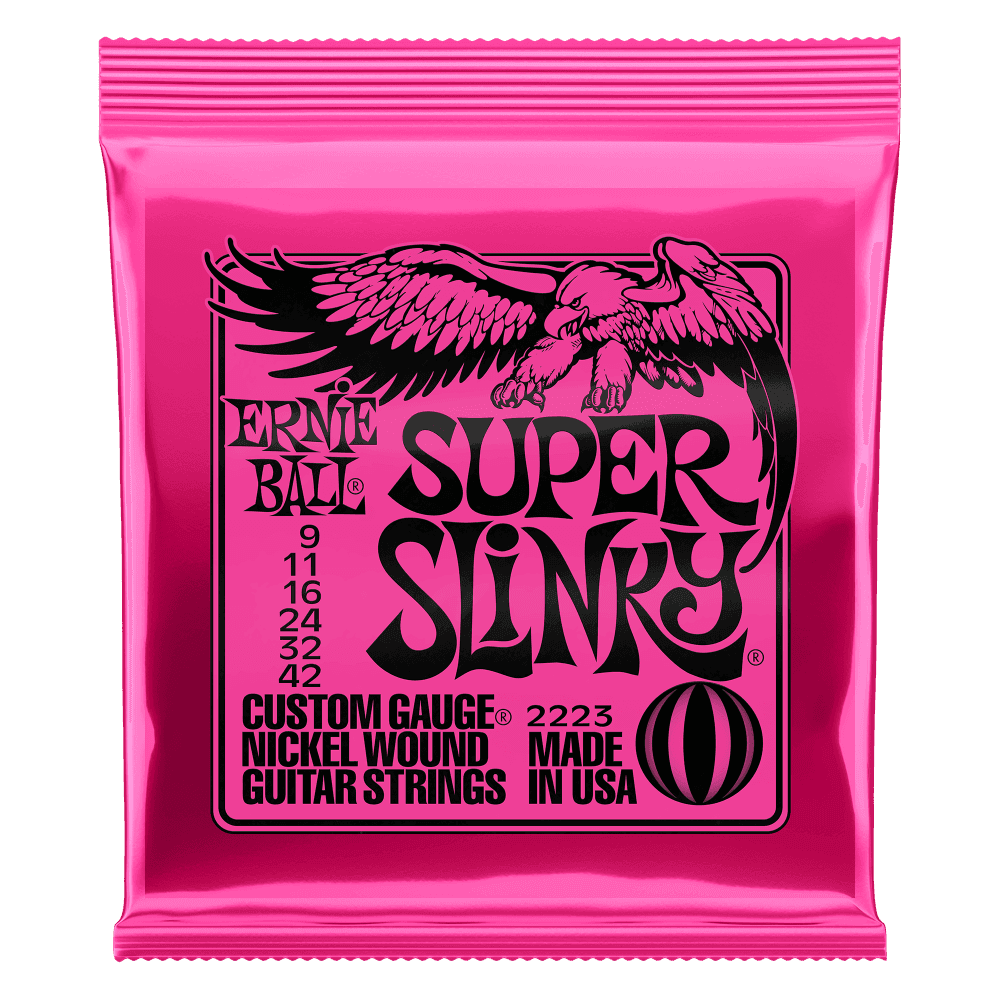
Super Slinky (.009-.042)
Why this one: Not Springsteen's confirmed personal gauge, which isn't documented anywhere CYS could find. The closest honest match to the light, versatile electric feel he's described wanting from the Mutt.