Ernie Ball Super Slinky Cobalt Bass (.045–.100): the Cobalt line's all-purpose 4-string gauge
Written with AI help · Updated
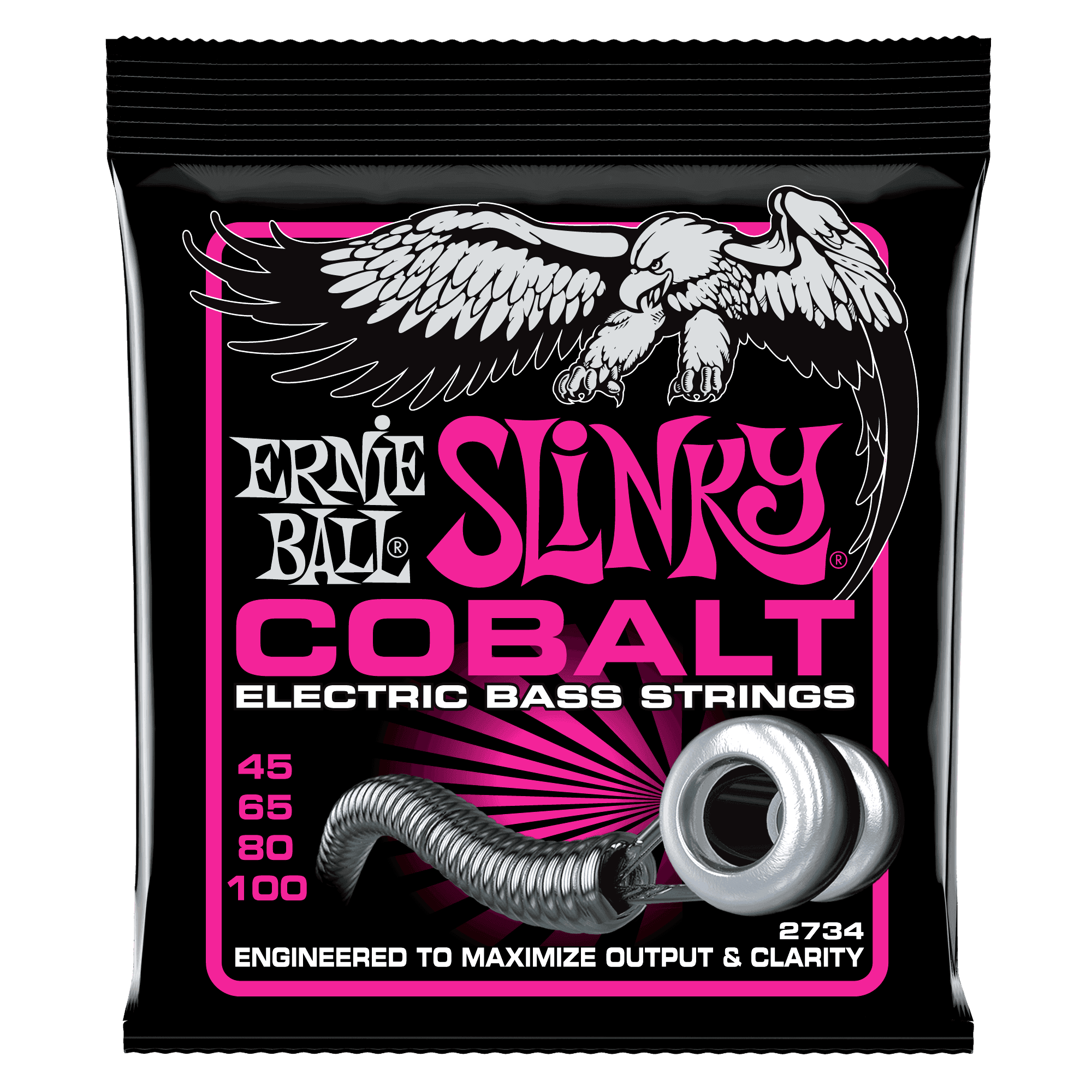
Ernie Ball 2734 Super Slinky Cobalt Bass strings run .045, .065, .080, .100, the all-purpose middleweight in Ernie Ball's 4-string Cobalt bass line. Cobalt alloy replaces nickel-plated steel on the wrap, which Ernie Ball markets for more output and a brighter, more articulate voice through a passive pickup, because cobalt is more magnetic. Pick it for standard-tuned rock, funk, and hard rock that wants Cobalt bite with balanced, everyday tension.
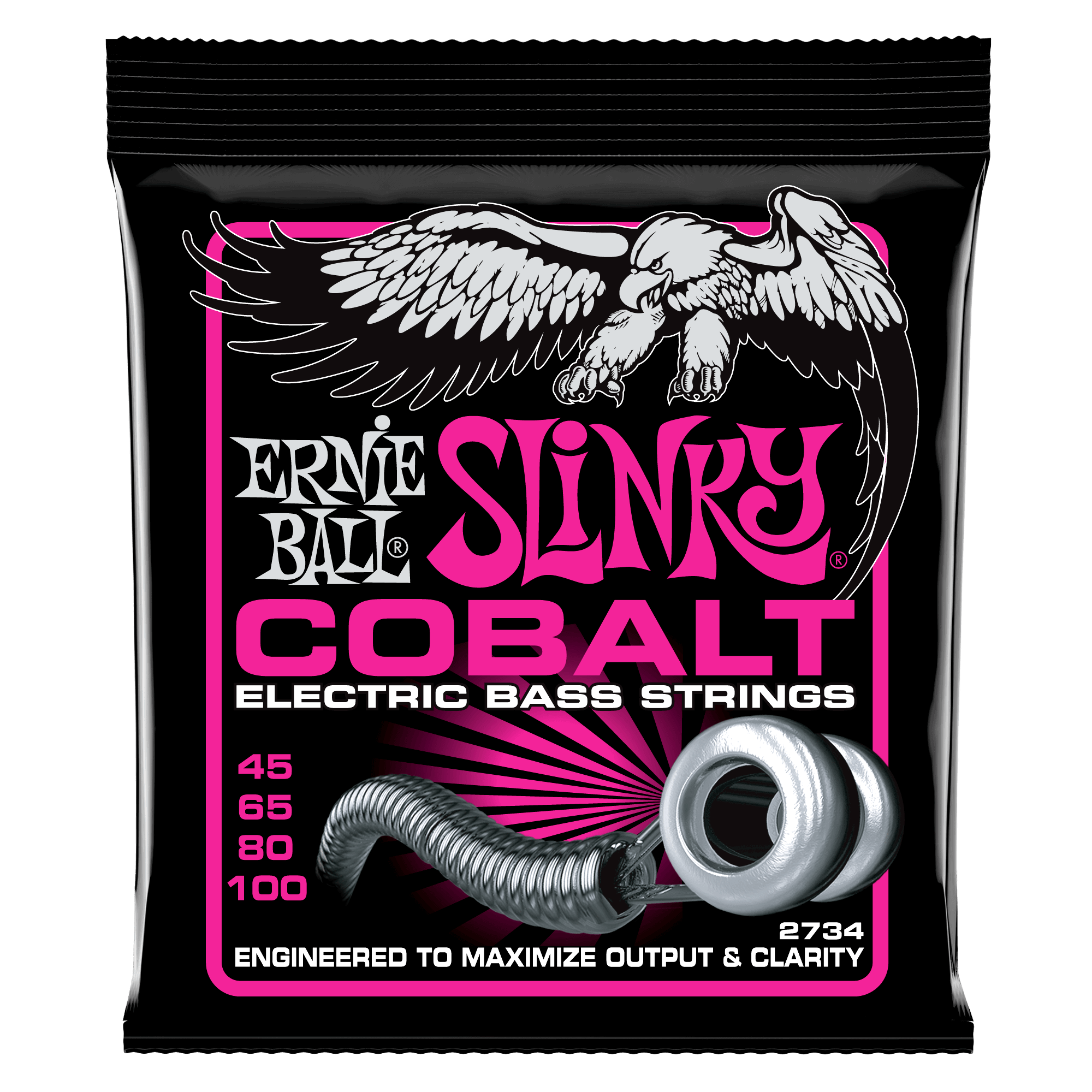
What this set is
Ernie Ball's Super Slinky Cobalt Bass takes the brand's all-purpose 4-string bass gauge, .045 to .100, and winds it in a cobalt alloy instead of nickel-plated steel. Ernie Ball's own product page describes the Cobalt line as engineered "to maximize output and clarity," giving bassists "an extended dynamic range, incredible harmonic response, increased low end, and crisp, clear highs," with cobalt creating "a stronger magnetic relationship between pickups and strings than any other alloy previously available."
It's a straight alloy swap on the middleweight gauge most bassists reach for first. The cobalt wrap is more magnetic than nickel-plated steel, which is why Ernie Ball positions the whole Cobalt family for higher output and a brighter, more articulate voice through a passive pickup. That's a tonal descriptor, not a paid-artist claim: no bassist is independently confirmed on this exact .045 to .100 Cobalt gauge, so treat the voicing claims as Ernie Ball's own positioning.
Super Slinky sits just below the middle of Ernie Ball's 4-string Cobalt bass family, which runs Extra Slinky (.040–.095), Super Slinky (.045–.100, this set), Hybrid Slinky (.045–.105), Regular Slinky (.050–.105), and Power Slinky (.055–.110). Ernie Ball also ships 5-string Cobalt bass gauges for extended-range instruments.
Cobalt is a deliberate upgrade path, not a beginner tier. Ernie Ball prices it above the standard nickel Slinky bass line and aims it at players who already know their preferred gauge and want a different pickup response out of it. Super Slinky Cobalt Bass is the pick when you want the most versatile tension in the Cobalt line, light enough for fast playing, firm enough to dig in, with the alloy's extra bite layered on top.
Anatomy
- Model
- Ernie Ball 2734 Super Slinky Cobalt Bass
- MPN
- P02734
- Gauge
- .045 – .100 (Super Slinky)
- Gauge set
- .045, .065, .080, .100
- String count
- 4 strings
- Core wire
- Tin-plated hex steel
- Wrap wire
- Cobalt alloy
- Coating
- None, uncoated
- Winding
- Standard roundwound
- Intended scale
- Long scale, Ernie Ball's standard 4-string bass length
- Intended tunings
- E standard primary; also handles Eb standard
- Package
- Single pack
Cobalt vs nickel: the tone difference
Voicing through a passive pickup
- Output
- Cobalt alloy is more magnetic than nickel-plated steel, so it drives a passive pickup harder. Ernie Ball's claim: a stronger magnetic relationship with pickups than any other alloy the company has shipped.
- Voice
- Brighter and more articulate than the equivalent nickel gauge, with extended dynamic range. Ernie Ball markets the Cobalt line for crisp, clear highs across all four wound strings.
- Low end
- Ernie Ball markets the Cobalt bass line for increased low end alongside the output bump, useful for cutting through a dense mix without extra EQ, even on a middleweight .100 low string.
- Bend feel
- Ernie Ball describes the Cobalt wrap as wound for added flexibility, marginally softer under a fretting finger than the equivalent nickel gauge at the same .045 to .100 spread.
For the broader tradeoff between wrap-wire alloys on bass, see nickel vs steel bass strings. The measured Cobalt-versus-nickel voicing shift is documented on Ernie Ball's guitar Cobalt line; the wrap alloy and Ernie Ball's marketing claims carry over to bass, but CYS hasn't independently measured bass-specific numbers.
Where this sits in Ernie Ball's Cobalt bass family
| Extra Slinky Cobalt | Super Slinky Cobalt (this set) | Hybrid Slinky Cobalt | Regular Slinky Cobalt | |
|---|---|---|---|---|
| Gauge | .040-.095 | .045-.100 | .045-.105 | .050-.105 |
| Gauge set | .040/.060/.070/.095 | .045/.065/.080/.100 | .045/.065/.085/.105 | .050/.070/.085/.105 |
| Low string | .095 | .100 | .105 | .105 |
| Feel | Lightest, fastest | All-purpose middleweight | Same top, heavier low | Standard-tuning default |
Super Slinky and Hybrid Slinky share the identical .045 top string; the difference is below it. Super runs .065, .080, .100, while Hybrid keeps the .045 top but steps up to a .105 low E for more standard-tuning weight. If you want a thicker low end without touching the top string, Hybrid Slinky Cobalt Bass is the move; for a lighter, faster set, drop to Extra Slinky Cobalt Bass.
The nickel counterpart: same gauge, different alloy
Ernie Ball's standard nickel Slinky bass line runs the same all-purpose .045 to .100 gauge without the Cobalt wrap-wire upcharge. Everything true about the nickel set's tension and playability carries over here, because Cobalt changes only the wrap wire, cobalt alloy instead of nickel-plated steel, not the tension profile. A bass already set up for the nickel Super Slinky gauge takes this Cobalt set with no adjustment.
What you gain is the alloy's output and articulation bump. What you pay for it is a higher per-set price and the same uncoated wear curve. No bassist is independently confirmed on the Cobalt version of this specific gauge as of this review, so read the tone claims as Ernie Ball's own manufacturer positioning until a documented player surfaces. For the deeper alloy tradeoff, see nickel vs steel bass strings.
Best for
- All-purpose standard-tuned bass. The .045 to .100 spread is the most versatile tension in the Cobalt bass line, light enough for fast fingerstyle, firm enough to dig in with a pick.
- Passive-pickup basses. The magnetic-response claim behind Cobalt's voicing shift matters most on a passive pickup; an active preamp already adds its own gain and EQ, so some of the Cobalt bump gets masked by the preamp's coloring.
- Rock, funk, and hard rock that wants Cobalt's brightness and articulation with everyday, balanced tension rather than a heavy set.
Worst for
- Heavy or drop tuning. The .100 low string is a standard-tuning gauge. For Drop D and below, step up to Power Slinky Cobalt Bass (.055–.110).
- Players who want the thickest low end in the line. A .100 low E sits between the light Extra set and the standard .105 sets. If you want more weight, the Regular Slinky Cobalt Bass .105 low string hits harder.
- Players chasing maximum string life. Cobalt is uncoated, same wear curve as any uncoated roundwound; Ernie Ball's own longevity line is Paradigm (Everlast nano-treatment), not Cobalt.
Install and break-in
Because this is Ernie Ball's all-purpose gauge, a bass already set up for a standard nickel Super Slinky bass set takes it as a straight swap with no setup changes. Coming off a heavier .050 to .105 set, expect slightly lower tension and a light relief check. Break-in runs about the same as any fresh roundwound, 15 to 20 minutes of playing before the top end settles. Stretch each string, pull up gently a few times, retune, repeat, before a gig or session. New to restringing a bass, see how to change bass strings.
Verdict
Super Slinky Cobalt Bass is the most versatile set in Ernie Ball's 4-string Cobalt bass line, .045 to .100 rewound in cobalt alloy for more output and a brighter, more articulate voice than nickel-plated steel. It's the pick when you want everyday, balanced tension with the alloy's extra bite layered on top, the natural starting point in the Cobalt bass family.
If you want more low-end weight, the Hybrid Slinky Cobalt Bass (.045–.105) keeps this top string and steps up the low E, and the Regular Slinky Cobalt Bass (.050–.105) is the heavier standard-tuning default. For a lighter, faster set, drop to Extra Slinky Cobalt Bass (.040–.095).
Related
Related