Ernie Ball Stainless Steel Flatwound Light (.011–.050): the other traditional jazz flat
Written with AI help · Updated
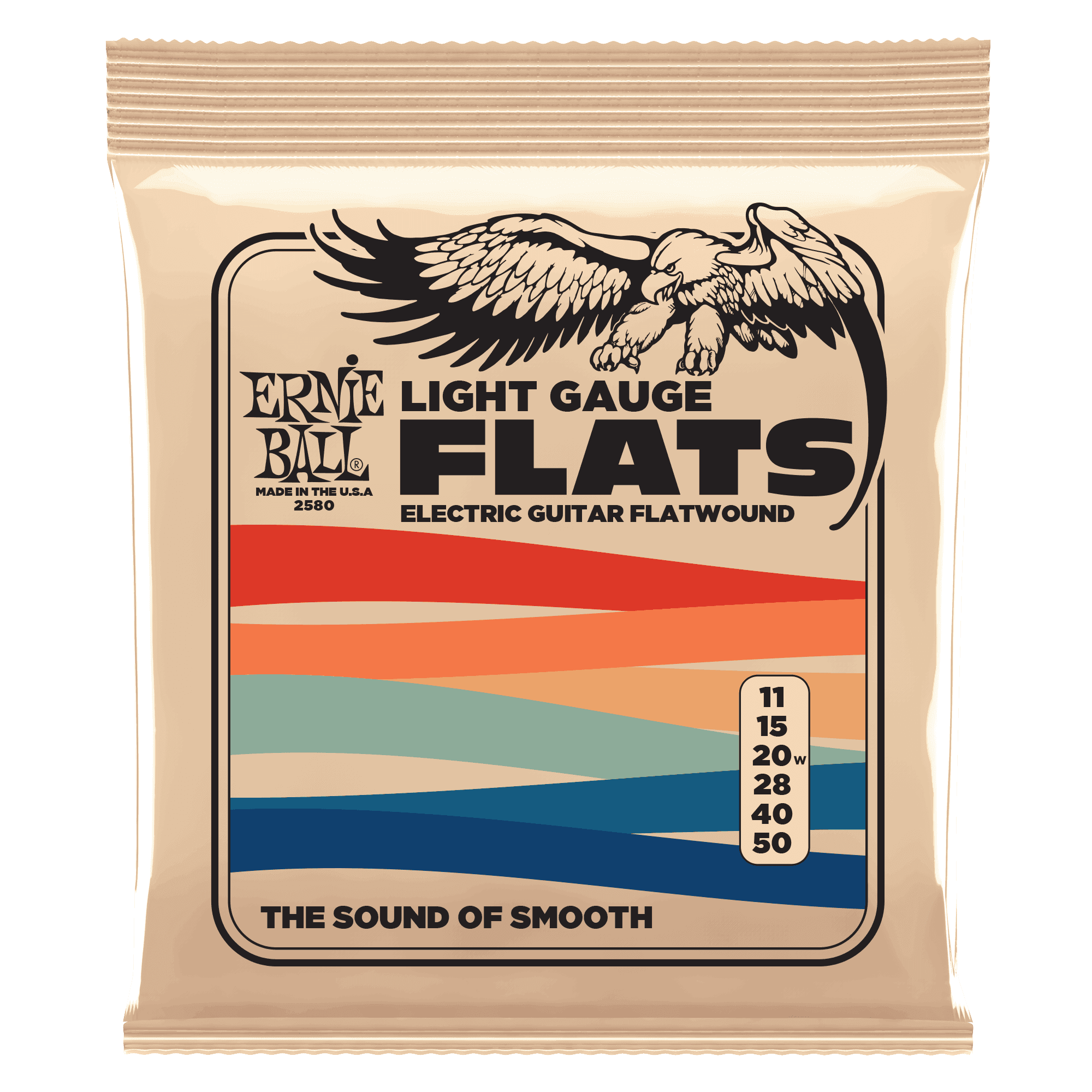
Ernie Ball Stainless Steel Flatwound Light (.011 to .050) is Ernie Ball's traditional flatwound electric guitar string: a tin-plated steel hex core wrapped in polished stainless steel ribbon for a warm, dark, vintage tone with minimal finger noise. Ernie Ball markets it toward jazz and session players, the same lane as D'Addario's XL Chromes, though the two brands' middle-string gauges differ even at the same nominal 11-50 spec. Uncoated.

What this set is
Ernie Ball Stainless Steel Flatwound is the company's traditional flatwound electric guitar string: a tin-plated steel hex core wrapped in a stainless steel ribbon, polished to what Ernie Ball's own product page calls a "smooth glass-like finish." Light is the .011 to .050 gauge, the same nominal spec jazz players already know from D'Addario's XL Chromes ECG24.
Ernie Ball frames the tone the same way every traditional flatwound maker does: warm, dark, and vintage-leaning, with the finger and slide noise of a roundwound set almost entirely gone.
Ernie Ball's own copy pitches the set at the same warm, dead jazz tone every traditional flatwound targets.
The resulting sound is vintage-inspired with a dark, smooth fundamental.
Official Stainless Steel Flatwound product description
Unlike D'Addario, whose Chromes marketing names blues guitarist Gary Clark Jr and jazz guitarist Pat Metheny directly, Ernie Ball's own page doesn't attach a specific artist to Stainless Steel Flatwound. It only frames the set generally, calling it a favorite among "Jazz players and session recording artists alike." That's a real difference in how the two brands sell what is, on paper, a very similar product, and it's worth knowing before you see a specific-artist claim for this set somewhere else online.
Anatomy
- Model
- Ernie Ball Stainless Steel Flatwound, Light
- Gauge
- .011 – .050 (Light)
- Gauge set
- .011, .015, .020, .028, .040, .050 (wound from the G string down)
- String count
- 6 strings
- Core wire
- Tin-plated steel hex core
- Wrap wire
- Stainless steel ribbon, flatwound and polished
- Coating
- None, uncoated
- Winding
- Flatwound, polished smooth
- String tension
- Not published by Ernie Ball for this set, unlike D'Addario's published Chromes tension chart
- Intended tunings
- E standard
- Other gauge in this line
- Medium-Light .012 – .052 (SKU P02582)
- Pack sizes
- Single (P02580)
Ernie Ball's own two flatwound lines, compared
Ernie Ball sells two genuinely different flatwound electric families, not one, and it's easy to grab the wrong one if you're only skimming a search result. Stainless Steel Flatwound, this page, is the traditional flat: a stainless ribbon wrap, a wrapped G string, and a heavier .011-.050 gauge built for a dark, dead jazz tone. Slinky Cobalt Flatwound is a hybrid: a cobalt ribbon wrap, a plain G string, and Ernie Ball's lighter, familiar .010-.046 Regular Slinky numbers, aimed at rock and blues players who want a quieter string without losing the ability to bend.
| Stainless Steel Flatwound (this set) | Slinky Cobalt Flatwound | D'Addario XL Chromes ECG24 | |
|---|---|---|---|
| Wrap alloy | Stainless steel ribbon | Cobalt alloy ribbon | Stainless steel ribbon |
| Gauge | .011–.050 | .010–.046 | .011–.050 |
| G string | Wrapped, .020 | Plain, .017 | Wrapped, .022 |
| Voicing | Warm, dark, traditional jazz | Brighter, Slinky-like, rock and blues | Warm, dead, mellow, traditional jazz |
| Best known for | Traditional jazz and session work | Rock and blues players curious about flatwound | The flatwound set most jazz guitarists picture first |
If you already play a nickel Regular Slinky and just want less finger noise without relearning your bends, Cobalt Flatwound is the easier on-ramp. If you want the full traditional flatwound experience, wrapped G string and all, Stainless Steel Flatwound is the one to reach for, and it's the set that actually competes with Chromes on Ernie Ball's own shelf.
The other traditional stainless flat
Set next to D'Addario Chromes, the gap is smaller than the gap to Cobalt Flatwound, but it isn't zero. Both are stainless steel ribbon flatwounds in the same nominal 11-50 gauge, both wrap the G string, and both are pitched at the same dark, traditional jazz tone. The construction language even overlaps: D'Addario's own site describes Chromes as built from "precisely flattened stainless steel wrap wire" over a hex core it says it pioneered, and Ernie Ball describes this set as a "stainless steel ribbon wrap" over a "tin-plated steel hex core."
| Stainless Steel Flatwound (this set) | D'Addario XL Chromes ECG24 | |
|---|---|---|
| Core wire | Tin-plated steel hex core | Hex high-carbon steel core, tin plating not specified |
| Wrap wire | Stainless steel ribbon | Stainless steel ribbon |
| Gauge | .011, .015, .020, .028, .040, .050 | .011, .015, .022, .030, .040, .050 |
| G / D strings | .020 / .028 wound | .022 / .030 wound, heavier |
| A string | .040 wound | .040 wound, same |
| Named artist tie | None published by Ernie Ball | Gary Clark Jr, per D'Addario's own product page |
| Published tension chart | No | Yes, on D'Addario's own site |
The two outer strings, the plain .011 high E and the wound .050 low E, are identical between the sets, and so is the wound A string at .040. The G and D strings are not: D'Addario runs .002 heavier on each, .022 and .030 against Ernie Ball's .020 and .028, which nudges Chromes toward slightly more tension and a marginally fuller midrange at the same nominal gauge name. Neither brand publishes a reason for the gap; it's simply how each company rounded its own flatwound spec.
The bigger practical difference is sourcing. D'Addario backs Chromes with a named artist, a published tension chart, and a long-running Pat Metheny origin story. Ernie Ball backs Stainless Steel Flatwound with neither, just its general jazz-and-session-player framing. That doesn't make the string worse. It makes it the quieter option in the flatwound conversation, the one you try because you already trust the Ernie Ball name or because you want a second opinion on the traditional-flat tone before committing to the market leader.
Best for
- Traditional jazz and archtop or hollow-body electrics where a dark, dead low end matters more than sustain or a bright attack
- Session and studio players who need the finger and slide noise of a roundwound set gone entirely
- Ernie Ball loyalists who want a traditional stainless flat without switching brands to D'Addario Chromes
- Anyone comparison-shopping the two market leaders in traditional stainless flatwound before buying either
Worst for
- Fast rock or metal lead lines: the stiffer flatwound feel and rolled-off top end fight against bends and bright articulation the way any traditional flat does
- Beginners still building finger strength: flatwound's heavier feel and this set's .011 gauge ask more of a new player than a .009 or .010 roundwound set
- Rock and blues players who still want easy bends: Ernie Ball's own Slinky Cobalt Flatwound keeps the G string plain specifically so you don't give that up
- Players who want a documented artist pedigree: D'Addario's Chromes carries a named, sourced player behind it; this set doesn't
Verdict
Stainless Steel Flatwound is Ernie Ball's answer to D'Addario Chromes, built to the same nominal 11-50 gauge with Ernie Ball's own tin-plated-core-and-stainless-ribbon construction. The G and D strings run a hair lighter than Chromes, and Ernie Ball doesn't back it with a named player or a published tension chart the way D'Addario does. What it does offer is a legitimate second traditional flatwound option from a brand most electric players already trust, at the same gauge jazz guitarists expect.
If you're starting from zero and just want the flatwound most other jazz guitarists already own, Chromes is still the safer first buy. If you already play Ernie Ball strings elsewhere in your rotation, or you want to compare two traditional flats before settling on one, this is the one to try next to it.
Related
Related