Fender Custom Shop Recreates George Harrison's 1967 Bass VI
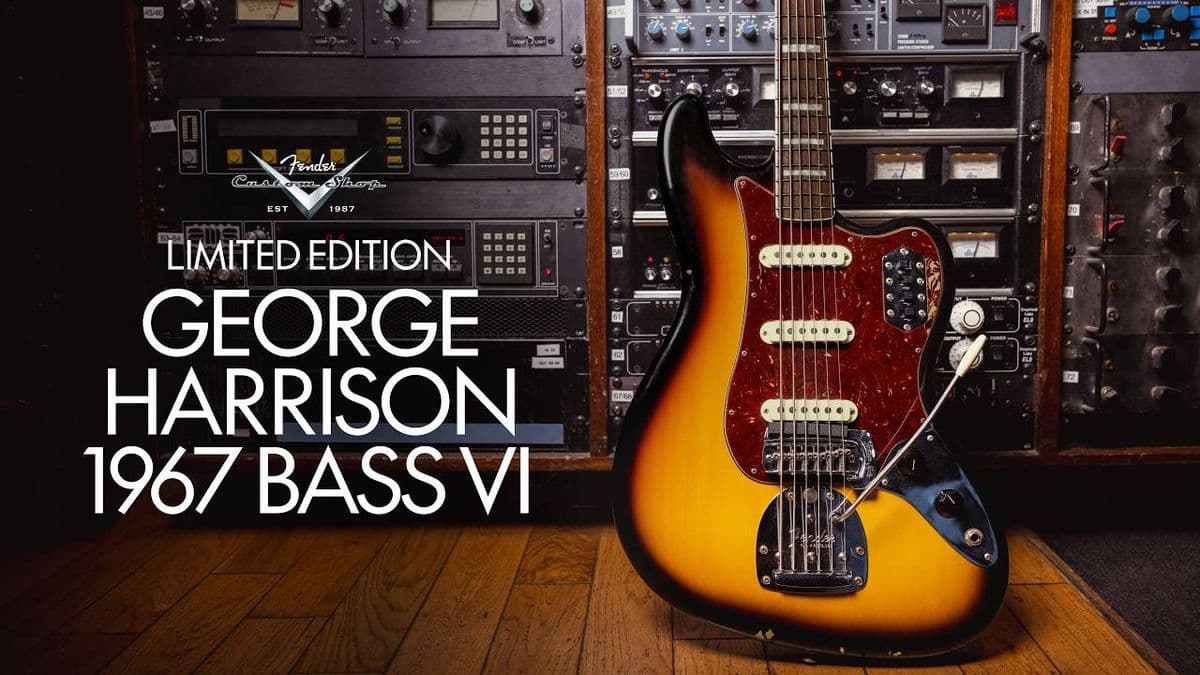
Fender's Custom Shop just recreated the sunburst Bass VI George Harrison used at Abbey Road. It ships with a different string spec than his original ever had, and no Bass VI, vintage or new, takes a normal guitar or bass set.
By Lowe, Bass desk · Edited by Cadence ·
 George Harrison
Fender Custom Shop unveiled a Limited Edition George Harrison 1967 Bass VI on August 25, 2026: a $9,500 recreation of the sunburst six-string bass Harrison used at Abbey Road Studios. It ships strung .025 to .095 in stainless steel, different from Fender's original 1961 to 1975 factory spec of .024 to .100 nickel wound. Corona built, hand aged, three Jaguar style single coil pickups. Custom Shop dealers only, no Amazon listing.
What Fender just built
On August 25, 2026, the Fender Custom Shop unveiled the Limited Edition George Harrison 1967 Bass VI, a hand-built recreation of the sunburst Bass VI that Fender says Harrison acquired that year and used at Abbey Road Studios (Premier Guitar). It is built in Corona, California, Relic-aged to look decades-played, and priced at $9,500.
- Model
- Limited Edition George Harrison 1967 Bass VI
- Builder
- Fender Custom Shop, Corona, California
- Body
- Alder, Bleached 3-Color Sunburst Relic finish
- Neck/fretboard
- Bound 3A rosewood, 7.25 inch radius, 21 vintage frets
- Scale length
- 30 inch
- Pickups
- 3x Custom Shop hand-wound Jaguar-style single-coils
- Factory strings
- Fender Bass VI stainless steel, .025-.095
- Price
- $9,500 USD / £8,599 GBP / €10,099 EUR
- Availability
- Fender Custom Shop dealers, unveiled Aug 25, 2026
George Harrison's Bass VI holds a unique place in Fender history. It played a defining role in some of the most influential recordings ever made while showcasing the remarkable versatility of the Bass VI itself.
Director, Fender Custom Shop
George Harrison's actual Bass VI
Fender's own account is specific: Harrison acquired this sunburst Bass VI in 1967 and leaned on it at Abbey Road, where the instrument added melodic counterpoint and texture to tracks recorded during one of The Beatles's most experimental studio periods. That timeline lines up with Harrison's documented instrument rotation for the era, the Rosewood Telecaster, the Les Paul known as Lucy, and the rest of his catalog covered on his full CYS profile.
Wikipedia's Fender Bass VI page adds a useful, more specific detail, citing a Guitar Player feature on the gear behind the Beatles' Let It Be sessions: Bass VI parts on Beatles tracks where bassist Paul McCartney switched to piano or guitar were played by both Harrison and John Lennon, across The White Album, Abbey Road, and Let It Be. So the honest framing is that the Bass VI was a shared studio tool the guitarists reached for whenever McCartney stepped away from his bass, not a lead instrument credited to Harrison alone on every track. Fender's release focuses on the specific instrument Harrison owned; who actually played it on any given song is a separate, less-documented question.
What actually strings a Bass VI
A Bass VI is not a bass in the normal sense, and it does not take a normal bass or guitar set. Tuned E to E a full octave below standard guitar, on a 30-inch scale versus the 34-inch scale of a Precision or Jazz Bass, it needs its own dedicated six-string set, thicker than a guitar set and thinner than a four-string bass set, with ball ends sized for the Bass VI's own bridge and tailpiece.
Fender's own spec sheet for this new model lists .025 to .095 in stainless steel, but only the two end gauges are public so far, not the full six-string breakdown. That is a real departure from what Fender originally shipped on the Bass VI between 1961 and 1975: nickel wound strings gauged .024, .034, .044, .065, .080, and .100, under Fender's own part number 073-5350-000, according to Wikipedia's sourced spec box for the instrument.
| Original Fender VI (1961-1975) | 2026 Custom Shop tribute | D'Addario EXL156 (modern replacement) | |
|---|---|---|---|
| Gauge | .024 / .034 / .044 / .065 / .080 / .100 | .025-.095 (end gauges only, published) | .024 / .034 / .044 / .056 / .072 / .084 |
| Material | Nickel wound | Stainless steel | Nickel-plated steel, round wound |
| Available today | Discontinued Fender P/N, no longer sold | Ships stock on this model only | Yes, widely stocked, guitar-sized ball ends |
| Best for | Vintage-accuracy restorations | This specific 2026 reissue | Restringing any Bass VI, vintage or new |
Practically, that means a player who owns any other Bass VI, a vintage original, a Squier Vintage Modified or Classic Vibe, or Fender's own Vintera II reissue, is not shopping for this exact stainless set. The standard aftermarket answer is a dedicated Bass VI set like D'Addario's EXL156, a nickel wound .024-.084 round wound set built specifically for the instrument's scale and taper, with guitar-sized ball ends for a clean retrofit.
Who else has played a Bass VI
Harrison is far from the only name attached to the instrument. Wikipedia's Fender Bass VI page documents a long list of players who have reached for one over six decades: The Who's John Entwistle, Led Zeppelin's John Paul Jones, Red Hot Chili Peppers' John Frusciante, Cream's Jack Bruce, and Aerosmith's Joe Perry, who used a Bass VI to record "Back in the Saddle" on the band's Rocks album. The instrument's pitch, an octave below guitar but strung and played like one, keeps drawing guitarists who want a lower voice without switching to an actual bass.
Price and the honest catch
$9,500 puts this well into collector territory, and Fender Custom Shop instruments sell through authorized dealers, never Amazon, so there is no CYS affiliate link for the guitar itself. That is normal for boutique Custom Shop work, not a red flag specific to this release. If the point is the sound and the feel rather than the exact recreated relic finish, a production Bass VI, Squier's Classic Vibe or Fender's own Vintera II, gets a player into the same tuning and the same six-string-bass territory for a small fraction of the price, restrung with a proper Bass VI set rather than Fender's new stainless spec.
Related