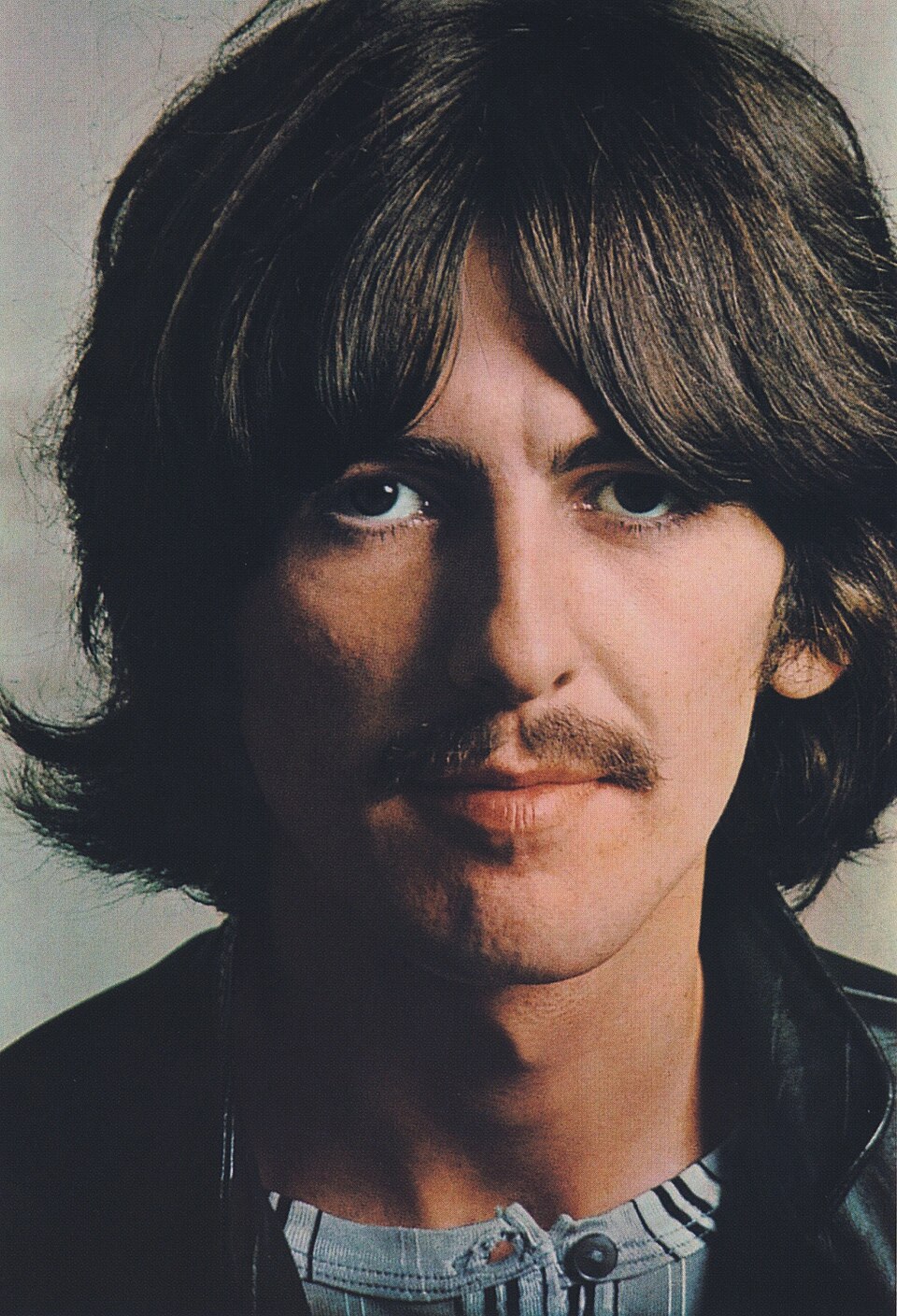
George Harrison's guitar strings: the Beatles + solo rig, sourced
Documented string gauges, brands, and tunings George Harrison used with The Beatles and across his solo catalog. Gibson catalog flat-tops + open D slide work + Rickenbacker 360/12 12-string electric. With citations.
The Beatles / Solo / The Traveling Wilburys · written with AI help · updated
George Harrison used Gibson catalog flat-top light-gauge strings (.010-.046 territory) on his electric instruments across the Beatles era and his solo catalog. His instrument rotation included a 1963 Rickenbacker 360/12 (the 12-string electric on 'A Hard Day's Night'), Gretsch Country Gentleman, Fender Rosewood Telecaster, the painted Stratocaster 'Rocky,' and his Les Paul 'Lucy' (a gift from Eric Clapton). Open D and Open E tunings on his slide-guitar work, primarily on 'My Sweet Lord' (1970) and his post-Beatles solo material. Harrison died in November 2001 at age 58.
Who George Harrison was
George Harrison (February 25, 1943, Liverpool, England, November 29, 2001, Los Angeles, California) was the lead guitarist and one of three primary songwriters of The Beatles, the Liverpool-formed band whose 1962-1970 catalog reshaped popular music. After the Beatles disbanded in 1970, his triple-LP All Things Must Pass (1970) became one of the most-celebrated solo records of the rock era; his 1988-1990 collaboration with Bob Dylan, Tom Petty, Roy Orbison, and Jeff Lynne in The Traveling Wilburys produced two records of high-profile late-period American rock.
His role as the Beatles' lead guitarist is foundational to the band's sound, the chiming 12-string Rickenbacker tones, the slide-guitar work on his solo catalog, the Indian classical music influence that brought sitar into popular music, and the late-Beatles-era integration of Western rock with Eastern musical structure on tracks like 'Within You Without You' and 'The Inner Light.'
What he played
A rotating cast of instruments across his career. The Rickenbacker 360/12 (1963, the second one ever made, gift from Rickenbacker in 1964) is the canonical 'A Hard Day's Night' instrument. The Gretsch Country Gentleman appears on the early Beatles records. The Rosewood Fender Telecaster played the Let It Be sessions and the Beatles' rooftop concert in January 1969. Lucy, a 1957 Gibson Les Paul cherry-red goldtop given to him by Eric Clapton in 1968, played the late-Beatles and early-solo material. The painted Stratocaster known as Rocky played the Magical Mystery Tour sessions and beyond.
For strings, light-gauge nickel-wound electric, .010-.046 territory across the catalog. Specific brand documented variably; Gibson and Fender catalog sets of the era are the period-correct choices. Standard E for most material; Open D and Open E for the slide-guitar work that became a defining solo-era voice.
In the studio, Harrison also had a sunburst Fender Bass VI, a six-string bass tuned an octave below standard guitar, that he acquired in 1967 and used at Abbey Road Studios. It shows up on Beatles tracks where Paul McCartney switched to piano or guitar, played by both Harrison and John Lennon rather than credited to either one alone. Fender's Custom Shop recreated that specific instrument in August 2026.
Why this fits the rig
The Rickenbacker 360/12's 12-string design (paired strings tuned to octaves on the lower four pairs and unison on the top two) produces the chiming, harmonic-rich texture that defined the early Beatles tone and the entire 1960s folk-rock movement that followed. Light .010 strings on the 12-string electric keep the tension manageable across all twelve strings; heavier gauges would put the neck under unworkable load.
For slide-guitar work, Open D and Open E tunings tune the open strings as a major chord, so the slide bar can move along the strings without the slide bar fretting individual notes incorrectly. The slide vocabulary across Harrison's solo catalog (most prominent on 'My Sweet Lord' and the All Things Must Pass sessions) depends on this tuning convention.
If you want this rig
Light-gauge .010-.046 nickel-wound strings on any electric (a Rickenbacker 360/12 if you want the canonical 12-string tone, otherwise a 6-string with the same gauge) gets you in the territory. For the slide work, retune to Open D or Open E and use a glass or metal slide.