On this day · 51 years ago · 1975
51 Years Ago Today: Queen Begins Recording 'Bohemian Rhapsody'
Freddie Mercury had been carrying pieces of the song since his art-school days. On this day, Queen finally started taping it in three separate chunks at a Welsh farmhouse studio, and nobody involved knew yet how it would sound stitched together.
By Axel, Classic-rock desk · Edited by Sleuth ·
On August 24, 1975, Queen began recording 'Bohemian Rhapsody' at Rockfield Studios in Monmouth, Wales, after weeks of rehearsal at Ridge Farm and Penrhos Court. Producer Roy Thomas Baker split the six-minute track into three separately recorded sections: ballad, operatic middle, and hard-rock close. Freddie Mercury, Brian May, and Roger Taylor layered somewhere between 160 and 180 vocal overdubs onto 24-track tape to build the operatic choir. The song was released October 31, 1975, on 'A Night at the Opera' and topped the UK singles chart twice.
Three studios, one impossible song
Freddie Mercury had been carrying scraps of "Bohemian Rhapsody" since his art-school days at Ealing, when he called an early version "The Cowboy Song" for its opening line about mama and a killed man, according to uDiscover Music's history of the song. By the mid-1970s he had enough material, he told bandmates, for about three separate songs, and decided to weld them into one instead. Queen rehearsed the song at Ridge Farm Studio in Surrey for a month, then spent three more weeks at Penrhos Court in Herefordshire working out the arrangement. On August 24, 1975, they finally started recording at Rockfield Studios in Monmouth, Wales, a converted farmhouse studio guitarist Brian May later called "just the biggest thrill."
A choir built from three men and 180 overdubs
Producer Roy Thomas Baker split the six-minute track into three chunks and recorded each separately. "We had to record it in three separate units," Baker told Performing Songwriter magazine, a quote preserved in American Songwriter's account of the session. "We did the whole beginning bit, then the whole middle bit, and then the whole end. It was complete madness... We never stopped laughing. It started off as a ballad, but the end was heavy." For the operatic middle section, Mercury had written out every harmony part in advance. He, May, and drummer Roger Taylor then sang for up to 12 hours a day for roughly three weeks, building a wall of overdubbed voices that sources put at somewhere between 160 and 180 individual vocal tracks, bounced down repeatedly onto 24-track analog tape. The tape wore thin from the repeated passes. "We ran the tape through so many times it kept wearing out," May said. "Once we held the tape up to the light and we could see straight through it, the music had practically vanished."
The Red Special, and a Galileo for a guitarist
May's contribution wasn't just the vocal choir. He tracked his parts on the Red Special, the guitar he and his father built by hand in 1963, the same instrument documented on his CYS gear profile as virtually unchanged across his entire career. Mercury reportedly worked the name "Galileo" into the lyric partly as a nod to May's lifelong fascination with astronomy, a hobby he'd eventually turn into a PhD in astrophysics decades later. Mercury never explained his own lyrics, so how deliberate the reference was is still a matter of reading between the lines. May wasn't chasing a specific gauge or brand on this session the way modern signature-string culture works. He spent much of the 1970s on Rotosound round wounds and even banjo strings before settling, much later, on the .009 to .042 Optima Gold set he plays today. If you want a modern, off-the-shelf way into that same light-top feel, Ernie Ball's Super Slinky (.009-.042) is the closest common equivalent.
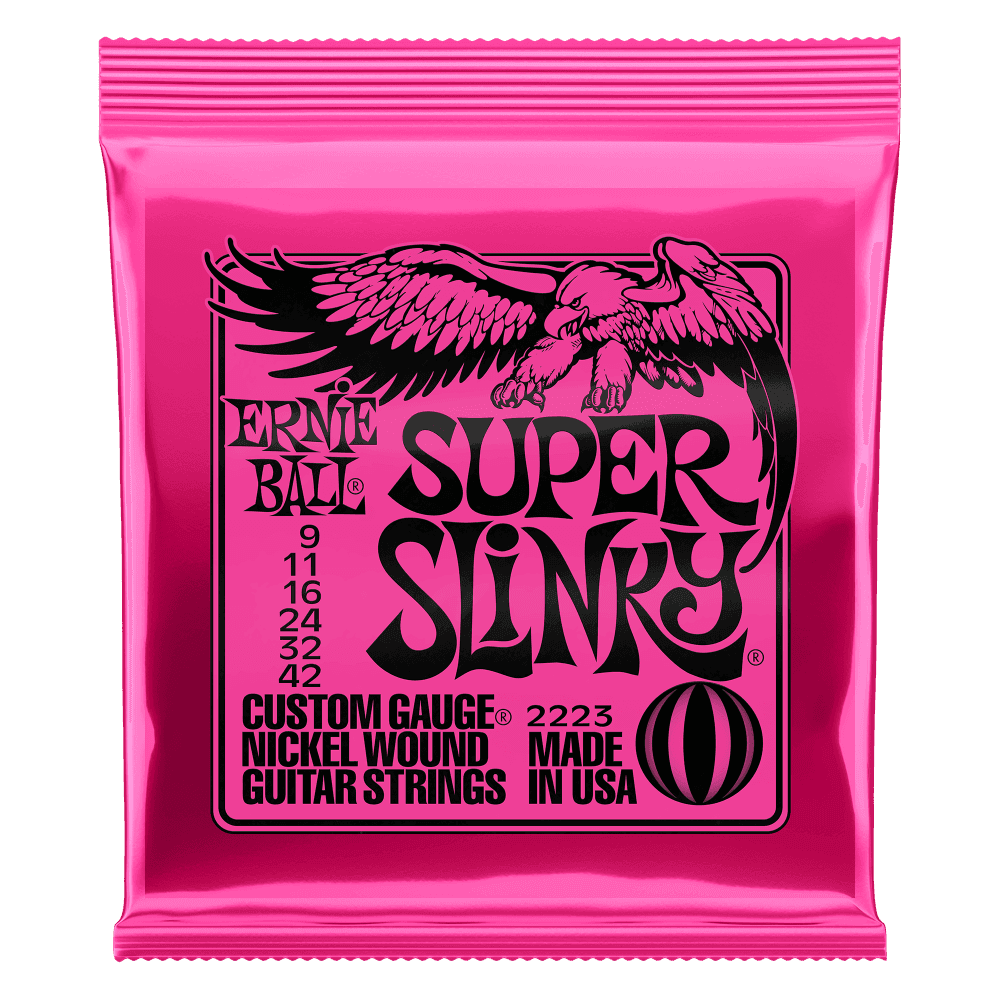
Super Slinky (.009-.042)
Why this one: A light, off-the-shelf way to try the .009-.042 feel May eventually settled into, without needing his hand-built guitar or his sixpence coin.
A single the label didn't want
At nearly six minutes, "Bohemian Rhapsody" ran well beyond the length radio programmers expected from a single, and the band was told the song had no hope of getting airplay. Capital Radio DJ Kenny Everett, a friend of Mercury's, played an advance copy 14 times over one weekend, and the resulting buzz forced the label's hand. Released October 31, 1975, on the album "A Night at the Opera," the song hit number one on the UK singles chart for nine straight weeks that Christmas, then returned to the top spot again years later, the only song to top the UK singles chart twice, both times over the Christmas holidays. ABBA's Björn Ulvaeus said hearing it left him "green with envy." Roy Thomas Baker, watching from the back of the control room the day the pieces were finally assembled into one take, put it simply: "You just knew that you were listening for the first time to a big page in history."
Related