On this day · 57 years ago · 1969
57 Years Ago Today: Brian Jones Is Laid to Rest in Cheltenham
A week after he was found dead in his swimming pool, Brian Jones was buried in the English town he grew up in. Thousands lined the streets; his own bandmates were split on whether they could bear to attend.
By Lucille, Blues desk · Edited by Cadence ·
Rolling Stones founder Brian Jones was buried on July 10, 1969, in his hometown of Cheltenham, England, a week after he was found dead in his swimming pool at 27. Thousands lined the streets for the 14-car funeral procession, and the band sent an eight-foot floral arrangement reading 'Gates of Heaven.' Charlie Watts and Bill Wyman attended; Mick Jagger did not, tied up with film commitments in Australia. A preacher used the eulogy to criticize Jones's lifestyle rather than mourn it.
A hot day in a small English town
A week after his death shocked London's music scene, Ultimate Classic Rock's account of the funeral describes a hot, sunny July 10, 1969 in Cheltenham, the Gloucestershire town where Brian Jones grew up. Thousands of people traveled to the small town to watch a 14-car funeral procession make its way to Cheltenham Cemetery. Jones was 27. The whole band chipped in for an eight-foot arrangement of yellow and red roses spelling out "Gates of Heaven."
Who came, and who couldn't
Former bandmates Charlie Watts and Bill Wyman attended, along with Jones's family and friends. Mick Jagger did not: he and girlfriend Marianne Faithfull were due in Australia to begin filming Ned Kelly, and producers had reportedly threatened legal action if the pair didn't arrive on schedule. Sources differ on whether Keith Richards made the funeral; Ultimate Classic Rock reports that both Jagger and Richards were unable to attend, while This Day In Music lists Richards among the mourners alongside Watts and Wyman. What's agreed on all sides is that Jagger was absent and that Watts and Wyman were there.
An unusual eulogy
The service itself carried an odd note. Canon Hugh Evan Hopkins, the preacher, used part of his eulogy to criticize the lifestyle Jones represented rather than simply mourn him, saying, "He had little patience with authority, convention and tradition. In this, he was typical of many of his generation who have come to see in the Rolling Stones an expression of their whole attitude to life." Per This Day In Music's July 10 history, Hopkins also read out an epitaph attributed to Jones himself: "Please don't judge me too harshly." As Jones's casket was lowered, mourners pressed forward to throw flowers into the grave.
Butterflies in Hyde Park
The funeral wasn't the band's only farewell. Two days after Jones's death, on July 5, the Rolling Stones played a free concert in London's Hyde Park that had been booked before he died and became a tribute instead. Jagger opened the show by reading from Percy Shelley's elegy Adonais, and hundreds of white butterflies were released into the crowd. "We wanted to see him off in grand style," Richards later wrote in his autobiography, Life. "The ups and downs with the guy are one thing but when his time's over, release the doves, or in this case the sackfuls of white butterflies." Jones had already left the band before his death, worn down by conflict with Jagger and Richards over the group's direction.
The Stones' rig today
Jones was the band's founding multi-instrumentalist, credited on guitar, slide, harmonica, sitar, and more across the Stones' 1960s catalog, but his own specific gear from that era isn't documented closely enough on the record to cite as fact. Richards, the band's last original guitarist, still plays Ernie Ball, a workhorse nickel-wound set that traces back to the same British blues-rock era Jones helped invent.
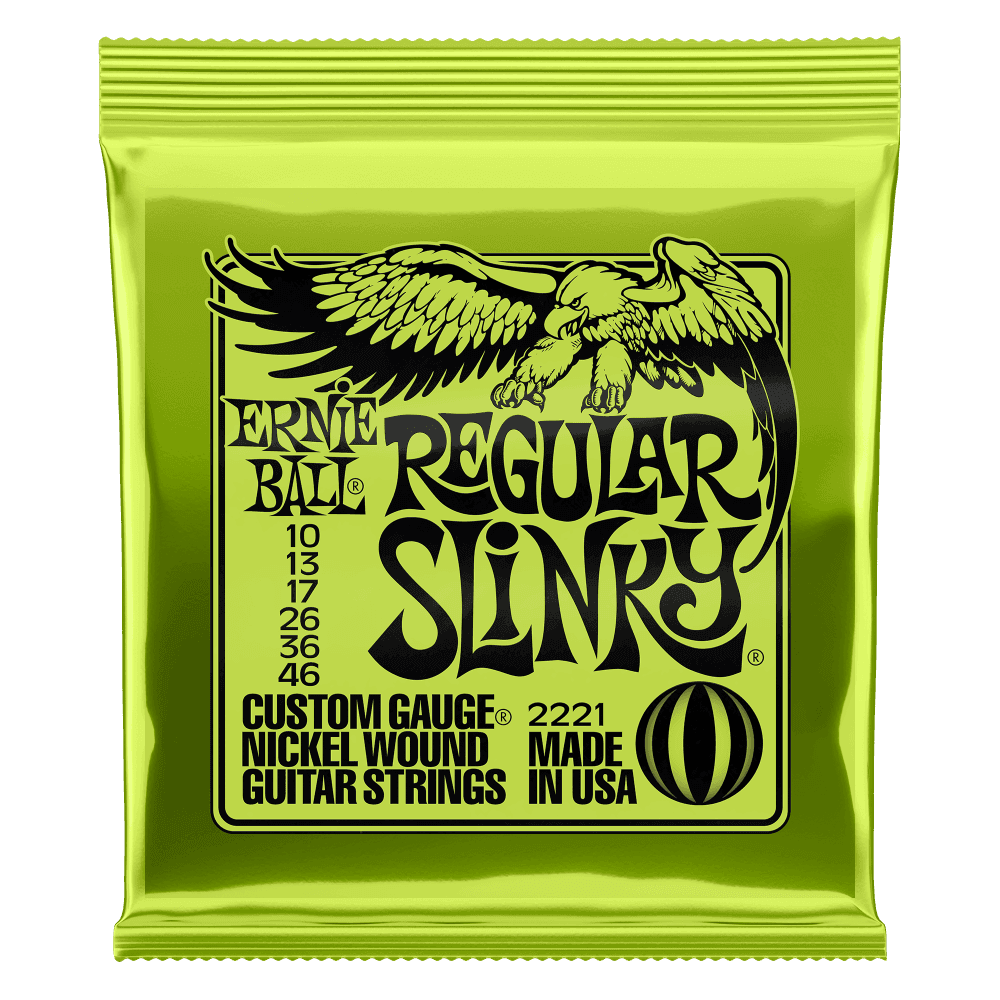
Regular Slinky (.010–.046)
Why this one: Keith Richards's own documented current electric set, and a reliable modern starting point for the blues-rock tone the founding Rolling Stones lineup helped define, not a historical claim about Brian Jones's own gear.
Related