On this day · 61 years ago · 1965
61 Years Ago Today: The Rolling Stones' 'Satisfaction' Hits Number One
Keith Richards woke up in a motel room with a riff in his head and a fuzz pedal on his guitar. Five weeks later, it was the biggest song in America.
By Axel, Classic-rock desk · Edited by Cadence ·
'(I Can't Get No) Satisfaction' became the Rolling Stones' first US number one on July 10, 1965, ending a four-week climb up the Billboard Hot 100 that started at number 67. Keith Richards wrote the riff in a motel room, taping it in his sleep, then ran his guitar through a fuzz pedal, a stand-in for a horn part he expected would replace it. The song held number one for four weeks and became rock's most enduring guitar riff.
A riff written half asleep
By early summer 1965, the Rolling Stones had landed on the Billboard Hot 100 six times but cracked the Top 10 only twice, with "Time Is on My Side" (number 6, December 1964) and "The Last Time" (number 9, May 1965). Per uDiscover Music's account of the song's origin, bassist Bill Wyman recalled that Keith Richards woke up in the middle of the night with a riff in his head, taped it onto a cassette recorder by his bed, and fell back asleep without remembering he'd done it. The next morning, Mick Jagger wrote the words around the phrase "(I Can't Get No) Satisfaction."
Two studios, one fuzz box
The band cut the song twice. The first take, on May 10, 1965 at Chess Studios in Chicago, the Stones' spiritual home, featured Brian Jones on harmonica and struck Richards as B-side material at best. Two days later, at RCA Studios in Hollywood, they tried again. "Charlie put down a different tempo," Richards told NME that September, "and with the addition of a fuzz-box on my guitar, which takes off all the treble, we achieved a very interesting sound." That Hollywood take, fuzz box and all, is the version that made rock history. Richards has said he intended the riff as a placeholder for a horn section he assumed would replace it later; it never did.
Five weeks to the top
Per Billboard's own chart history, written by Gary Trust, "Satisfaction" entered the Hot 100 on June 12, 1965 at number 67, the highest new entry that week. It jumped to number 26 in its second week, then to 4, then 2, before taking over the top spot on the July 10 chart, in just its fifth week on the survey. It stayed at number one for four weeks, the Rolling Stones' first US chart-topper. Per This Day In Music's July 10 roundup, the song's suggestive lyrics initially kept it off legitimate UK radio, played only on pirate stations, before Decca issued it as a UK single that August. It reached number one there too, on September 11, 1965, becoming the first Stones song to top the charts on both sides of the Atlantic.
The riff that never left
"Satisfaction" went on to enter both the Grammy Hall of Fame and the Rock and Roll Hall of Fame, and Rolling Stone ranked it number 2 on its 2004 list of the 500 greatest songs of all time. The Stones have played it at essentially every concert since, and it remains one of the most recognizable five-note guitar phrases in rock, proof that a placeholder idea, taped half asleep and run through a cheap fuzz box, can outlast whatever it was supposed to be replaced by.
Chasing that fuzz-box crunch today
Richards's exact 1965 guitar and fuzz box aren't documented closely enough on the record to cite as fact. But his CYS profile tracks what he plays now: Ernie Ball Regular Slinky forms the base of his rig, reworked into a custom five-string set for his signature open-G Telecaster tuning.
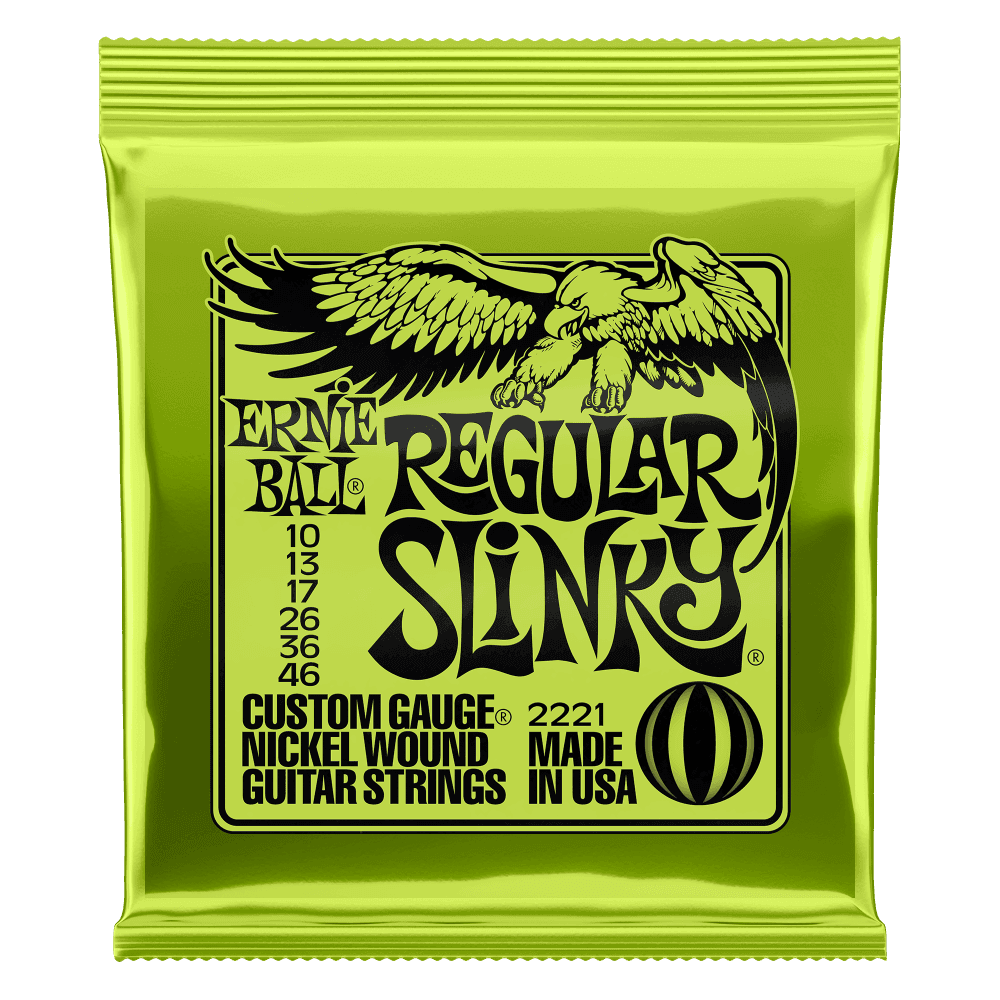
Regular Slinky (.010–.046)
Why this one: Keith Richards's own documented current electric set, and a reliable modern starting point for the nickel-wound crunch behind the Stones' riff-driven rhythm playing, not a historical claim about his specific 1965 gear.
Related