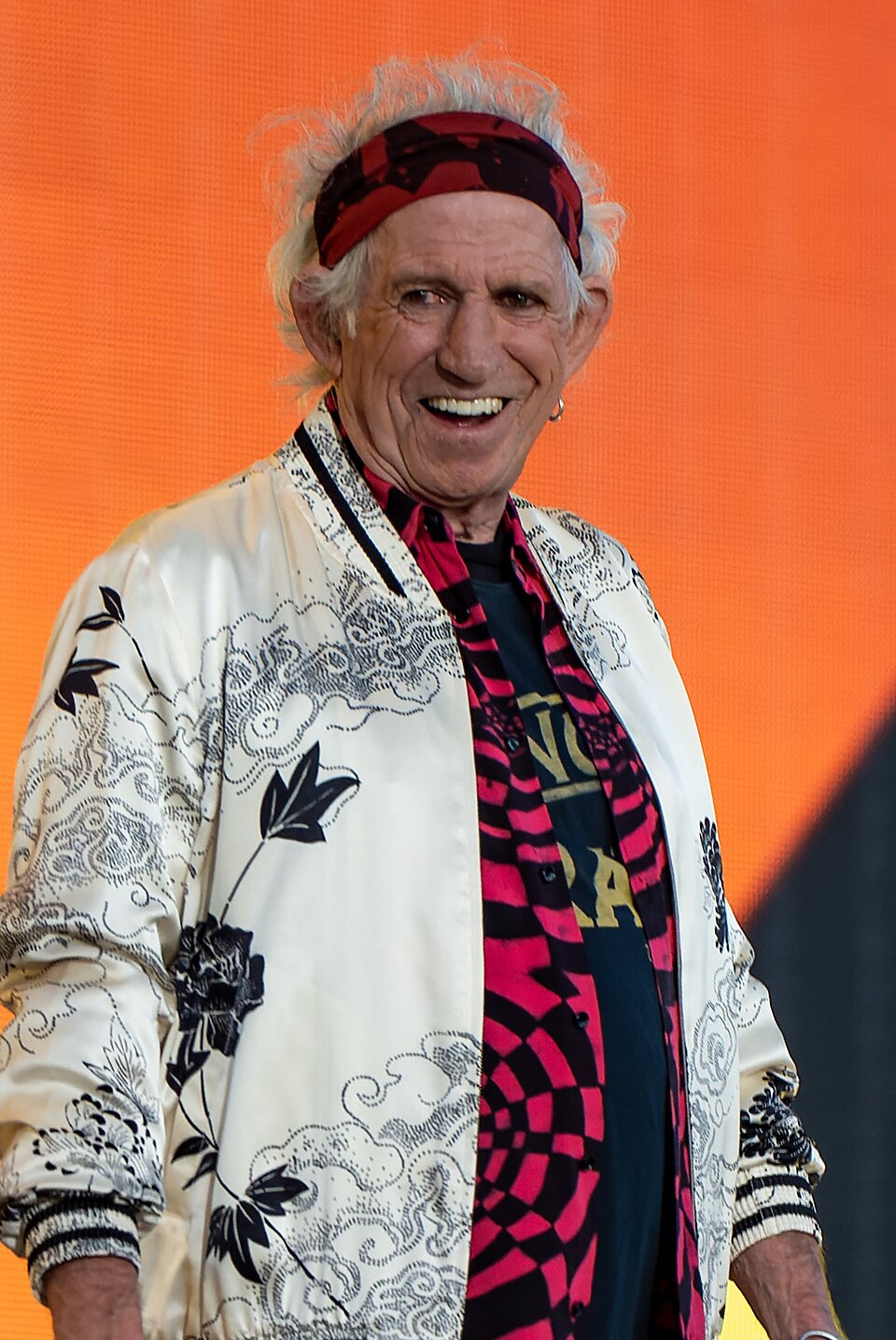
Keith Richards's guitar strings: the open-G Telecaster rig, sourced
Documented string gauges, tunings, and the famous five-string open-G setup Keith Richards uses with The Rolling Stones. Ernie Ball Regular Slinky base, custom configurations on his Telecaster Micawber. With citations.
The Rolling Stones / Solo / X-Pensive Winos · written with AI help · updated
Keith Richards is famous for his five-string open G tuning: he removes the low E string entirely from his Telecasters and tunes the remaining five strings to G-D-G-B-D from low to high. The configuration is on Micawber, his 1953 Telecaster, and on Malcolm, a 1954 Telecaster. He plays Ernie Ball custom gauges to suit the open-G-with-no-low-E setup. Standard-tuning rigs use a more conventional Ernie Ball Slinky set. The five-string open G is the signature riff voicing on 'Brown Sugar' (1971), 'Honky Tonk Women' (1969), 'Start Me Up' (1981), and most of the Stones' iconic Richards riffs.
Who Keith Richards is
Keith Richards (born December 18, 1943, Dartford, England) is the founding rhythm guitarist + co-songwriter of The Rolling Stones, alongside Mick Jagger since 1962. The Richards-Jagger writing partnership is one of the most-cited songwriting catalogs in modern rock; the Stones records from Beggars Banquet (1968) through Hackney Diamonds (2023) span sixty-plus years of continuous output. His rhythm-guitar voicings, particularly the five-string-open-G riffs on Micawber, are among the most-imitated guitar parts in popular music.
He's also fronted his own X-Pensive Winos solo project on multiple records, including Talk Is Cheap (1988) and Crosseyed Heart (2015).
What he plays
Five-string open G tuning on a heavily modified 1953 Telecaster nicknamed Micawber, with the low E string removed and the remaining five tuned G-D-G-B-D low to high. Micawber carries a Gibson PAF humbucker in the neck position (replacing the stock Tele neck pickup), a brass bridge piece, and bridge-saddle modifications to suit the missing-low-E configuration.
He also plays Malcolm, a 1954 Telecaster with similar modifications, plus a rotation of other Telecasters, a 1957 Gibson Les Paul Black Beauty, and various acoustics. The Telecaster is the defining instrument across the catalog, and the five-string open-G Micawber spec is the canonical rhythm voicing.
For strings, he's a documented Ernie Ball user; gauges chosen to suit the open-G-no-low-E configuration. The signal chain is mostly into vintage tube amps (Fender Twin variants, vintage Marshalls) at workable volumes.
Why this fits the rig
Open G's three-finger major-chord voicings suit his rhythm-riff songwriting. Without a low E to mute, the five-string setup means every chord he plays sits on the same root pattern (the low G), which produces the signature bass-pedal anchor of his riffs. The Tele bridge pickup into a vintage tube amp at moderate gain is voiced for the pick-attack-driven rhythm tone he's known for; the PAF humbucker in the neck position lets him cover the warmer rhythm voicings without changing instruments mid-song.
The five-string configuration is mechanically calibrated to his playing: removed low E means no sympathetic vibration on a string he wasn't using anyway, and the saved physical space simplifies his right-hand attack. The configuration has remained essentially unchanged for fifty years.
If you want this rig
The five-string open-G setup is the unique element. Any Telecaster (or guitar with Tele-like bridge and a humbucker neck pickup) can be set up to spec: remove the low E, tune G-D-G-B-D, adjust the high-G saddle if needed. The Ernie Ball string side is conventional; for the open-G-no-low-E setup, players typically use the top five strings of an Ernie Ball Regular Slinky set with the low E discarded.

Regular Slinky (.010–.046)
Why this one: A documented Ernie Ball user; the full six-string set is his standard-tuning configuration, and the top five strings are the base for his signature no-low-E open G rig.
Further reading and listening
Go deeper on Keith Richards. Books and Audible audiobooks on Amazon, so you can read or listen.
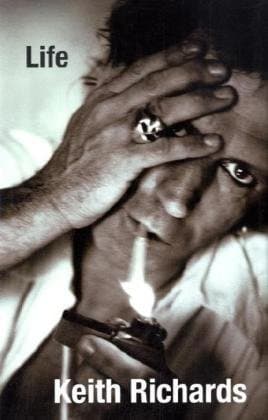
Life
by Keith Richards
Narrated by Johnny Depp and Joe Hurley
Richards's own memoir: the open-G rig, the riffs, and five decades with the Rolling Stones. The audiobook is narrated in part by Johnny Depp.