Best Guitar Capos for Acoustic and Electric: 7 Picks Compared
Written with AI help · Updated
G7th Performance 3 is our pick for most players, based on manufacturer specs. Its Adaptive Radius Technology pad is built to adapt to both flat and radiused fretboards, and squeezing it on lets you control pressure. Kyser Quick-Change is the faster, cheaper trigger option. Choose Shubb C1 for tuning accuracy, D'Addario Pro Plus for flat to vintage necks, and Kyser Short Cut for partial-capo tunings.
The short answer
There is no single best capo. The right one depends on your neck, your playing, and how much you hate retuning. We checked each claim below against the maker's own product page. We have not tested these capos ourselves, so specs are "per the manufacturer."
If you want one pick, buy the G7th Performance 3. If you want the classic fast trigger style for less, buy a Kyser Quick-Change. If you care most about staying in tune, look at the Shubb C1.
| Best for | Style | Price | |
|---|---|---|---|
| G7th Performance 3 | Best overall, adapts to neck curve | Squeeze-on, tension control | $$$ |
| Kyser Quick-Change Acoustic | Best fast trigger capo | Trigger | $ |
| Shubb C1 | Best for tuning accuracy | Over-center lever | $ |
| Dunlop Trigger Curved | Best spring-clamp value | Spring trigger | $ |
| D'Addario Pro Plus | Best for flat to vintage radius necks | Clamp with FlexFit pad | $$ |
| Paige Original 6-String | Best adjustable-tension clamp | Adjustable bar clamp | $$ |
| Kyser Short Cut Partial | Best partial capo | Partial trigger | $ |
Performance 3 ART Capo (6-String)
Why this one: Our overall pick. Per G7th, the ART pad adapts to your fretboard radius and string gauge, and squeezing it on gives you pressure control.
How to choose a capo
Capos fall into a few families. Each one trades speed against precision.
Pick by how you play, not by looks
- Trigger or spring-clamp
- Fastest to move, one hand. Best for live sets and quick key changes. Pressure is mostly fixed by the spring.
- Lever (over-center)
- Flip to lock. Shubb says the design is built to avoid retuning. Good for precise players.
- Squeeze with tension control
- G7th style. You squeeze to attach, so you control pressure by hand.
- Screw or adjustable bar
- Slower to move, but you set pressure exactly. Often parks behind the nut.
- Partial capo
- Covers only some strings. Opens up drones and alternate-tuning sounds without retuning.
Three things matter more than brand. First, your neck radius. Acoustics are usually fairly flat to slightly curved, and many electrics are more curved. Second, your string gauge and action height. Heavy strings and high action need more clamp force. Third, how often you move the capo mid-song.
Some makers publish neck-fit details, and we cite them where they exist. Dunlop labels its Trigger as a curved-radius acoustic model and also lists flat versions. Shubb sells a 7.25 inch radius model and notes it fits some, not most, vintage electrics. D'Addario says the Pro Plus handles flat classical fingerboards through 7 inch radius vintage electrics. G7th says the Performance 3 suits flat and radiused fingerboards. If a maker did not publish neck fit, we do not guess.
A capo also changes your open chord shapes, not your tuning. If you are new to key changes, read how scale length affects feel and keep a tuner handy. After you clamp on, always recheck pitch.
Best overall: G7th Performance 3
The Performance 3 is the most engineered capo on this page. G7th says its Adaptive Radius Technology, or ART, sits under the string pad. It responds to the radius of your neck and the gauge of your strings to spread pressure evenly. G7th's own explainer argues that uneven pressure is why many capos hurt tuning stability.
You attach and release it by squeezing. G7th calls this its Unique Tension Control system. It also lists silicone pads at every touchpoint to protect the finish, and a free lifetime warranty. You can park it on the headstock or behind the nut between songs.
G7th says the Performance 3 suits virtually all steel 6-string acoustic, electric or hybrid nylon string guitars, depending on setup, string gauge and action height. It also lists flat and radiused fingerboards. For high actions or heavy strings, G7th points you to its Heritage or Newport capos instead.
The tradeoff is cost. It sits at the top price tier here. It is also bulkier to move than a simple trigger. If you change capo position constantly in a live set, a Kyser is quicker.
Performance 3 ART Capo (6-String)
Why this one: ART pad adapts to neck radius and string gauge, per G7th. The best pick if tuning stability matters more than speed or price.
Best fast trigger capo: Kyser Quick-Change Acoustic
Kyser has built trigger-style capos for over 40 years, according to its product page. The Quick-Change Acoustic works with one hand. You squeeze it on, squeeze it off, and move on. Kyser says it uses aircraft-grade aluminum, is sourced and made in the United States, and carries a lifetime guarantee that covers repair or replacement.
This is the capo to buy if you gig, jam or teach. It is quick, simple and widely used. Kyser says more artists choose it than any other brand, though that is a company claim, not something we verified.
The tradeoff is that spring pressure is mostly fixed. On a neck with heavy strings or a high action you may notice some sharpening. You can nudge it with your tuner. If you want to fine tune pressure, look at the Shubb or G7th instead.
If you play electric, Kyser also makes a separate Quick-Change Electric. Per Kyser, it is tailored to specific string gauges, with lower tension and a smaller body. We did not verify an Amazon listing for that model, so we do not feature it as a pick.
Quick-Change Acoustic Guitar Capo, Black (KG6BA)
Why this one: A one-handed trigger capo with a lifetime guarantee, per Kyser. The easy default for gigging and quick key changes.
Best for tuning accuracy: Shubb C1
The Shubb C1 uses what Shubb calls an over-center locking mechanism. One flip of the lever locks it, and another releases it. Shubb says it is machined of solid brass and uses soft rubber designed to work like a fingertip. The company claims it is the best at not creating tuning problems.
Treat that as Shubb's claim. Still, the lever design is widely used and has a long track record among acoustic players. It is slimmer than most triggers and stays out of your fretting hand's way.
The tradeoff is the learning curve. Lever capos reward practice, and they are a little slower to move than a trigger. They also come in separate models. The C1 targets steel-string guitars. Shubb's stainless Deluxe S1 is listed as fitting most acoustics and electrics, and its S4 is for a 7.25 inch radius fretboard and fits some, not most, vintage electrics. Pick the model that matches your neck.
C1 Standard Steel-String Capo, Polished Nickel
Why this one: Over-center lever design that Shubb says avoids pulling strings off center. A strong value for players who hate retuning.
Best spring-clamp value: Dunlop Trigger Curved
The Dunlop Trigger Capo 83CB is the budget-friendly spring option. Dunlop describes it as a curved-radius acoustic capo that changes key with a squeeze of the hand. It has a strong spring-action clamp, a slim profile, and padding to protect the neck. Per Dunlop, the body is lightweight aircraft-grade aluminum.
Dunlop lists both curved and flat versions of the Trigger. The 83CB we feature is the curved version. If you have a flat or classical-style fingerboard, check the flat model instead of guessing.
The tradeoff is the same as other triggers. The spring sets the pressure. On heavy strings you may need to retune. It is also less refined than a G7th or Shubb. For the price tier, though, it is a hard-to-beat starter.
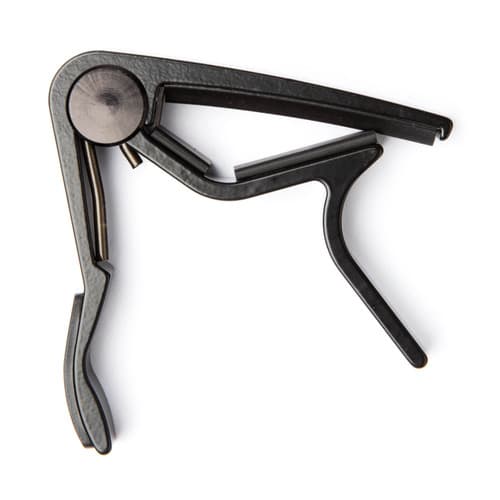
Trigger Capo Acoustic Curved, Black (83CB)
Why this one: A curved-radius spring trigger in aircraft-grade aluminum, per Dunlop. The budget pick for acoustic players.
Best for varied neck radii: D'Addario Pro Plus
The D'Addario Pro Plus is built around a FlexFit pad. D'Addario says the pad mimics how a human finger works when fretting a string, so you avoid buzzing, muted strings and intonation problems from uneven capo pressure. With minimal overall pressure, every string should ring clear and in tune.
The notable spec is range. Per D'Addario, the Pro Plus is designed to function on virtually all guitars, from flat fingerboard classical guitars to vintage electrics with a 7 inch fretboard radius. If you own both acoustic and electric guitars, that range is useful. One capo can cover the whole rack.
The tradeoff is the clamp style and price. It sits in the middle price tier. Because it is a clamp, it moves a little slower than a pure trigger.

Pro Plus Guitar Capo, Black (PW-CP-19)
Why this one: FlexFit pad and a stated range from flat classical necks to 7 inch radius vintage electrics, per D'Addario.
Best adjustable-tension clamp: Paige Original 6-String
The Paige Original 6-String Acoustic Capo uses a stable bar design. Paige says it allows precise tension control with less spring resistance, which means cleaner tone, better sustain and less retuning when you move it. The felt on the saddle is secured with shrink tube for durability, and the low-profile shape stores behind the nut.
Paige says it is built for standard neck profiles. If your neck is wider than standard, check the maker's wide models first. Paige also sells an electric version of the Original capo with extra thick tubing meant to hold strings during hard bends, per its product page. We did not verify an Amazon listing for that one.
The tradeoff is price and speed. It costs more than a basic trigger. You also set tension by hand, so it takes a moment longer to place.
Original 6-String Acoustic Capo, Nickel (P-6N)
Why this one: A stable bar design with adjustable tension and behind-the-nut storage, per Paige. A good pick if you like to set pressure yourself.
Best partial capo: Kyser Short Cut
A partial capo leaves some strings open. The Kyser Quick-Change Short Cut is a trigger-style partial capo. Kyser says it lets you create drone strings, drop into new tunings, or explore open tunings in ways your fretting hand could not handle.
The appeal is simple. You get new sounds without retuning. Shubb also makes partial capos, including the C7 and C8, which Shubb describes as skipping outside strings to emulate DADGAD and drop D sounds. Players commonly use partial capos this way. If that appeals, see our DADGAD and Drop D pages for the real tunings.
The tradeoff is that a partial capo is a specialty tool. It is not your everyday capo. Check which strings the model covers before you buy, because coverage differs by model.
Quick-Change Short Cut Partial Capo, Black (KG3BA)
Why this one: A trigger-style partial capo for drones and open-tuning sounds, per Kyser. A fun, low-risk way to explore.
Bottom line
Buy the G7th Performance 3 if you want the most advanced option and can pay for it. Buy a Kyser Quick-Change or Dunlop Trigger if you want speed and low cost. Buy the Shubb C1 if tuning stability is your top concern. Pick the D'Addario Pro Plus if you move one capo across acoustic and electric guitars. Add a partial capo later, when you want new sounds.
Whatever you buy, check the neck-fit details on the maker's page. Then recheck your tuning after you clamp on. For new strings to go under that capo, see our best acoustic guitar strings and best electric guitar strings. If your strings are old, a capo will make dead tone and tuning drift worse, so read how often to change strings first.