Green Day, gear encyclopedia, member by member, album by album
The complete Green Day gear encyclopedia. Strings, guitars, amps, basses, drums, every documented piece of equipment Billie Joe Armstrong, Mike Dirnt, and Tré Cool play, with primary-source citations and album-by-album evolution from 39/Smooth (1990) to Saviors (2024).
Written with AI help · Updated
Green Day formed in Berkeley, California in 1986 (originally as Sweet Children, renamed Green Day in 1989). Core lineup since 1990: Billie Joe Armstrong (vocals, lead guitar), Mike Dirnt (bass, vocals), Tré Cool (drums). Touring members Jason White (guitar) and Jason Freese (keys, sax) anchor the live show. Long-documented gear: Billie Joe plays Fernandes Stratocaster 'Blue' and 1956 Gibson Les Paul Junior 'Floyd' through Marshall amplifiers, strung with Ernie Ball Regular Slinky (.010-.046). Mike Dirnt plays Fender Precision Bass with Fender Super 7250 strings (.045-.105). Tré Cool plays SJC Custom Drums. 75+ million records sold; Rock and Roll Hall of Fame inductees (2015).
Band members(3)
Touring members(2)
Engineers(1)
Mixers(1)
Producers(1)
At a glance
Role
Active
Affiliations
- Reprise Records (Warner, since 1993)
- Adeline Records (now-defunct; Billie Joe Armstrong + Jason White co-founded)
- Rock and Roll Hall of Fame (inducted 2015)
- Five Grammy Awards
- 75+ million records sold globally
Notable credits
- Dookie (1994), 20× Platinum US
- American Idiot (2004), 6× Platinum US, won Best Rock Album Grammy
- 21st Century Breakdown (2009)
- Saviors (2024), most recent studio record
- Boulevard of Broken Dreams, 2005 Record of the Year Grammy
The band, decoded
Green Day is the punk-rock-to-arena-rock American band that holds the title for keeping a single three-piece lineup commercially relevant for almost four decades. Formed in 1986 in Berkeley, California by 14-year-olds Billie Joe Armstrong (then on guitar and vocals) and Mike Dirnt (then on bass), the band was originally called Sweet Children. They renamed to Green Day in April 1989. Tré Cool joined in 1990, replacing original drummer John Kiffmeyer, and that lineup has been the band's recording and touring core for 35+ years.
The commercial trajectory: Lookout! Records indie phase (1989–1993). Reprise Records signing (1993, by Rob Cavallo). Dookie (1994), the major-label debut that turned them into a global concern. The post-Dookie consolidation (Insomniac 1995, Nimrod 1997, Warning 2000). The American Idiot (2004) rock-opera pivot. The continued release cadence through 21st Century Breakdown (2009), the ¡Uno! / ¡Dos! / ¡Tré! trilogy (2012), Revolution Radio (2016), Father of All… (2020), and Saviors (2024). Rock and Roll Hall of Fame induction in 2015. 75+ million records sold globally.
This page is the gear encyclopedia for the band. Per-member deep dives live on the individual member profiles linked above (Billie Joe, Mike, Tré, plus touring guitarist Jason White and touring keys/sax Jason Freese). The discography-and-gear timeline below tracks how the band's equipment evolved across the catalog, with primary-source citations and affiliate product links wherever the gear maps to a catalog page.
Discography and gear evolution, album by album
The catalog (Sweet Children era through Saviors)
- 39/Smooth (1990, Lookout! Records)
- First full-length, recorded with original drummer John Kiffmeyer. Tracked at Art of Ears in San Francisco. Billie Joe on Blue (Fernandes Strat), Mike on a Fender Precision Bass, Kiffmeyer on a basic Pearl drum kit. Strings: Ernie Ball Regular Slinky (.010-.046) on guitar, Fender bass strings on bass.
- Kerplunk! (1991, Lookout! Records)
- First record with Tré Cool on drums. Same studio (Art of Ears), same producers. The string and gauge lane locked in here: Regular Slinky on guitar, Fender Super 7250 (.045-.105) on bass.
- Dookie (1994, Reprise)
- Major-label debut. Producer: Rob Cavallo. Tracked at Fantasy Studios, Berkeley. Billie Joe on Blue through a Marshall stack (Plexi-derived heads). Mike on a Fender Precision. Tré on a Premier kit. The album that made everything that followed possible. 20× Platinum US.
- Insomniac (1995, Reprise)
- Same Cavallo / Fantasy Studios architecture. Same gear lane. Heavier production gloss; same string and bass-string choices.
- Nimrod (1997, Reprise)
- First record mixed by Chris Lord-Alge. The compositional range expanded, "Good Riddance (Time of Your Life)" introduces acoustic guitar work to the Green Day catalog. Acoustic tracking used Martin and Gibson dreadnoughts.
- Warning (2000, Reprise)
- The transitional record. Billie Joe acquires Floyd (his 1956 Gibson Les Paul Junior) at a San Rafael guitar show before tracking; Floyd's P-90 single-coil becomes the secondary guitar voice. Cassidy Wagner produced alongside Cavallo.
- American Idiot (2004, Reprise)
- The rock-opera pivot. Producer: Rob Cavallo. Engineer: Chris Dugan (his first Green Day record). Mixed by Chris Lord-Alge. Billie Joe shifts primarily to Floyd (Les Paul Junior with P-90s) for the angrier, more biting tone; Blue stays in rotation. Cavallo plays piano. 6× Platinum US, won 2004 Best Rock Album Grammy. "Boulevard of Broken Dreams" won 2005 Record of the Year.
- 21st Century Breakdown (2009, Reprise)
- Same production team (Cavallo / Dugan / Lord-Alge). Touring keys/sax player Jason Freese, who joined the live lineup in 2004, plays prominently on the orchestral and horn passages.
- ¡Uno! / ¡Dos! / ¡Tré! trilogy (2012, Reprise)
- Three records released in close succession, deliberately tracked with a four-guitar live-band feel. Touring guitarist Jason White brought in as a session musician (the only studio period where he's a full credited player). Cavallo / Dugan production.
- Revolution Radio (2016, Reprise)
- Self-produced (Green Day, no Cavallo). Engineered by Chris Dugan. Same gear lane. Billie Joe on Floyd and Blue.
- Father of All... (2020, Reprise)
- Self-produced. Glam-rock and falsetto-experimental detour. Same string and bass gauges; the song-shape is the variable, the gear isn't.
- Saviors (2024, Reprise)
- Producer: Rob Cavallo (returns after 8+ years). Engineer: Chris Dugan. Mixed by Chris Lord-Alge (his 7th Green Day record). Tracked at Jingletown Studios, Oakland. Same core gear lane the band has used for two decades. The Cavallo + Dugan + Lord-Alge team that made American Idiot reunites.
Billie Joe Armstrong's signature gear
The Armstrong rig has been remarkably stable for 30+ years. The variable across records isn't the gear; it's which guitar he reaches for and how the amp is dialed in.
The two iconic guitars
- Blue (Fernandes Stratocaster copy)
- His first guitar, bought as a teenager. Modified over the years with Seymour Duncan pickups. Sticker-covered body. Defining tone of the pre-American Idiot catalog. Still in active rotation. Sources: Ground Guitar, Equipboard, Premier Guitar Rig Rundown.
- Floyd (1956 Gibson Les Paul Junior)
- Bought 2000 at a San Rafael guitar show before tracking Warning. The P-90 single-coil pickup defines the American Idiot–era tone. Inspiration for the Gibson Billie Joe Armstrong Les Paul Junior signature model. Sources: Guitar World, Gibson.com.
- Gibson BJA Signature Les Paul Junior
- Production model based on Floyd. Custom H-90 pickup (a hotter version of the standard P-90). Available in Silver Mist, Mahogany, and other limited finishes.
- Reverend Billie Joe Armstrong signature
- Earlier-era signature deal with Reverend Guitars. Different design language than the Gibson. Less common on the current touring rig but historically documented.
Strings
- Ernie Ball Regular Slinky (.010–.046)
- The default. 25.5-inch scale, E or Eb standard. Decades-long Ernie Ball relationship.
The strings hook for Billie Joe's strings:
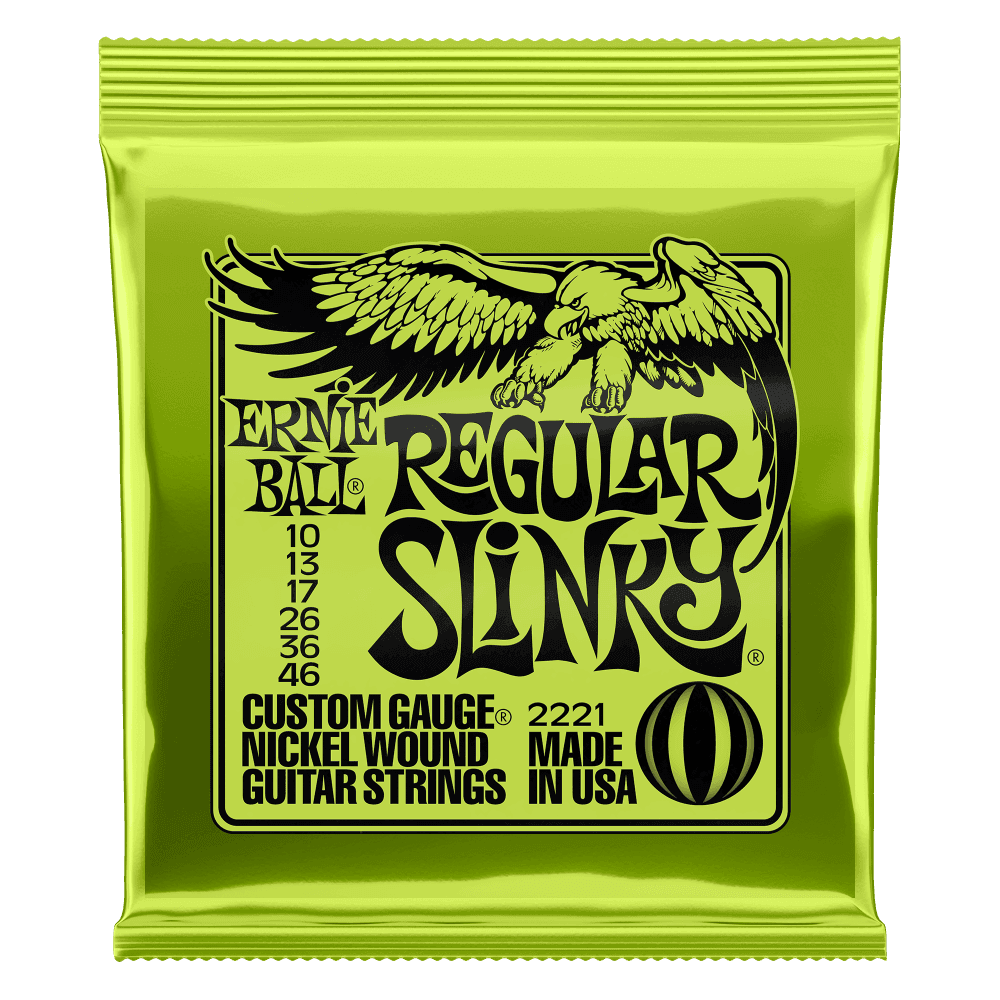
Regular Slinky (.010–.046)
Why this one: The Billie Joe Armstrong / Green Day default. Same gauge across Blue and Floyd, same lane on every Reprise record. E or Eb standard on 25.5-inch scale electric.
If you're chasing the Green Day rhythm-guitar tone at home, this set is the foundation. Pair with a Marshall-Plexi-style dirty-channel amp or an amp sim (Universal Audio's Marshall Plexi UAD plugin, the Neural DSP Soldano SLO, or the IK Multimedia Marshall Plexi cabinet IRs) and you have 80% of the Green Day rhythm sound at the input.
Amplification
- Marshall Plexi (vintage and reissue)
- The driving force behind Armstrong's electric sound. Vintage Plexi heads paired with a Marshall 4×12. Crunchy overdrive without the saturation of a high-gain modern amp.
- Marshall JCM900
- Often modified with Bradshaw gain mods for extra distortion. The high-gain channel for the heavier tracks (American Idiot, 21st Century Breakdown).
- Vox AC30
- Occasionally on cleaner passages and acoustic-electric work. Less prominent than Marshall in the live rig but documented in studio sessions.
Mike Dirnt's signature gear
The basses
- Stella ('69 Fender Precision Bass)
- Mike Dirnt's primary bass for decades. Heavily modified, sticker-covered, the visible character of the Green Day low end.
- The Weapon ('71 Fender Precision Bass)
- Backup primary, also heavily modified. Often used in alternate tunings or on alternate-album tracks.
- Fender Mike Dirnt Road Worn Precision Bass
- Production signature model from Fender. Built around a 1951 P-Bass spec. The signature bass available to consumers; the closest you can get to Stella's tone without modifying a vintage P-Bass.
Strings
- Fender Super 7250 .045–.105 Roundwounds
- Documented across Mike Dirnt's entire bass collection. Same gauge on Stella, the Weapon, and his signature P-Bass. The .045-.105 medium gauge is also Fender's factory-spec set on most production P-Basses, which means Dirnt's strings double as the default Fender bass tone you'd hear on any new P-Bass off the wall.
The strings hook for Mike Dirnt's low end:
Super 7250 Bass (.045–.105)
Why this one: Mike Dirnt's documented gauge across the Green Day catalog. Fender's factory-spec P-Bass roundwound, nickel-plated steel, long-scale .045 to .105. Same set on Stella, the Weapon, and his signature P-Bass.
Amplification
- Mesa Boogie 400+
- Tube bass head. High-headroom for the loud-rock-bass attack. Documented in the touring rig across multiple Green Day eras.
- Ampeg SVT classics
- Alternative tube-bass-amp lane. Used on different tour configurations.
Tré Cool's signature gear
The drum kit
- SJC Custom Drums (current primary endorsement)
- Tré Cool's live setup with Green Day in 2026 is an SJC kit. Documented current endorsement.
- Past kits: DW Drums, Gretsch
- Both featured prominently across earlier Green Day eras before the SJC era. DW for the American Idiot / 21st Century Breakdown peak.
- Sticks
- Zildjian Tré Cool Artist Series. American hickory, 16-1/2 inch length, 0.625 inch diameter, medium taper, acorn tip. Corrected per Zildjian's own product page; an earlier version of this page mis-attributed the stick to Vater.
- Heads + cymbals
- Specific head model and cymbal lineup aren't pinned down by primary sources (Modern Drummer, Drumhead Authority) at the level we'd publish on a per-drummer page. The next interview that names them is the citation we'll add.
Tré Cool's stick is a buyable signature. The Zildjian Tré Cool Artist Series is 2B-dimension American hickory, 16-1/2 inch length, medium taper, acorn wood tip. A chunky, front-heavy stick that suits the loud, four-on-the-floor punk drumming.
Zildjian Tré Cool sticks on AmazonThe hit-record signal chain
For anyone trying to chase the Green Day sound at home, the signal chain stays consistent across the catalog:
- Guitar. Single-coil-equipped solidbody (Strat-style or Les Paul Junior P-90). Fresh Regular Slinky .010-.046. E or Eb standard.
- Pickup output. Vintage-spec single coils or P-90s. Not high-output humbuckers.
- Amp. Marshall-voiced overdriven tube amp. Plexi-character, not high-gain modern.
- Cab. Marshall 4×12 or 2×12 voiced equivalent. SM57 on the cap edge of the speaker.
- Bass. Fender Precision Bass into a high-headroom tube bass head. Strung with Fender Super 7250 .045-.105.
- Drums. SJC kit (current). Standard rock tuning, not over-dampened, not over-tight.
- Mix architecture. Forward, present, vocal-on-top mix philosophy (Chris Lord-Alge's lane). Compression as architecture, not as effect.
The sound isn't a trick. It's a stable signal chain played with great pocket discipline by a three-piece who have been doing this for 35+ years.
Where to start listening (and what gear era it represents)
- If you're new to Green Day
- Start with Dookie (1994). Blue era. Unmodified Plexi-style Marshall. Three-piece in a tracking room. Regular Slinky on the guitar, Super 7250 on the bass. The fundamentals.
- If you want the rock-opera version
- American Idiot (2004). Floyd era. Multi-track guitar layering with Cavallo / Dugan / Lord-Alge. The arrangement is the protagonist, not the riff.
- If you want the current band
- Saviors (2024). The Cavallo / Dugan / Lord-Alge team reunited at Jingletown Studios, Oakland. Same gear lane the band has used for two decades, with 30 years of road-tested arrangement instincts.
- If you want the deep cuts
- Kerplunk! (1991, Lookout!). Pre-major-label. Tré Cool's first record with the band. The most transparent recording of the band's three-piece voice before any production architecture wraps it.