Eric Johnson's guitar strings: the Ah Via Musicom tone, sourced
Documented gear for Eric Johnson: his switch to D'Addario strings in 2016, his 1954 Strat 'Virginia,' Fender Thinline signature Strat, and a four-amp clean, dirty, and lead rig. With citations.
Solo · written with AI help · updated
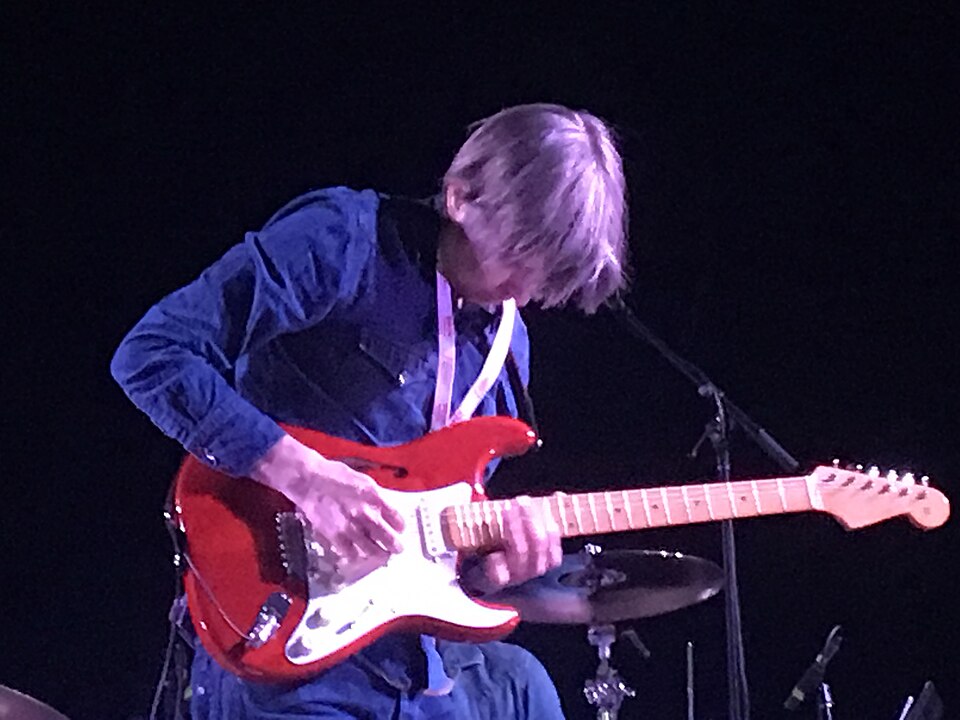
Eric Johnson played GHS Nickel Rockers strings for decades, in two signature gauges: a light set (.010-.050) for longer-scale guitars and a medium set (.011-.052) for shorter-scale instruments. In December 2016, Guitar World reported he'd joined D'Addario's artist roster, quoting him directly on switching to D'Addario Pure Nickel XLs, and GHS's current online roster no longer lists him. His main touring guitar is a Fender Eric Johnson Signature Thinline Stratocaster with a DiMarzio HS-2 bridge pickup, alongside his famous 1954 Strat 'Virginia.' Per Premier Guitar's 2018 Rig Rundown, he runs a four-amp rig: a Two-Rock for dirty rhythm, twin 1966 Fender Twins for clean headroom, and two 1969 Marshall plexi heads for lead tone, one active and one backup.
Who Eric Johnson is
Eric Johnson is an Austin, Texas guitarist known for a violin-like, singing lead tone built from a genuinely unusual combination: multiple amps running at once, each doing one job, and an obsessive, well-documented attention to gear detail. Born August 17, 1954, in the city where Stevie Ray Vaughan later built his career, he started on guitar at 11 and worked through Austin's local scene, including the fusion group Electromagnets and years as a session player for artists like Christopher Cross, before his 1990 major-label album Ah Via Musicom went platinum.
Per Wikipedia's sourced biography, that album's "Cliffs of Dover" won the 1992 Grammy Award for Best Rock Instrumental Performance and remains his best-known composition, out of eight Grammy nominations across his career. The same source documents his three G3 tour appearances: the original 1996 run with Joe Satriani and Steve Vai, a separate 2006 Latin America leg with Satriani and John Petrucci (that year's Satriani/Vai dates, in Australia, didn't include Johnson), and a full 2024 reunion of the original 1996 trio. He continues to release new studio and acoustic albums.
What he plays
The rig, sourced
- Strings
- D'Addario since a December 2016 switch confirmed by Guitar World and a direct Johnson quote. Before that, GHS Nickel Rockers in his own signature gauges for many years: light .010-.050 for longer-scale guitars, medium .011-.052 for shorter-scale guitars.
- Guitar
- Fender Eric Johnson Signature Thinline Stratocaster (semi-hollow), plus his famous 1954 Strat 'Virginia.'
- Amps
- Four in the rig: Two-Rock Traditional Clean (dirty rhythm), twin 1966 Fender Twins (clean), and a pair of 1969 Marshall plexi heads for lead, one active and one backup.
- Pedals
- Modified dual Echoplex tape delays, Dunlop Cry Baby, Ibanez TS-808, B.K. Butler Tube Driver, vintage Fuzz Face.
Why this fits his sound
Johnson's reputation for tone obsession is not a myth invented by guitar magazines, it shows up directly in his amp count. Rather than one amp trying to cover clean, crunch, and lead, he assigns each job to a different amp built for that specific job: Fender Twins for headroom, a Two-Rock for midrange crunch, and a vintage Marshall plexi for the lead tone he is most known for. That approach demands a switching system to match, which is why his pedalboards are dominated by custom-built amp switchers as much as by effects.
The string gauge choice on his old GHS signature sets followed the same logic in miniature. Rather than a single set across every guitar, he matched gauge to scale length: heavier strings on shorter-scale guitars keep tension in a comfortable range, lighter strings on longer-scale guitars do the same. It is a small detail most players never think about, but it is the same instinct that drives the four-amp rig: match the tool to the specific job, not the other way around. Our own E standard tuning guide covers the tension math behind that swap in more detail.
Strings
Current, since December 2016
D'Addario Pure Nickel XL (exact retail part number unconfirmed)
Johnson's own quote announcing the switch: "I use D'Addario strings on acoustic and electric to get the exact tone I want. Recently, I started using the Pure Nickel XLs, and they have a great response." No gauge was given in that announcement, so treat the exact set as confirmed-brand rather than confirmed-gauge.
Source: Guitar World, December 2016.
Before the D'Addario switch, Johnson played GHS Nickel Rockers in two signature gauges for many years. GHS's current online artist roster no longer lists him, but the sets below remain available for sale and are worth knowing if you're chasing his pre-2016, Ah Via Musicom-era tone specifically.
Historical · Light gauge
GHS Nickel Rockers Eric Johnson Signature (.010-.050)
Johnson's own quote from 2015: "GHS Nickel Rockers have always been my favorite string." He reached for this light gauge (.010-.013-.018-.026-.038-.050) mainly on his longer-scale guitars, before his 2016 move to D'Addario.
Source: M Music & Musicians Magazine, 2015.
Historical · Medium gauge
GHS Nickel Rockers Eric Johnson Signature (.011-.052)
The heavier of his two former signature gauges (.011-.014-.019-.028-.040-.052), used mainly on his shorter-scale guitars to keep string tension in the same comfortable range as the light set on a longer scale.
Source: M Music & Musicians Magazine, 2015.
For a contrasting blues-rock rig built around a single plain gauge instead, see Buddy Guy's Ernie Ball Power Slinky setup.