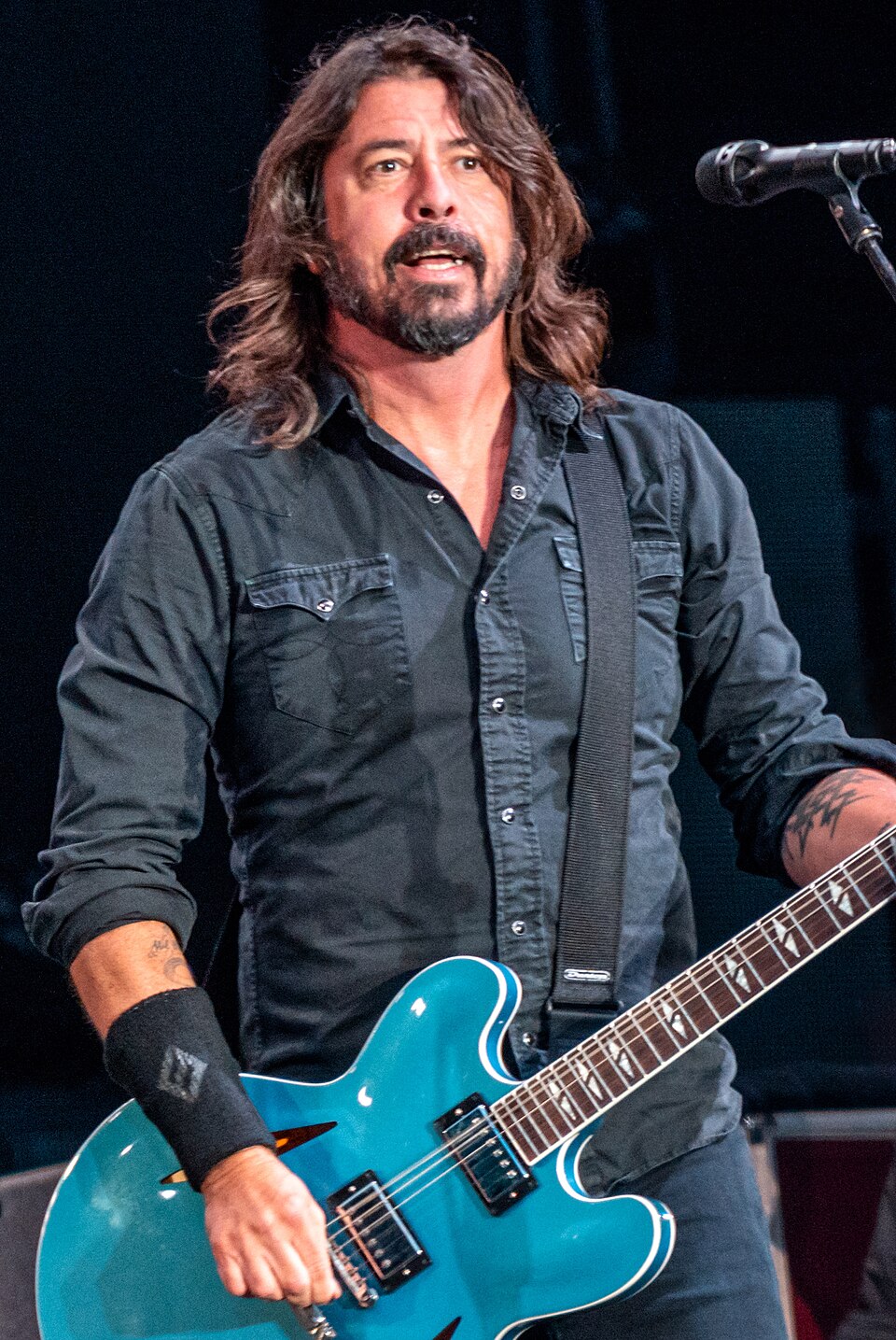
Dave Grohl's guitar strings: the Foo Fighters rig, sourced
Documented guitars and string gauges Dave Grohl plays with Foo Fighters: a custom-gauge D'Addario EXL115, the 1967 Gibson Trini Lopez, and his Gibson DG-335 signature model. Tech and interview sourced.
Foo Fighters · written with AI help · updated
Dave Grohl's guitar tech Joe Beebe fits his D'Addario EXL115 sets with two heavier single strings on top: a .042 for the A and a .060 for the low E, replacing the stock .038 and .049, because Grohl breaks strings hitting them so hard. His main studio guitar since 1992 is a 1967 Gibson Trini Lopez; his main stage guitar since 2007 is the Gibson DG-335 signature model built from the same design.
Who Dave Grohl is
Dave Grohl drummed in Nirvana from 1990 until Kurt Cobain's death in 1994, then founded Foo Fighters that same year, writing and playing every instrument on the band's self-titled 1995 debut himself. He's fronted the band as singer and lead guitarist ever since, across nine studio albums and three decades of arena and stadium shows. His full drumming history, from Nirvana through Foo Fighters session work, is covered on his drummer profile; this page covers the guitar side: what he plays, and what his tech does to make it survive him.
Grohl came to guitar and rhythm songwriting from behind a drum kit, and it shows. His rhythm parts sit on a hard, percussive attack more than intricate voicings, which is part of why his tech has to reinforce the low strings just to keep them from snapping.
What he plays
A D'Addario EXL115 base set with the bottom two strings swapped for a heavier .042 and .060, on a 1967 Gibson Trini Lopez in the studio and a Gibson DG-335 signature model on stage, through a Vox AC30 and a Mesa/Boogie Dual Rectifier.
The documented rig, sourced
- Strings
- D'Addario EXL115 base set (.011-.014-.018-.028-.038-.049), customized by tech Joe Beebe with a .042 A and a .060 low E in place of the stock .038 and .049.
- Main guitars
- 1967 Gibson Trini Lopez for recording (bought around 1992, on every Foo Fighters studio record since) and the Gibson DG-335 signature for the stage, built from the same design.
- Signature model
- Gibson Dave Grohl Signature DG-335, introduced 2007. Trini Lopez body and headstock with a modern Tune-o-Matic and stopbar bridge, Burstbucker humbuckers, almost always in Pelham Blue.
- Amps and pedals
- Vox AC30 for clean and moderate overdrive, Mesa/Boogie Dual Rectifier for heavy distortion, and a ProCo RAT stacked in front of the Vox on specific tracks like Stacked Actors.
The custom low-string swap isn't a stock, purchasable set: it's two single strings added on top of a stock EXL115 pack. D'Addario's EXL115 is the closest thing you can buy off the shelf: Buy on Amazon.
The D'Addario strings, and why his tech beefs them up
Grohl's documented electric set starts as a stock D'Addario EXL115, the Blues/Jazz Rock gauge at .011, .014, .018, .028, .038, .049. What actually ends up on his guitars is different. Guitar tech Joe Beebe has described the modification directly:
I use D'Addario EXL 115s, but I throw the bottom two strings away and I replace them with a .42 for the A-string and a .60 for the E-string.
That's a jump from .038 to .042 on the A string and from .049 to .060 on the low E, while the top four strings (.011, .014, .018, .028) stay stock. Beebe's explanation for the swap is blunt:
He is such a hard player, he's a chainsaw live! He was breaking strings a lot, so I had to beef up the gauges a bunch and I also have to raise the action on him, otherwise he's hitting the strings so hard all it would do is buzz all day long.
Two changes come out of that one problem: heavier low strings that can absorb a harder pick attack without snapping, and raised action so the extra string energy doesn't just rattle against the frets. Neither change is subtle. It's a rig built around a specific, documented playing problem rather than a tone preference.
Why the heavy-hand setup makes sense
Grohl learned guitar and songwriting after years behind a drum kit, and his right hand still plays like one. A drummer's strike doesn't taper off for a delicate passage; it's calibrated for a backbeat that has to cut through a full band at arena volume. Carried over to a guitar, that same attack chews through standard-gauge strings fast, which is exactly the failure mode Beebe describes fixing.
The guitar side of the story runs on the same logic. The 1967 Trini Lopez is Grohl's own "most prized possession" and most-recorded instrument, and by his own account it has been kept largely out of touring conditions since he bought it: early live years ran through Les Pauls, SGs, and a battered black Explorer instead. When Gibson built him a signature model in 2007, it didn't just copy the Trini Lopez's look. It replaced the original's vintage trapeze tailpiece with a modern Tune-o-Matic and stopbar bridge, a small but real durability upgrade for a guitar meant to survive a touring schedule the original never had to.
Heavier low strings and a road-hardened bridge are the same instinct pointed at two different problems: keep the gear working under a player who hits harder than most rigs are built for.
Style signatures
Three things across the Foo Fighters catalog you can identify as Grohl's:
-
Percussive rhythm attack. Grohl's guitar strumming is loud and downstroke-heavy, closer to a drummer hitting a snare than a guitarist finessing dynamics. It's the same instinct that forces his tech to run heavier low strings just to keep them intact.
-
Verse-to-chorus dynamic lift. Foo Fighters songs frequently build from a tighter, palm-muted verse into a wide-open, full-strum chorus, a structural device that mirrors the loud-quiet dynamics he played behind in Nirvana, now written into his own guitar parts instead of just his drumming.
-
Hook-first songwriting. Grohl writes choruses built around a single, immediately singable line ("Everlong," "My Hero," "Learn to Fly"), a pop-song instinct layered on top of hard-rock volume that's a big part of why Foo Fighters crossed over to stadium audiences beyond the alternative-rock lane Nirvana defined.
Electric guitars
The core electric stable, sourced from Ground Guitar's archive and Guitar World's 2024 feature on Grohl's collection.
Bought circa 1992 · Main studio guitar
1967 Gibson Trini Lopez Standard
Bought in a Bethesda, Maryland guitar shop while Grohl was still Nirvana's drummer. By his own account, every Foo Fighters studio record has been made with this guitar. Rarely taken on tour; the basis for his signature DG-335.
Source: Ground Guitar: Dave Grohl's 1967 Gibson Trini Lopez.
Introduced 2007 · Main stage guitar · Pelham Blue
Gibson Dave Grohl Signature DG-335
Gibson's production signature model, built from the Trini Lopez's semi-hollow body and headstock shape. Modern Tune-o-Matic and stopbar bridge in place of the vintage trapeze tailpiece, Burstbucker humbuckers. Black and Metallic Gold finishes exist but Grohl sticks mostly to the original Pelham Blue.
Circa 1995 to early 2000s · Live workhorse · Ebony
Gibson Explorer (late 1990s)
A beaten-up black Explorer, slung low, that defined Grohl's live look through the band's formative years before he moved on to a Firebird and then the DG-335 signature.
Source: Guitar World: Dave Grohl's guitars.
Circa 2005 · In Your Honor tour
Gibson Firebird Studio
A non-standard Firebird build: no neck-through construction, and full-sized humbuckers swapped in for the model's usual mini-humbuckers.
Source: Guitar World: Dave Grohl's guitars.
Acoustic guitars
Modeled on a 1969 original
Gibson Elvis Presley Dove
Modeled on a customized 1969 Dove that Elvis Presley's father gave him: a blacked-out square-shoulder dreadnought with a spruce top, maple back and sides, and a mahogany neck. Grohl's most-associated acoustic for live use.
Source: Guitar World: Dave Grohl's guitars.
Late Late Show, February 16, 2001
Martin D-18
Played on a cover of Elton John's "Tiny Dancer" on The Late Late Show with Craig Kilborn. Ground Guitar's own reporting hedges on ownership: it's unconfirmed whether this was Grohl's guitar or one supplied by the show.
Amps
Main clean amp · There Is Nothing Left to Lose (1999)
Vox AC30
Grohl's main clean and moderate-overdrive amp for years. By his own account it ran for pretty much everything on There Is Nothing Left to Lose, paired with a RAT pedal or dirtier amps for the heavier parts.
Source: Ground Guitar: Dave Grohl's Vox AC30.
The Colour and the Shape (1997)
Mesa/Boogie Dual Rectifier
Grohl has said the band leaned heavily on the Dual/Triple Rectifier sound on The Colour and the Shape, then deliberately eased off it for the next record. Songs including "Everlong" and "Monkey Wrench" run on this amp for their distorted sections.
Source: Ground Guitar: Dave Grohl's Mesa/Boogie Dual Rectifier.
Effects
"Stacked Actors," There Is Nothing Left to Lose
ProCo RAT Distortion
Grohl has described detuning his low E to A and running it through a RAT into the Vox AC30 for something warmer and less razor-sharp than a straight Rectifier distortion. One of his most-documented pedals, though specific per-song use is rarely confirmed beyond this one.
Strings
The purchasable base set, and the modification his tech makes on top of it.
Base set · Stock gauge
D'Addario EXL115 (.011-.049)
The set Grohl's tech starts from before modifying it. Stock gauge, nickel-plated steel on a hex steel core, the same Blues/Jazz Rock set D'Addario sells to anyone.
The actual on-guitar setup · Not a stock pack
EXL115 top four, plus a .042 A and .060 low E
Tech Joe Beebe keeps the stock .011, .014, .018, .028 top four and replaces the .038 A and .049 low E with heavier single strings, because Grohl's attack breaks the stock gauge and needs raised action to stop the buzz.
Picks
Documented since the 1990s
Dunlop Gator Grip .71mm (Purple)
A matte-surfaced pick built for extra grip over a smooth standard pick. Dunlop later produced custom Foo Fighters logo picks in the same shape and gauge.
Source: Ground Guitar: Dave Grohl's Dunlop Gator Grip picks.
If you want this rig

EXL115 XL Nickel Wound (.011–.049)
Why this one: The base set Grohl's tech starts from before beefing up the low strings. Play it stock for a well-balanced Blues/Jazz Rock gauge, or follow his tech's lead and swap in a heavier .042 A and .060 low E if you're a hard-hitting rhythm player who breaks strings.