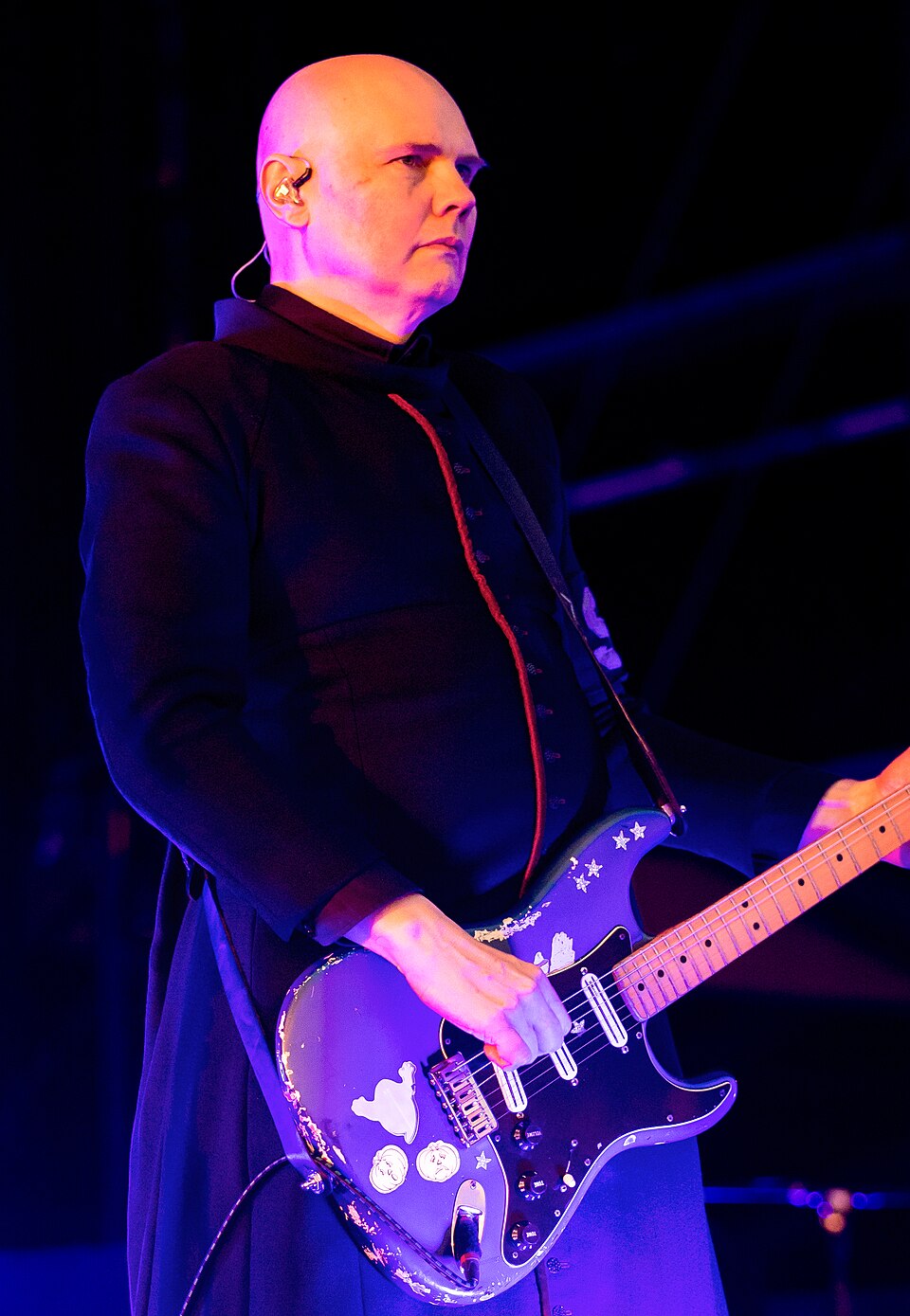
Billy Corgan's guitar strings: the Smashing Pumpkins rig, sourced
Documented string gauges and signature gear Billy Corgan uses with the Smashing Pumpkins: three Reverend signature guitars (factory-strung .010-.046), a self-reported .009-.042 gauge preference, and his current Carstens Grace, Empire, and Cathedral amps. With citations.
The Smashing Pumpkins · written with AI help · updated
Billy Corgan's three signature Reverend guitars (the Signature, Z-One, and Terz) all factory-ship with a .010-.046 string gauge, per Reverend's own spec sheets, though Reverend never names a brand. In an archival Guitar World column, Corgan wrote that he personally uses .009-.042 for soloing and all-purpose rock rhythm. His amp rig has moved from a 2012 Salvation Mods modular preamp system to three custom Carstens amps (Grace, Empire, Cathedral) today.
Who Billy Corgan is
William Patrick Corgan Jr. was born March 17, 1967, in Chicago. He formed The Smashing Pumpkins in his hometown in 1988 with guitarist James Iha and bassist D'Arcy Wretzky, and the band played its first show as a quartet on October 5, 1988, once drummer Jimmy Chamberlin joined to help land a gig at the Cabaret Metro.
Corgan is the band's sole constant member, its primary songwriter, and its guitarist. Gish (1991) folded psychedelic rock and heavy metal together into a debut that outperformed expectations. Siamese Dream (1993) went multi-platinum and confirmed a rumor Corgan later admitted was true: he played nearly all the guitar and bass parts on the record himself. Mellon Collie and the Infinite Sadness (1995), a 28-song double album, went on to sell ten times platinum in the US and produced "1979," his biggest chart hit. The band broke up in 2000, reformed in 2007 with new members including guitarist Jeff Schroeder, and has continued releasing and touring since, including a 2018 reunion run with Iha and Chamberlin back in the lineup.
What he plays
Two different string facts, both without a confirmed brand, plus three signature Reverend guitars and an amp rig that has completely changed since 2012.
The gear, sourced
- Strings
- Two documented gauges, no confirmed brand for either: .009-.042 (Corgan's own self-reported gauge from a Guitar World column, Gish/Siamese Dream era) and .010-.046 (the factory gauge Reverend ships on all three of his signature guitars today).
- Signature guitars
- Reverend Billy Corgan Signature (Korina, Railhammer pickups), Z-One (alder, heavier tone), and Terz (short scale, tuned a minor third up). All three, plus historical Fender Stratocasters and a Fender Jaguar documented in Premier Guitar's 2012 Rig Rundown.
- Amps
- Currently three Carstens Amplification heads: Grace (his first signature amp), Empire (metal-focused), and Cathedral (clean). In 2012 his rig ran through eight Salvation Mods preamp modules cloning vintage amps he owns.
The closest widely available match to the factory gauge Reverend ships on his signature guitars is Ernie Ball's Regular Slinky (.010–.046), though neither Reverend nor Corgan has confirmed that's the actual brand on those guitars. See it on Amazon
Three Reverend signatures
Corgan's relationship with Reverend Guitars has produced three distinct production models, each built for a different slice of the catalog.
The original Billy Corgan Signature (also called the BC-1) came first: a Korina solidbody with a raised center section, thinner wings, and strategic chambers under the pickguard to add resonance and cut weight. Its Railhammer Billy Corgan Signature pickups use rails under the wound strings and poles under the plain strings, a design meant to deliver a P90-like snap with humbucker-level output and no hum. Guitar World gave it a Platinum Award in its 2016 review, with critic Chris Gill calling it "one of those rare exceptions" among new solidbody designs, one with genuine tonal personality rather than a variation on something familiar. Gill noted Corgan's tonal reference point for the pickups was Tony Iommi's "cocked wah" midrange.
The Z-One followed as Reverend's third Corgan and Joe Naylor collaboration, built for the heavier end of the Pumpkins catalog. Reverend's own product page names specific reference songs Corgan gave the team while developing it: "Geek USA," "Quiet," "Jellybelly," "Zero," and "Bodies," all early, harder-hitting Pumpkins tracks. The Z-One swaps the Korina body for alder, which Reverend describes as thicker and smoother sounding, and beefs up the pickup output accordingly.
The Terz is the odd one out: a production electric version of a 19th-century instrument tuned a minor third above standard pitch (G-C-F-A#-D-G) on a 21.5-inch short scale. Reverend says Corgan suggested it after years of capoing at the third fret, and that Reverend is the first company to build an electric Terz as a production model. It carries a single Railhammer Billy Corgan pickup rather than the two on the other models.
All three ship, per Reverend's own spec sheets, with a factory string gauge of .010-.046. Reverend doesn't name the string brand on any of the three product pages.
From Salvation Mods to Carstens: the amp story
Corgan's amp rig has gone through a near-complete overhaul since Premier Guitar last filmed his gear in 2012.
Back then, his rig ran through eight preamp modules custom-built by Salvation Mods, each one cloning a personal amp Corgan owned: a 1960s Selmer, a modified "Soul" Marshall 2203, a Reeves Custom Jimmy (a Hiwatt-style clone associated with Jimmy Page), a Marshall Super Lead 1959RR Randy Rhoads Limited Edition, a VamPower amp with a fuzz mod for Oceania-era material, a Diezel VH4, and a 1969 Marshall Super Tremolo. The modules fed Mesa/Boogie Strategy 500 power amps left over from the Mellon Collie touring rig, mixed with a mic'd 1960 Marshall 4x12 cabinet loaded with new Celestion 75-watt speakers.
That system is gone today. According to a 2026 Guitar World feature on amp builder Brian Carstens, Corgan met Carstens backstage at a Pumpkins show through guitarist Jeff Schroeder, whose gear Carstens had also worked on. Carstens reached out afterward as a fan, and the two struck up a relationship that led to a custom amp commission. Corgan's brief was mostly about what he didn't want: no Marshall, and nothing that repeated a sound he'd already used. He reportedly told Carstens, "I've never played a high-gain amp that I like," before Carstens spent months building a prototype.
When Carstens brought the finished amp to Corgan's Chicago studio and set it up on a silver Marshall 4x12 cab left over from the Mellon Collie tour, Corgan reportedly stopped mid-adjustment, smiled at Chamberlin, and started playing "Shiva." He asked to keep it. That amp became the Grace, Corgan's first and so far only signature amp. Carstens has since built the Empire, a modern metal-oriented design developed with input from Periphery's Misha Mansoor, and the Cathedral, aimed at clean, chimey tones. A photo in the Guitar World piece confirms all three, Grace, Empire, and Cathedral, are part of Corgan's current live setup. Laney has also released the Supergrace, a pedal-format unit combining the Grace circuit with Laney's own Supergroup voicing, shown publicly at NAMM on January 22, 2026.
Why this fits the rig
Three different signature guitar bodies for one player only makes sense if the player genuinely uses all three for different jobs, and the sourcing backs that up: Korina for the original Signature's balanced resonance, alder on the Z-One for a thicker low end on heavier songs, and a completely different short-scale, alternate-tuned instrument in the Terz. That's a wider spread than most signature-guitar deals bother with.
The amp story tracks the same instinct. Carstens described Corgan's brief as mostly a list of things to avoid, and quoted him saying he'd never liked a high-gain amp before the Grace. Corgan has said, in Carstens' own account, that he doesn't like to repeat himself. Three separate Carstens amps, each voiced for a different job (high-gain, extended-range metal, and clean), fits that stated preference better than a single do-everything channel-switcher would.
The string picture is honestly the least settled part of the rig. Reverend's own spec sheets confirm .010-.046 on the current signature guitars without naming a brand, and Corgan's own most specific public gauge statement, .009-.042, comes from an archival column that reads like a mid-1990s preference rather than a current one. Both are real, sourced data points. Neither should be read as more current or authoritative than the other.
Style signatures
Three things you can trace across the Pumpkins catalog back to Corgan specifically:
-
Studio layering as a control mechanism. The rumor that Corgan played most of the guitar and bass parts on Siamese Dream himself was a music-press controversy at the time. He later confirmed it. That layering approach, building a wall of guitars from a single player's takes rather than a full-band performance, is part of why the album's guitar tone sounds so dense on record compared to a four-piece live band.
-
Genre-blending over genre loyalty. Gish fused psychedelic rock and heavy metal in a way that didn't fit neatly into the early-1990s alternative landscape. That refusal to sit inside one lane is consistent with a catalog that runs from the acoustic, electronic-leaning Adore to the harder Machina records.
-
Never repeating a gear decision. Carstens' own account of developing the Grace amp centers on Corgan's insistence that it not sound like anything he'd already used. Three differently-bodied signature guitars and three differently-voiced signature amps both point at the same underlying habit: treat each new piece of gear as solving a problem the last one didn't.
Electric guitars
Sourced from Premier Guitar's 2012 Rig Rundown, Reverend's own product pages, and Guitar World's 2016 review of the original Signature model.
Signature model · Guitar World Platinum Award, 2016
Reverend Billy Corgan Signature (BC-1)
Korina solidbody with strategic body chambering, a string-thru hardtail bridge, and Railhammer Billy Corgan Signature pickups (rails under the wound strings, poles under the plain strings) for a P90-snap, humbucker-output tone with no hum. Guitar World's Chris Gill said Corgan's tonal reference point was Tony Iommi's "cocked wah" midrange.
Third Corgan and Joe Naylor collaboration
Reverend Billy Corgan Signature Z-One
Alder body instead of the original's Korina, for a thicker, smoother, heavier tone. Reverend's own product page cites specific reference songs Corgan gave the design team: "Geek USA," "Quiet," "Jellybelly," "Zero," and "Bodies."
Source: Reverend product page.
21.5-inch short scale · Tuned G-C-F-A#-D-G
Reverend Billy Corgan Terz
A production electric version of a 19th-century Terz guitar, tuned a minor third above standard. Reverend says Corgan requested it after years of capoing at the third fret, and calls it the first production electric Terz from any manufacturer. Single Railhammer Billy Corgan pickup.
Source: Reverend product page.
2012 touring rig · Tuned to E
Fender Stratocaster(s)
Premier Guitar's 2012 Rig Rundown describes Corgan's main-set guitars as "his signature Fender Billy Corgan Strats," loaded with Billy Corgan DiMarzio pickups and tuned to standard E for most of the set.
Source: Premier Guitar Rig Rundown, 2012.
E-flat songs · Nicknamed "I Love My Mom"
Mid-1970s Fender Stratocaster
A DiMarzio-loaded, mid-70s Strat used for songs tuned to E-flat in the 2012 rundown, previously known as his "I Love My Mom" guitar. The same rundown separately describes a mid-70s DiMarzio Strat that Corgan says is the closest match to his original Gish-era Strat, stolen in the 1990s. Premier Guitar's text doesn't make clear whether these are the same physical guitar or two different ones from the same era.
Source: Premier Guitar Rig Rundown, 2012.
Oceania-era songs · Recent-issue at the time
Fender Jaguar
Used for material from Oceania (2012) in the same rundown. The piece also names two other situational instruments for specific songs: a Reverend tuned to G for "Violet Rays," and a vintage Harmony loaded with Alembic pickups for "Pinwheels."
Source: Premier Guitar Rig Rundown, 2012.
Amps
Current · First-ever signature amp
Carstens Grace
Built by Brian Carstens after Corgan told him he'd never played a high-gain amp he liked. Single-channel by design, meant to sound "wide and harmonic and open and big" rather than compressed. Corgan reportedly asked to keep the prototype the first time he played it, mid-take on "Shiva."
Source: Guitar World, 2026.
Current · Live rig, per Guitar World photo
Carstens Empire
A modern metal-oriented Carstens amp developed with input from Periphery's Misha Mansoor, built for extended-range guitars. A Guitar World photo caption confirms it's part of Corgan's current live setup alongside the Grace and Cathedral.
Source: Guitar World, 2026.
Current · Clean-voiced
Carstens Cathedral
Designed to be, in Carstens' words, "the ultimate clean, chimey, glassy, beautiful clean amplifier." The third Carstens head confirmed in Corgan's current live rig alongside the Grace and Empire.
Source: Guitar World, 2026.
Pedal format · Shown at NAMM, January 2026
Laney Supergrace
A pedal-format hybrid combining the Grace circuit with Laney's own Supergroup voicing on the other side, built so players can access an approximation of Corgan's live tone at a pedal price point rather than a full amp head.
Source: Guitar World, 2026.
Historical · 2012 touring rig
Salvation Mods modular preamp system
Eight preamp modules cloning Corgan's own amps: a 1960s Selmer, a modified "Soul" Marshall 2203, a Hiwatt-style Reeves Custom Jimmy, a Marshall Super Lead 1959RR Randy Rhoads Limited Edition, a fuzz-modded VamPower for Oceania material, a Diezel VH4, and a 1969 Marshall Super Tremolo. Fed Mesa/Boogie Strategy 500 power amps and a mic'd 1960 Marshall 4x12 with new Celestion 75-watt speakers, both held over from the Mellon Collie tour.
Source: Premier Guitar Rig Rundown, 2012.
Effects
Historical · 2012 touring pedalboard
Skreddy Echo, MXR Phase 90 (x2), Fulltone Catalyst, and more
Per the 2012 rundown: a Skreddy Echo (Corgan's closest available match to a vintage Binson Echorec), two MXR Phase 90s for solos, a Fulltone Catalyst used as a preamp, a Chicago Iron Octavian, a Boss PS-2 Phase Shifter, and a Strymon El Capistan. A discontinued custom pedal called the Bloody Finger was, per Corgan, his best solo pedal, described as a Brian May-style Queen tone with more gain. A Rocktron All Access switcher and Keeley loopers moved pedals in and out of the chain; Corgan told Premier Guitar that 90 percent of the show is just the guitar and amps.
Source: Premier Guitar Rig Rundown, 2012.
Strings
Self-reported · Gish and Siamese Dream era
.009–.042 (brand not stated)
From Corgan's own Guitar World column, republished from the archives in 2012: "For more all-purpose rock guitar styles that involve a lot of soloing and string bending, I recommend .009-.042, which I use." No brand named, and the column's references to Gish and Siamese Dream suggest this was a mid-1990s preference rather than a confirmed current gauge.
Current · Factory-strung on all 3 signature guitars
.010–.046 (brand not stated)
Reverend's own spec sheets list Strings: 10-46 on the Billy Corgan Signature, Z-One, and Terz product pages, but none of the three names a brand. The closest widely available equivalent gauge on CYS is Ernie Ball's Regular Slinky, offered here as a gauge match only, not a confirmed brand claim.
If you want this rig
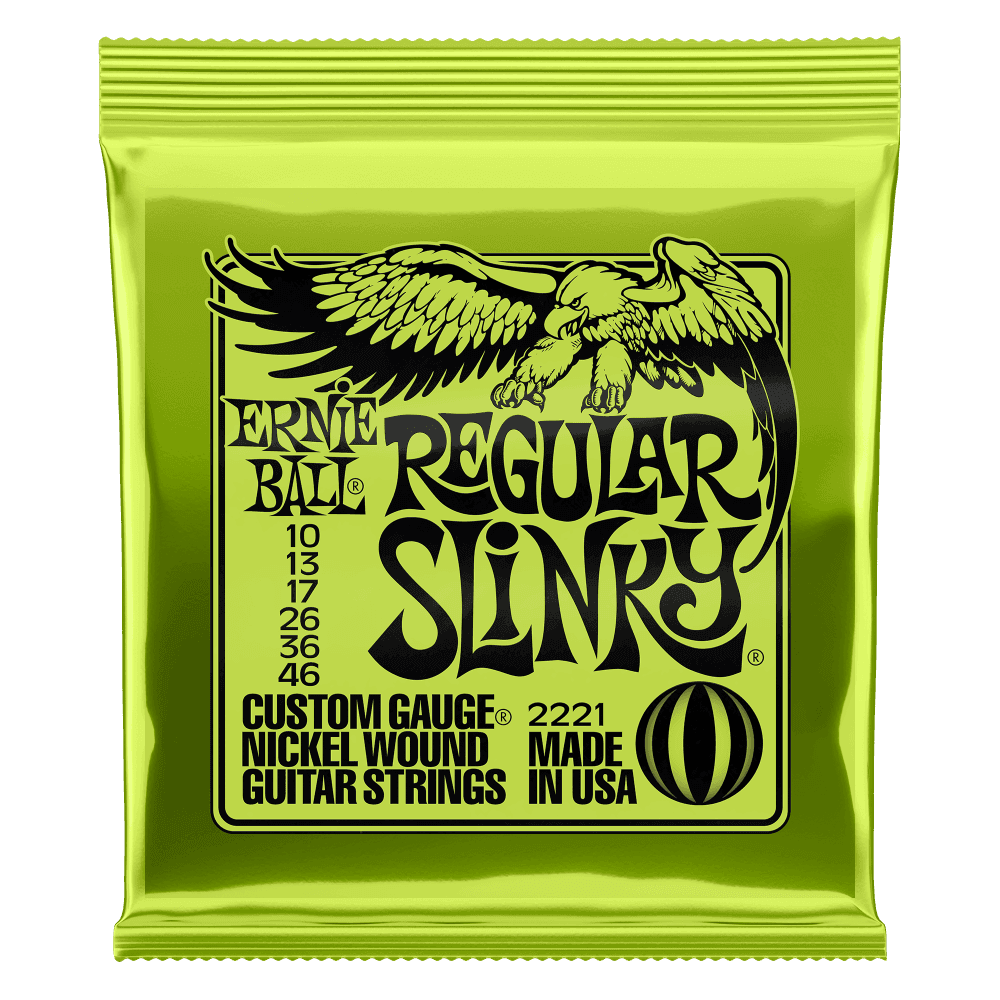
Regular Slinky (.010–.046)
Why this one: Not a confirmed match to Corgan's own strings, but the closest widely available set to the .010-.046 gauge Reverend's own spec sheets list on all three of his signature guitars.