Thomastik-Infeld Dominant violin strings: the synthetic-core workhorse, since 1970
Written with AI help · Updated
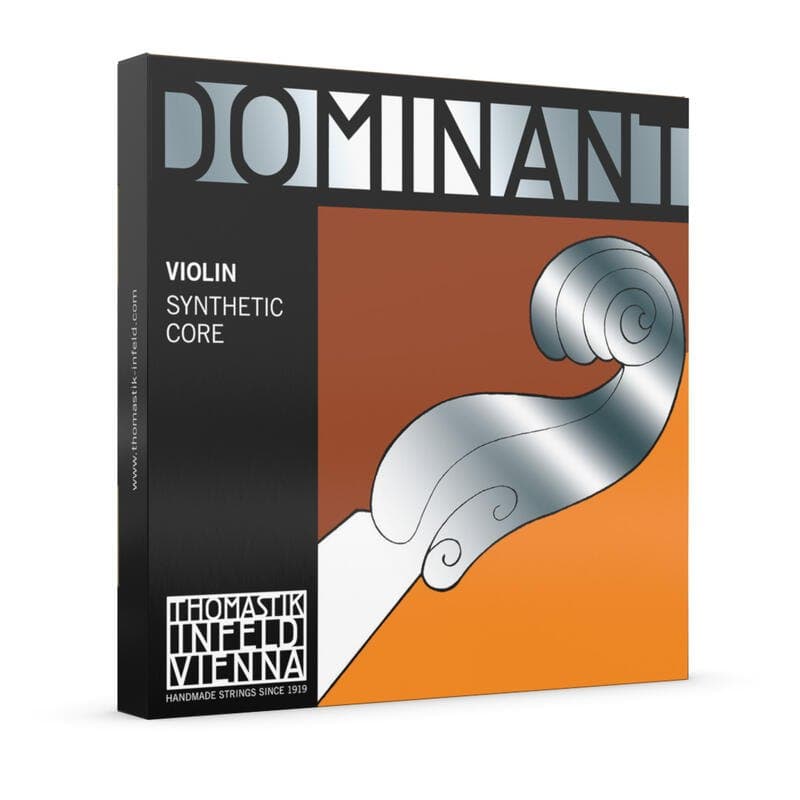
Thomastik-Infeld Dominant is the canonical synthetic-core 4/4 violin string, in continuous production since 1970. Perlon (synthetic multifilament) core, aluminium wrap on A and D, silver-wound aluminium on G, stainless steel E. Hilary Hahn's documented set since childhood and on every record she's released; Itzhak Perlman uses Dominant on A, D, and G with a Pirastro Gold Label E. Sits in the warm, balanced, responsive lane that conservatory training defaults to. The reference set most violin players measure other strings against.
Anatomy
- Model
- Thomastik-Infeld Dominant 4/4 Violin Set
- Variants
- Dominant 135B (medium tension), 135 (with ball end), individual strings sold separately. Three-quarter and half-size variants for student instruments.
- Strings
- 4-string set: E, A, D, G
- Core wire
- Perlon synthetic multifilament (the Thomastik proprietary synthetic-core blend)
- Wrap wire (A, D)
- Aluminium
- Wrap wire (G)
- Silver-wound aluminium
- E string construction
- Stainless steel (plain, unwound)
- Tension
- Medium (the standard 135B; lighter and heavier variants available)
- Coating
- None, uncoated
- Intended scale
- 4/4 full-size violin (3/4 and 1/2 variants for student sizes)
- Launched
- 1970 (the first commercial synthetic-core violin string set)
- Made in
- Vienna, Austria
Why Dominant is the conservatory default
- Synthetic-core stability
- Pre-1970, the only realistic violin-string options were gut (warm, expressive, but pitch-unstable) and steel-core (stable but harsh). Dominant's Perlon core was the first synthetic that matched gut's warm response while holding pitch like steel. That single innovation reshaped the entire category.
- Tonal forgiveness
- Dominant doesn't punish technique gaps the way brighter soloist sets do. Students learning bow control, intonation, and shifting work on Dominant because the strings give back what's played, not a harsher version of it. Conservatory faculties ship Dominant on student loaners for this reason.
- Predictable supply
- Available at every violin retailer worldwide. Never on backorder for the standard 135B medium-tension 4/4 set. Replacement single strings stock at most stores.
- The E string is the upgrade lever
- Pros routinely buy the A/D/G as a Dominant set and select an E separately. Pirastro Gold Label, Westminster, and Goldbrokat are the common upgrades; the Dominant E is fine for students but most professionals replace it within a year of using it.
Tone
Dominant lives in the warm-but-balanced lane. The Perlon core gives the A/D/G strings a slightly mellow attack with a controlled sustain, bowed notes bloom into the room rather than spike at the bow contact. The aluminium wrap adds enough definition that fast articulation reads cleanly without the strings feeling brittle.
Compared to its closest competitors:
| Thomastik Dominant | Pirastro Evah Pirazzi | Pirastro Eudoxa (gut-core) | |
|---|---|---|---|
| Core material | Perlon (synthetic) | Synthetic multifilament | Gut |
| Brightness | 6/10 | 8/10 | 3/10 |
| Sustain | Long, controlled | Long, intense | Short, complex |
| Pitch stability | High | High | Low (gut shifts with humidity) |
| Best for | Conservatory, orchestral, solo (warm) | Solo, projection, soloist | Vintage tone, period repertoire |
| Documented users | Hilary Hahn, Perlman (A/D/G) | Vengerov, Jansen (Neo variant) | Pre-1970 historical roster |
| Price tier | $$ | $$$ | $$$ (gut is expensive) |
Best for
- Conservatory and university violin students. The most-recommended set across faculty syllabi for technique-development.
- Orchestral section players. Predictable response, blends well in section work, doesn't fight the conductor.
- Solo violinists who want warmth over projection. Hilary Hahn's recorded sound is the canonical example, Dominant's Perlon-core warmth is part of what makes her tone identifiable.
- Recording sessions where a balanced room mic capture matters more than maximum projection. Dominant doesn't peak in the upper-midrange the way Evah Pirazzi can.
Worst for
- Concerto performance in large halls where projection is the priority. Step to Vision Solo or Evah Pirazzi if the room is fighting you.
- Fiddle and bluegrass players who want a bright, cutting top-end. Helicore (D'Addario, steel-core) or a dedicated fiddle set fits better.
- Players who want gut-core tone specifically. The Perlon core is engineered to approximate gut response, but it isn't gut. If you want gut, Eudoxa or Pirastro Oliv.
Who plays them
- Hilary Hahn: documented Dominant user since childhood per Thomastik's official Artist Family page. Every Hahn record was tracked on Dominant strings.
- Itzhak Perlman: Dominant on A, D, G plus a Pirastro Gold Label E. Documented across multiple violin-string-FAQ secondary sources.
- The conservatory roster broadly. Most students at Juilliard, Curtis, the Royal Academy, and equivalent institutions are on Dominant for at least their first several years of training.
Install and break-in
- Loosen the existing strings evenly. Don't remove all four at once, the bridge needs at least one or two strings holding it in position to maintain its setup angle.
- Replace one string at a time, starting with G (the lowest), working up to E.
- Wind each new string at the peg with even tension. Most violin tuning pegs require 2 to 4 wraps; over-wrapping causes binding.
- Tune to pitch, then re-tune. Synthetic-core strings stretch for the first 24 to 48 hours after install. Expect to retune 4 to 6 times in the first day before the set settles.
- Break-in: 30 to 60 minutes of bow work to seat the rosin contact and let the windings settle. Most violinists notice the tone open up around hour 2.
Verdict
Dominant is the violin-string equivalent of Ernie Ball Regular Slinky on guitar: the safe, reliable, technique-supporting default that most working players play either deliberately or because they've never been pushed to change. If you're a conservatory student, an orchestral section player, or a soloist who wants warmth over projection, this is the answer. If you want brighter projection, see Evah Pirazzi; if you want gut-core warmth, see Eudoxa.
Dominant Violin 4/4 (135B, Medium)
Why this one: The conservatory-default synthetic-core set since 1970: Perlon core, aluminium A/D wrap, silver-wound G, the reference standard most other violin strings get compared against.
Related
- The verified Dominant user with the deepest catalog: Hilary Hahn's rig page (when shipped).
- Brighter alternative in the synthetic-core lane: Pirastro Evah Pirazzi (review when shipped).
- Gut-core alternative: Pirastro Eudoxa (review when shipped).
- Compare violin string brands: Pirastro vs Thomastik vs D'Addario (guide when shipped).