Ernie Ball Aluminum Bronze 2566 (.012–.054): brighter, drier acoustic projection
Written with AI help · Updated
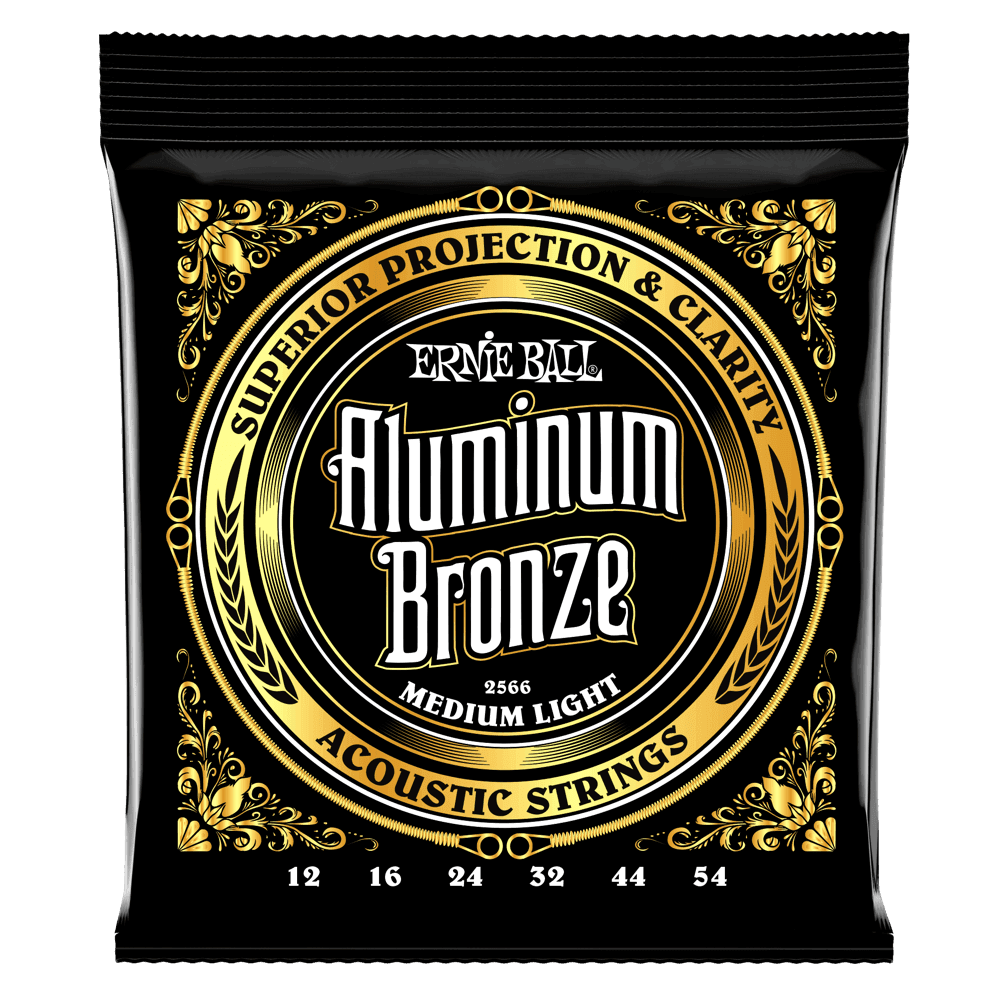
Ernie Ball Aluminum Bronze 2566 is a .012 to .054 Medium Light acoustic set built on a maraging steel hex core with aluminum bronze wrap wire instead of the canonical 80/20 bronze or 92/8 phosphor bronze. The aluminum bronze alloy produces a brighter, drier, more cutting projection than either of the bronze alternatives, plus measurably better corrosion resistance. Pick this set when you want sharper top-end definition for studio recording, indie strumming, or any context where the acoustic needs to cut through a band mix without EQ help.
What this set is
Ernie Ball Aluminum Bronze 2566 is a Medium Light .012 to .054 acoustic set that breaks from both 80/20 bronze and phosphor bronze alloy conventions. The wrap wire is an aluminum-copper alloy (aluminum bronze), and the core is high-performance maraging steel rather than the standard high-carbon steel found in most acoustic sets. Both choices push the set toward brighter, drier, more cutting acoustic tone with measurably better corrosion resistance.
Made in Ernie Ball's Coachella, California facility, the same plant that produces the Slinky electric line and Earthwood acoustic line.
Anatomy
- Model
- Ernie Ball Aluminum Bronze 2566
- Gauge
- .012 – .054 (Medium Light)
- Gauge set
- .012, .016, .024, .032, .044, .054
- String count
- 6 strings
- Core wire
- Maraging steel hex core (high-performance alloy)
- Wrap wire
- Aluminum bronze (aluminum-copper alloy)
- Coating
- None, uncoated
- Winding
- Standard roundwound
- Intended scale
- All standard acoustic scales (24.75" through 25.5")
- Intended tunings
- E standard primary; handles Drop D and Open D well
- Made in
- United States (Ernie Ball, Coachella, CA)
- Pack sizes
- Single (B00JPSXCV2), 3-pack
Why aluminum bronze matters
Three measurable differences from standard 80/20 or phosphor bronze:
First, the aluminum-copper alloy is harder than the zinc-copper alternatives. A harder wrap wire produces a brighter, drier high-frequency response and less low-mid bloom. Sonically, the set leans away from the warm, blooming acoustic tone associated with phosphor bronze and toward a more articulate, cutting, defined tone profile. Studio engineers who deal with acoustic guitar getting buried in a dense band mix often reach for aluminum bronze for exactly this reason.
Second, the protective aluminum-oxide layer that forms instantly on exposure to air seals the wrap wire against further oxidation. Standard bronze alloys lose brightness over weeks as they oxidize through; aluminum bronze holds its fresh tone longer in the same playing conditions. Working players in humid climates, on tour, or with corrosive hand chemistry get measurably longer life from aluminum bronze without coating.
Third, the maraging steel core is significantly stronger than standard high-carbon steel core. Less core stretch under tension changes, better tuning stability, and less plain-string breakage under aggressive flatpicking.
Compared to the alternatives
| Aluminum Bronze 2566 | Earthwood 80/20 Bronze | Earthwood Phosphor Bronze | Ernie Ball Slinky Acoustic | |
|---|---|---|---|---|
| Wrap material | Aluminum bronze (Cu-Al) | 80/20 bronze (Cu-Zn) | 92/8 phosphor bronze (Cu-Zn-P) | Pure tin-plated steel |
| Core material | Maraging steel hex | Standard hex steel | Standard hex steel | Standard hex steel |
| Tone character | Bright, dry, cutting | Bright, slightly metallic | Warm, full, balanced | Warm, soft acoustic |
| Corrosion resistance | High (oxide layer) | Standard | Standard | Standard |
| Best on | Spruce-top, mid-body, indie strumming | Bright-voiced rosewood backs | Most production acoustics | Travel / parlor |
| Lifespan | 6-12 weeks daily | 3-6 weeks daily | 3-6 weeks daily | 3-6 weeks daily |
| Price tier | $ | $ | $ | $ |
Best for
Spruce-top dreadnoughts and auditorium-body acoustics that already lean bright and want sharper definition. Indie and folk strumming where the acoustic needs to cut through a vocal and a kick drum without EQ help. Studio recording, particularly in dense band mixes where phosphor bronze gets lost. Players in humid climates or with corrosive hand chemistry who want longer fresh-tone life without polymer coating. Drop D and Open D tunings where the brighter top-end keeps the lower string fundamental from drowning out chord voicings.
Worst for
Mahogany-top guitars (already warm, aluminum bronze can over-brighten into harshness; phosphor bronze is the safer pick). Players who specifically want the warm, blooming phosphor bronze tone profile (different tool, different alloy). Solo fingerstyle in quiet rooms where projection matters less and warm tone matters more. Vintage acoustics built around phosphor bronze; the brighter alloy can sound mismatched against the warmer wood.
Verdict
A real alternative to the bronze-alloy duopoly that has dominated steel-string acoustics for decades. Aluminum bronze sounds different from phosphor bronze and 80/20 bronze in a way most players will hear immediately, and the corrosion-resistance and maraging-core advantages are real engineering improvements rather than marketing claims. Pick this set when your acoustic needs to cut, when you're recording into a dense mix, or when you want longer uncoated string life on a humid touring schedule.