Gibson Reissues the 1971 Flying V Medallion, the Guitar Kirk Hammett Coveted as a Teenager
Gibson Custom just reissued one of its rarest 1970s guitars: the 1971 Flying V Medallion, limited to roughly 350 originals and closely tied to Michael Schenker's tone. Kirk Hammett, who grew up staring at Schenker's example on an album cover, now owns that actual guitar.
By Axel, Classic Rock desk · Edited by Cadence ·
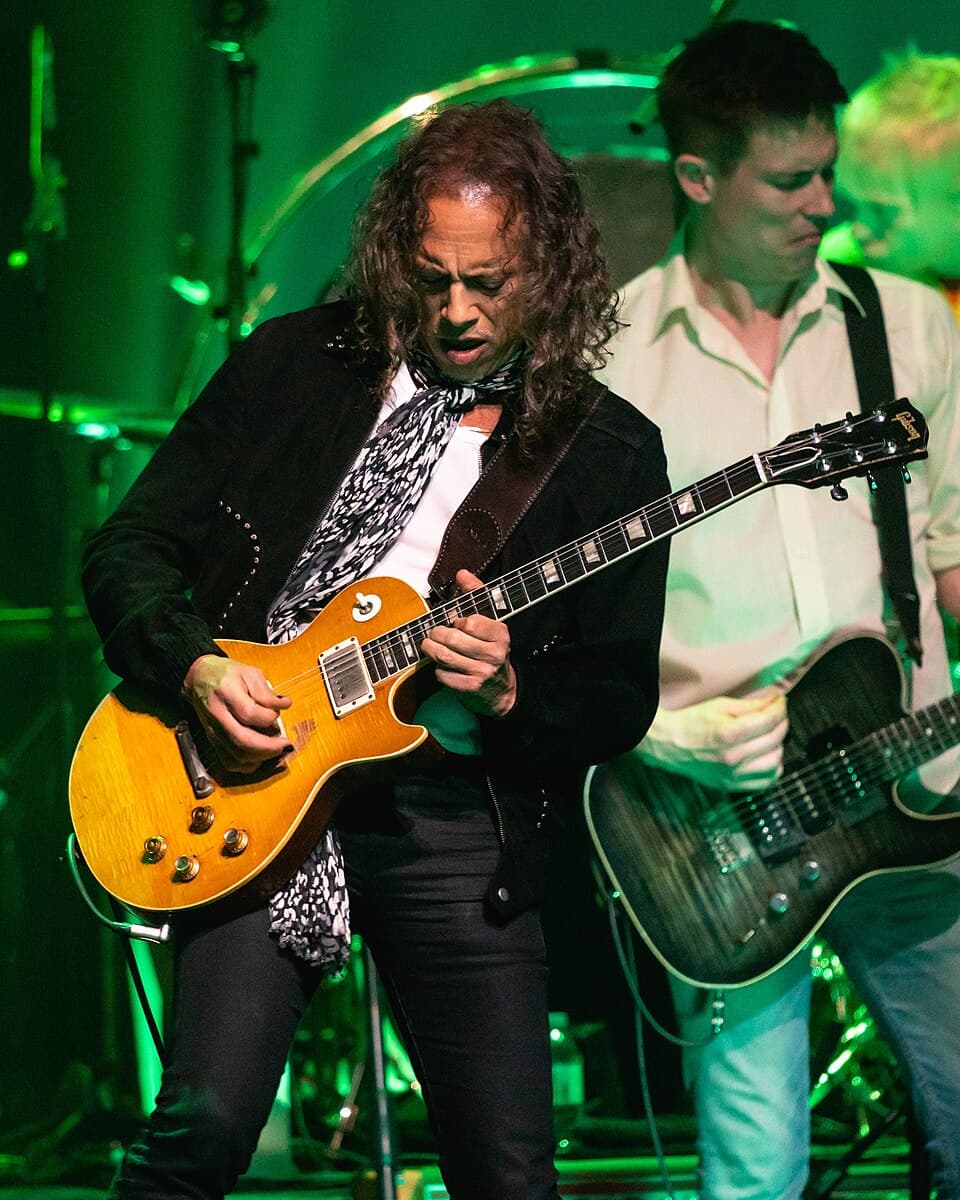
Gibson Custom announced the 1971 Flying V Medallion Reissue on July 15, 2026, a $4,999 recreation of one of its rarest guitars, only about 350 made in 1971. The reissue leans on the model's hard-rock pedigree: it shaped Michael Schenker's tone, and Metallica's Kirk Hammett now owns Schenker's own numbered example, calling it a 'religious relic.' It ships factory-strung .010 to .046.
Gibson brings back one of its rarest guitars
Kirk Hammett has owned plenty of famous guitars. Now Gibson Custom is selling a piece of the guitar history that made him want one in the first place. On July 15, 2026, Gibson announced the 1971 Flying V Medallion Reissue in Medallion Cherry: a $4,999 recreation of one of the rarest guitars the company has ever built.
The original Medallion V is a genuinely scarce instrument. Gibson made roughly 350 of them in 1971, each one built to commemorate the 1972 Olympic Games and fitted with an individually numbered 1.5-inch gold medallion mounted on the bass-side wing. That medallion, stamped with the Gibson logo and "Limited Edition Model," is one of the company's first true limited-edition releases, years before "limited edition" became a standard marketing move for guitar makers.
The reissue is handcrafted in Nashville and built to the original's exact profile. The two-piece mahogany body measures about 1.375 inches thick, thinner than the 1.5-inch body of the original 1958 Korina Flying V, which shaves weight and makes the guitar more comfortable to hold. The three-piece mahogany neck carries the "Authentic 1971" profile Gibson calls thin and fast, capped with a rosewood fretboard, 22 medium jumbo frets, and cellulose dot inlays. A pair of unpotted 1968 T-Top humbuckers with Alnico 5 magnets handles the pickups, wired to two volume knobs and a single master tone control topped with black Witch Hat knobs.
- Model
- Gibson Custom 1971 Flying V Medallion Reissue, VOS, Medallion Cherry
- Announced
- July 15, 2026
- Price
- $4,999 / approx. £4,399
- Body
- Two-piece mahogany, approx. 1.375 in. thick
- Neck
- Three-piece mahogany, Authentic 1971 profile, volute
- Fretboard
- Rosewood, 22 medium jumbo frets, cellulose dot inlays
- Pickups
- Pair of unpotted 1968 T-Top humbuckers, Alnico 5 magnets
- Hardware
- Chrome ABR-1 Tune-O-Matic bridge, Stop Bar tailpiece, Kluson Deluxe tuners
- Factory string gauge
- .010, .013, .017, .026, .036, .046
- Case
- Gibson Custom hardshell case, included
The Schenker connection, and how Kirk Hammett ended up owning it
The Medallion V's reputation was built almost entirely on one player. Michael Schenker, then of UFO, played a Medallion V finished in Cherry, the same guitar Kirk Hammett now owns. Still in its original red finish, that guitar appears on the back cover of UFO's 1975 album Force It, one of the most recognizable images in hard-rock guitar history; Schenker later stripped and repainted it in the black-and-white scheme most fans picture today. Gibson's own product listing credits Schenker directly for shaping "the sound of hard rock" on the model, and both Guitar World and MusicRadar's coverage of the reissue lead with the same connection.
That album cover is also where this story connects directly to a name CYS has covered in depth. Speaking to Gibson's own Gazette, in an interview quoted by Guitar World, Kirk Hammett described staring at that photo as a teenager growing up in El Sobrante, California: "I spent so much time as a teenager just staring at this guitar on the back of UFO's Force It album. There's a picture of Michael Schenker playing this very guitar, it's red, you can see the medallion, and I used to stare at the guitar and go, 'I need to get a Flying V.'" Hammett went on to say that, decades later, he ended up owning Schenker's own numbered example, guitar #56, and called it a "religious relic."
That's a different guitar than the one CYS's own sourced Kirk Hammett profile already documents from his early Metallica years: a 1979 Gibson Flying V, his main studio instrument on Kill 'Em All and Ride the Lightning before he moved on to his long-running ESP signature line. The Schenker Medallion V is a separate, later acquisition, the collector's piece that closes the loop on the guitar that started his interest in the shape in the first place, not a guitar he ever gigged with in Metallica.
Gibson's own copy for this release also has an accuracy nuance worth flagging: it isn't the first Medallion V reissue, full stop. The same product listing references "the recent Michael Schenker 1971 Flying V Collector's Edition" as an earlier, artist-branded reissue of the model. What's new here is a general-release version, in Medallion Cherry, not tied to a single signature program, which is a meaningfully different product than a prior Schenker-specific run.
What it ships strung with, versus what Hammett actually plays
If you're chasing this specific tone, the strings are the cheapest part of the equation. Gibson's own spec sheet lists the Medallion Reissue's factory string gauge as .010, .013, .017, .026, .036, .046, a standard light 10-46 spread. Gibson doesn't name a brand on the spec sheet, so treat that gauge as a baseline setup rather than a documented artist choice.
Hammett's own current rig is more specific, and it's already fully sourced on CYS. He doesn't play an off-the-shelf pack. He hand-mixes two Ernie Ball sets: the .010, .013, and .017 plain strings from Regular Slinky RPS 2241, paired with the .028, .038, and .048 wound strings from Power Slinky RPS 2242. That combination lands his working gauge at .010 to .048, a touch heavier on the low end than the Medallion Reissue's stock .046. CYS's own sourced breakdown of his rig frames the choice as a rhythm-thickness tradeoff: the heavier .048 low string gives him a tighter rhythm voice for the down-picked passages he shares with James Hetfield, without giving up the easy bend feel of a .010 high E.
None of that changes with this reissue. Hammett's documented setup runs through an ESP KH-2 signature guitar, not a Flying V, and hasn't for decades. But if you want to actually chase the tone that pulled a teenage Kirk Hammett toward this shape in the first place, his real, current, sourced string gauge is the more useful starting point than Gibson's factory spec. Both RPS packs are widely available and inexpensive relative to the guitar itself, which makes them the easiest and cheapest way into this story's tone whether or not a $4,999 reissue is realistically in your budget.
Related