Guitar Lesson 12: triads, and why the harder fingering makes you better (with Michael Angelo Batio)
Taught by Fret, your Change Your Strings Guitar teacher ·
A triad is a three-note chord built from a root, a third, and a fifth. Every major and minor chord you know is a triad, often doubled across six strings. In this lesson Michael Angelo Batio plays a triads exercise from Guitar Solo 2.0 and makes one key point: the same triad can be fingered in more than one position, and the harder position is the one that improves your technique.
Relevant gear
Watch Michael Angelo Batio play the triads exercise in the video above, then read the breakdown.
What Batio shows in this lesson
This is a short one, and Batio uses it to make a single point that matters more than it looks. He is pulling a triads exercise out of Guitar Solo 2.0, the intermediate section of the Sweetwater course (0:00 to 0:12). He plays it once so you can hear it (0:31), then says the thing worth remembering: most players would finger these triads "the easy way out," but the course deliberately takes "the harder approach so it makes your technique even better" (0:33 to 0:47).
Then he shows why (1:03 to 1:23): the same exercise can be played in two different spots on the neck. "They are both equally viable," he says, "they're the same notes." The course pushes you toward the one that makes you work a little harder, "which means you're going to be better." That is the whole lesson: triads are moveable, they live in more than one spot, and the spot you choose is a technique decision, not just a note decision. Below we will name what a triad actually is and map out those positions so you can practice the idea on your own.
What a triad actually is
A triad is the smallest real chord: three notes stacked in thirds, called the root, the third, and the fifth. Take C major. Its root is C, its third is E, and its fifth is G. Play C, E, and G together in any order or octave and you have a C major triad. Every open chord you already know is a triad underneath, just with some of those three notes doubled across the six strings.
The third is the note that decides the mood. A major third (four frets above the root) gives you a major, bright triad. A minor third (three frets above the root) gives you a minor, darker one. Change that one note and C major (C, E, G) becomes C minor (C, E flat, G). Everything else about chord vocabulary is built on top of this.
Because a triad is only three notes, it fits neatly on three adjacent strings, and that is where it becomes moveable in exactly the way Batio is talking about.
The same triad, two positions
Here is a C major triad, C, E, and G, on the top three strings in root position. Your third finger takes the C, your pinky the E, your index the G.
C major triad on the top three strings: G string 5th fret (C), B string 5th fret (E), high E string 3rd fret (G). Root position, close to the nut side of the neck.Now the same three notes, C, E, and G, moved up the neck into a different voicing. It sounds like the same chord because it is the same chord, but your hand has to stretch and re-shape to get there.
The same C major triad higher up: G string 9th fret (E), B string 8th fret (G), high E string 8th fret (C). Same notes as position 1, a harder reach. Barre the 8th fret with your index.That is Batio's point made visible. Both diagrams are C major. If the exercise only ever let you grab the first one, you would never build the reach and finger independence the second one demands. Working the harder position is the point, not a detour.
A minor triad, so you can hear the third
Swap the major third for a minor third and the triad flips to minor. Here is A minor, A, C, and E, on the same top three strings. Notice how close it sits to the shapes above while sounding completely different: that difference is the third.
A minor triad: G string 2nd fret (A), B string 1st fret (C), high E string open (E). Root, minor third, fifth.Once you can find both a major and a minor triad on the top three strings, you own a huge amount of the fretboard, because these shapes move. Slide the A minor shape up two frets and it becomes B minor. Slide the C major shape around and it names a new chord at every stop.
How to practice it
Start with position 1 of the C major triad and get it clean, every note ringing. Then jump to position 2 and do the same. Go back and forth slowly: same chord, two homes. When both feel solid, take the harder position and use it as your default for a week. That discomfort is your technique improving, which is exactly why Guitar Solo 2.0 builds the exercise the harder way.
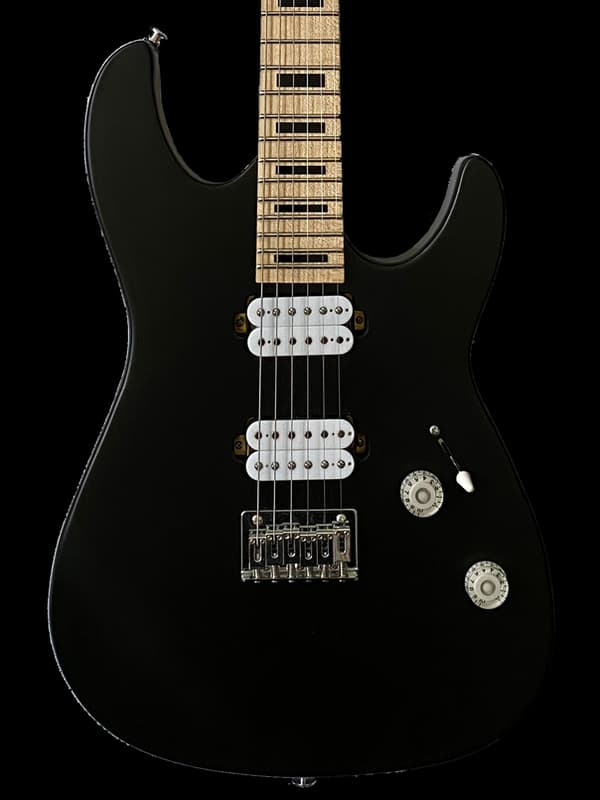
You do not need a special guitar for this, but the flatter, slimmer necks make the position-2 stretch friendlier while your hand is still developing. Batio's signature guitar is the Sawtooth ST-M24, whose neck is built for exactly this kind of reach. If you are just starting out, come back to Lesson 11, the finger position exercise first, since the one-finger-per-fret hand it builds is what makes these triad stretches possible. When you can play both C major positions cleanly, you are ready for the note names that let you rename these shapes anywhere on the neck.
Related