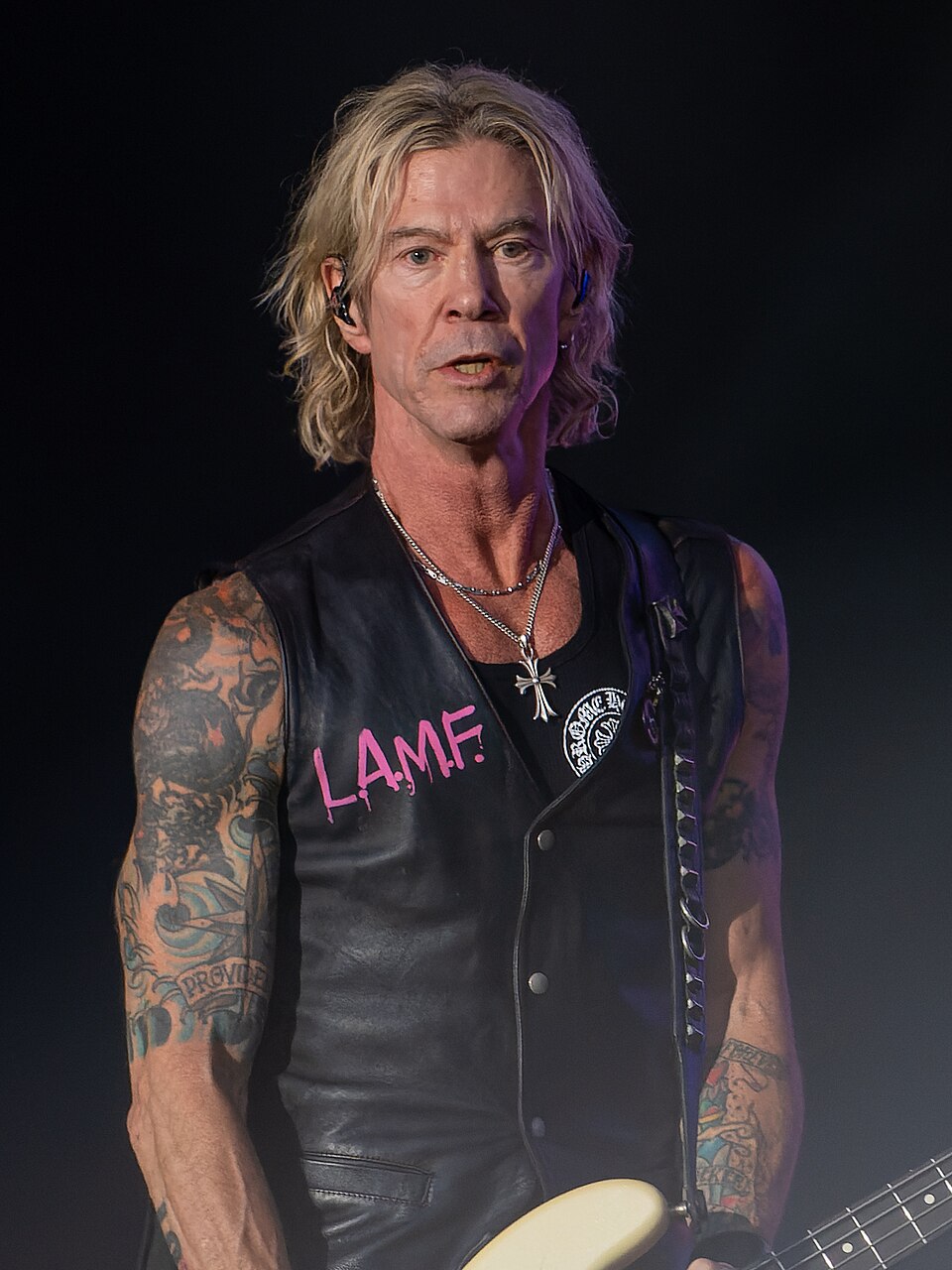
Duff McKagan's bass strings: the Guns N' Roses rig, sourced
Documented bass-string gauge, brand, and gear Duff McKagan uses with Guns N' Roses. Rotosound Swing Bass 66 stainless roundwound (.045–.105). With citations.
Guns N' Roses · written with AI help · updated
Duff McKagan calls Rotosound Swing Bass 66 stainless roundwound strings (.045–.105) the one constant in his career, per Rotosound's own artist roster and his own website. Gear sites commonly trace the pairing back to Guns N' Roses' Appetite for Destruction (1987), though that exact start date isn't independently confirmed. His signature Fender Precision Bass ships with a Hipshot Bass Xtender for instant drop-tuning live, a feature built around Guns N' Roses' multi-tuning sets.
Who Duff McKagan is
Michael Andrew "Duff" McKagan (born February 5, 1964, in Seattle) is the bassist of Guns N' Roses, a band he joined in March 1985 after moving to Los Angeles and meeting guitarist Slash and drummer Steven Adler. Before that, a teenage McKagan had already cut his teeth in Seattle's punk scene: he formed the band The Vains at 15 and later played in the Fastbacks, the Fartz, and 10 Minute Warning.
Guns N' Roses' 1987 debut, Appetite for Destruction, became one of the best-selling debut albums in rock history, and McKagan's driving, pick-and-fingers bass lines underneath it are part of why the record still holds up. He left the band in 1997, the last member of the classic Appetite lineup to go, then founded the supergroup Velvet Revolver in 2002 with former bandmates Slash, Matt Sorum, and Loaded guitarist Dave Kushner. On April 14, 2012, McKagan was inducted into the Rock and Roll Hall of Fame as a member of Guns N' Roses' classic lineup. He rejoined the band for a secret warmup gig at the Troubadour in Los Angeles on April 1, 2016, ahead of that year's Coachella performance and the Not in This Lifetime Tour, and has remained its bassist since.
Outside Guns N' Roses, McKagan fronted his own band, Loaded, released the solo albums Believe in Me (1993), Tenderness (2019), and Lighthouse (2023), and became a bestselling author, most notably with How to Be a Man (And Other Illusions) in 2015.
What he plays
McKagan's bass strings are Rotosound Swing Bass 66: stainless-steel roundwound, .045 to .105 gauge, long scale. He's listed on Rotosound's own current artist roster with a direct quote: "One constant in my ever-changing career and thoughts on rhythm has been my Rotosound Swing Bass strings. Nothing else comes close." His own official website also hosts a video built entirely around the subject, so this isn't a stale or lapsed relationship.
Bass-gear sites commonly date the pairing back to Appetite for Destruction (1987). Rotosound's own page doesn't pin an exact start year, so treat that specific date as commonly reported rather than independently confirmed.
His main instrument is the Fender Duff McKagan Deluxe Precision Bass, a signature model built around the Pearl White '80s Jazz Bass Special he actually used tracking Appetite for Destruction. It combines a Precision Bass body with a Jazz Bass neck and pickups from both instruments.
Endorsed vs. verified use
McKagan is a documented Rotosound endorser and a documented Fender signature artist, both confirmed directly on the manufacturers' own pages rather than fan-site aggregation. That distinction matters: plenty of artist-strings claims online trace back to nothing sturdier than a gear blog's guess. Here, Rotosound's own current artist roster carries his attributed quote, and Fender has shipped multiple McKagan signature bass models over the years, with his direct input into the design, per Bass Magazine's reporting on the collaboration and his own quotes about working with the company.
His signature bass
Current signature model · Precision/Jazz hybrid
Fender Duff McKagan Deluxe Precision Bass
Based on the Pearl White '80s Jazz Bass Special McKagan played tracking Appetite for Destruction. Seymour Duncan Quarter Pound P-style split-coil paired with a Seymour Duncan STKJ2B Jazz Bass bridge pickup, shaped by a Fender TBX tone circuit. A Hipshot Bass Xtender on the low-E tuner flips down for instant drop-tuning mid-set, a feature Fender added because Guns N' Roses' live sets move through three or four different tunings a night.
Source: Fender: Duff McKagan Deluxe Precision Bass, Bass Magazine.
Why this fits the rig
Guns N' Roses' live mix is dense: two guitarists trading rhythm and lead, often with both distorted at once. A bright, stainless-steel roundwound string cuts through that wall instead of getting buried under it, more top-end harmonic content than a nickel round, and far brighter than any flatwound set. McKagan's background matters here too: before Guns N' Roses, he played in Seattle punk and hardcore bands, and that pick-forward, aggressive attack carries into his GNR bass lines. Stainless rounds respond to a hard pick attack with more clarity than a warmer nickel set would, which suits that playing style.
The .045 to .105 gauge itself is a standard long-scale gauge, not unusually heavy or light. It's worth noting that Fender's own factory-strung nickel roundwound set on the signature bass ships at this same .045–.105 gauge, so a player picking up the Fender signature model new is already in the right gauge range before ever switching over to the stainless Rotosound set McKagan favors on stage.
You can hear the effect on record: the bass line under "Paradise City" and "Welcome to the Jungle" sits high enough in the mix to be a hook in its own right, not just a low-end anchor, which is a much harder trick to pull off with a darker-sounding string. A regular gauge also keeps the low string from feeling floppy in drop-tuned sections, without pushing into the stiffer feel a heavier .050-plus set would give a player who's also fingerpicking parts of a set.
If you want this rig
Swing Bass 66 (.045–.105)
Why this one: Duff McKagan's own described strings: stainless-steel roundwound at .045 to .105, long scale. Brighter and more aggressive than nickel, built to cut through a two-guitar wall of distortion live.
Related
Related