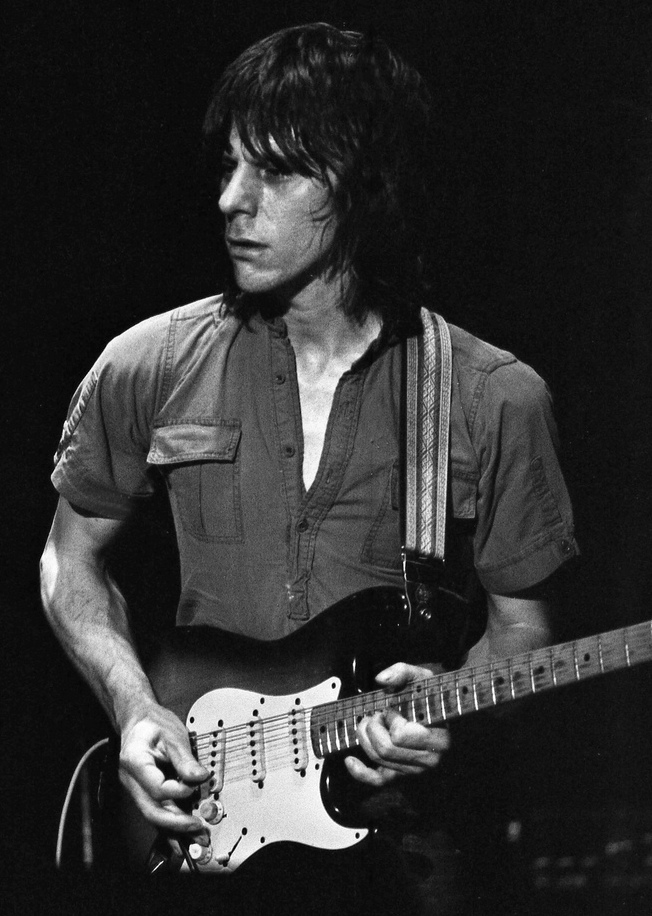
Jeff Beck's guitar strings: the signature Stratocaster rig, sourced
Documented string gauges and tunings Jeff Beck used on his Fender Jeff Beck Signature Stratocaster. Ernie Ball Slinky base in standard E, with thumb-and-fingers right-hand approach. With citations.
Solo / Jeff Beck Group / ex-Yardbirds / Beck, Bogert & Appice · written with AI help · updated
Jeff Beck used Ernie Ball Slinky strings on his Fender Jeff Beck Signature Stratocaster across the modern era of his career. The signature Strat was issued in 1991 and remained in continuous Fender production until his death in January 2023; Beck's spec included Lace Sensor pickups (or later Hot Noiseless models), a Wilkinson tremolo, and a soft-V neck profile. He played without a pick from the late 1980s onward, using his thumb and fingers exclusively, which let him manipulate the volume knob and tremolo arm continuously while playing. Beck won 8 Grammy Awards across a six-decade catalog.
Who Jeff Beck was
Geoffrey Arnold "Jeff" Beck (June 24, 1944, Wallington, Surrey, England, January 10, 2023) was a six-decade career guitarist whose catalog spans rock, blues-rock, jazz-fusion, and instrumental-rock. He joined the Yardbirds in 1965 (replacing Eric Clapton), formed the Jeff Beck Group with Rod Stewart on vocals in 1967, and went solo into instrumental territory with Blow by Blow (1975, produced by George Martin), which remains one of the canonical jazz-fusion records of the era. Eight Grammy Awards across his career.
His Fender Jeff Beck Signature Stratocaster (1991–present) is one of the longest-running production-model signature instruments in Fender's catalog. He died in January 2023 of bacterial meningitis at age 78.
What he played
Fender Jeff Beck Signature Stratocaster, 1991-onward, originally with Lace Sensor pickups and later updated to Hot Noiseless single-coils. Soft-V neck profile, Wilkinson VS-100 two-point tremolo with deeper-cut cavity, locking tuners. Sky Blue or Surf Green finish in the canonical configuration. Earlier in his career he played a 1959 Fender Telecaster (the original "Tele-Gib" with Gibson PAF pickups installed in the late 1960s), 1959 Les Pauls, and various other instruments; the signature Strat is the defining-era instrument.
Ernie Ball Regular Slinky (.010-.046) strings, per Ernie Ball's own social media, which names him a user since 1965; the original post could not be independently re-loaded to confirm its exact wording first-hand, so treat this as reported rather than fully verified. Ground Guitar's gear archive separately documents unbranded gauge shifts across his career (very light on his early Les Paul years, later .011-.049, then .010-.052 and .009-.052) without tying those specific gauges to a brand. Standard E tuning across the catalog. From the late 1980s onward he played without a pick, using thumb and fingers exclusively to keep his right hand free for continuous trem-arm and volume-knob manipulation.
Why this fits the rig
Regular Slinky's uniform .010-.046 gauge is Ernie Ball's most common set, a balance of low-end stability for rhythm playing and a top end still light enough for his bend-and-trem-arm vocabulary. The deeper-cut trem cavity on the signature Strat is non-negotiable for his playing either way, the standard Strat trem only drops pitch (the bridge plate sits flat on the body in trem-up), but Beck's vocabulary depends on pitch-up vibrato moves that need the trem to float in both directions.
The fingerstyle right hand, no pick, lets him manipulate the volume knob and trem arm with his palm and pinky while picking with thumb and fingers. The result is a continuously expressive lead phrasing where pitch, volume, and timbre are all under simultaneous independent control, the technical signature that puts him in conversation with no other electric guitarist of comparable catalog depth.
If you want this rig
The Fender Jeff Beck Signature Stratocaster remains in current production. For strings, Ernie Ball Regular Slinky (.010-.046) is the set Ernie Ball's own social media names for him, though that post could not be independently re-confirmed first-hand; treat the exact gauge as reported rather than fully pinned down, since separate gear-archive sources document his gauge shifting across eras.