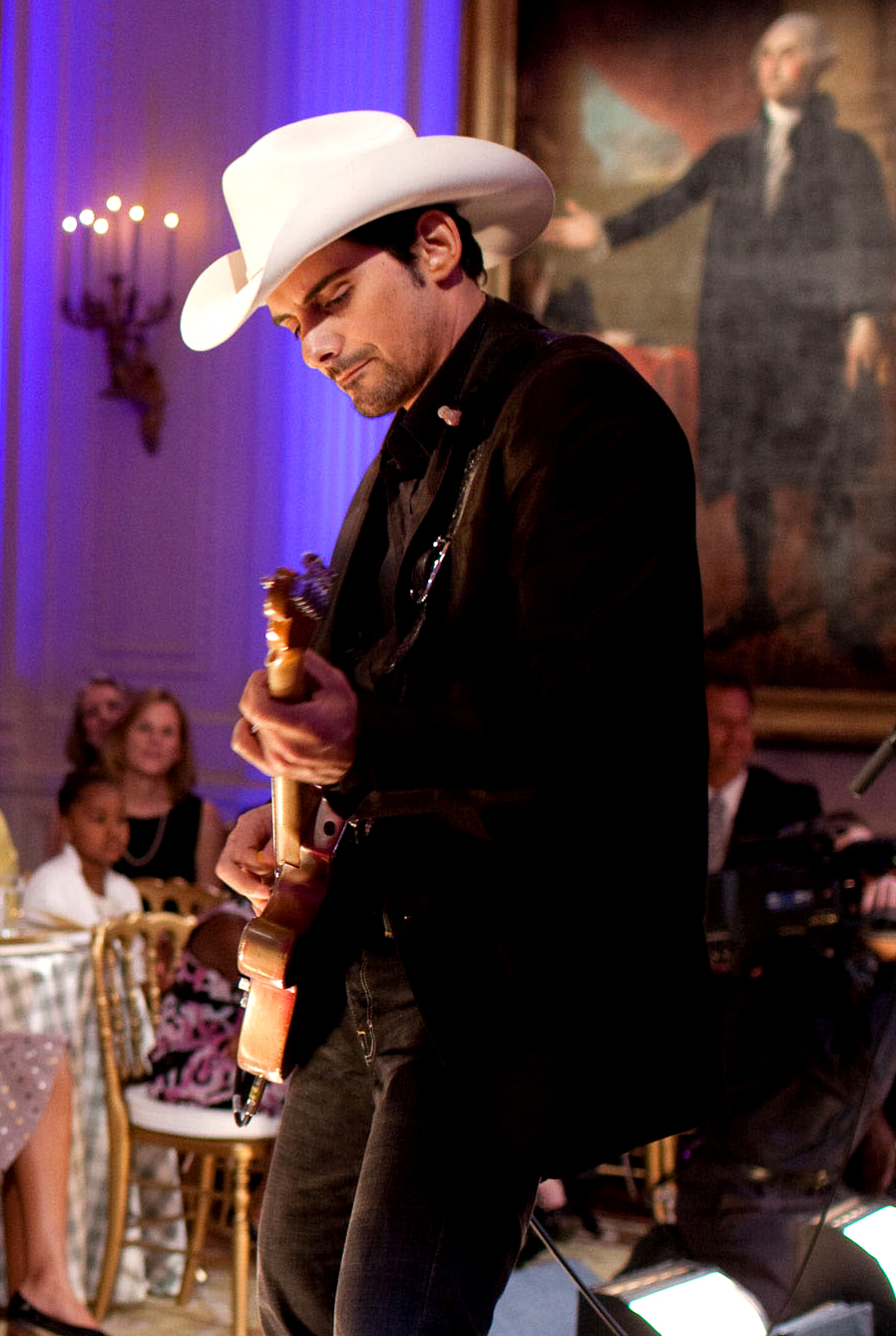
Brad Paisley's guitars and strings: the Telecaster rig, sourced
Brad Paisley's documented rig: the 1968 'La Brea' Paisley Telecaster, Bill Crook custom Teles, and the Ernie Ball strings his guitar tech confirmed to Vintage Guitar.
written with AI help · updated
Brad Paisley's electric rig centers on Fender and Bill Crook Telecasters, including his rare 1968 'La Brea' Paisley Telecaster and a 2024 Fender signature 'Lost Paisley' reissue. His longtime guitar tech told Vintage Guitar his Teles run Ernie Ball coated Slinky strings, .010 to .046, the same gauge as Ernie Ball's standard Regular Slinky. He's a Grand Ole Opry member since 2001 and an Ernie Ball artist-roster guitarist.
Who Brad Paisley is
Brad Douglas Paisley was born October 28, 1972, in Glen Dale, West Virginia. His grandfather Warren Jarvis gave him his first guitar at age 8 and introduced him to country music, and he began studying with local guitarist Clarence "Hank" Goddard not long after. As a young teenager, a radio station in nearby Wheeling put him on Jamboree USA, its long-running live country program, where he played for the next eight years.
Paisley signed with Arista Nashville in 1998 and released his debut album, Who Needs Pictures, on June 1, 1999. Less than two years later, on February 17, 2001, Opry member and longtime friend Steve Wariner inducted him into the Grand Ole Opry, a Nashville institution described in more detail on CYS's Nashville guide. He released 12 studio albums for Arista Nashville before the label closed in 2023 and he moved to EMI Nashville, including 2008's largely instrumental Play: The Guitar Album, whose all-star guitar jam "Cluster Pluck" won the Grammy for Best Country Instrumental Performance.
What he plays
Two Fender Telecasters and 4 custom Telecaster-style guitars built by master builder Bill Crook made up Paisley's touring rotation as of a Vintage Guitar interview with his longtime guitar tech, Chad Weaver. His most identifiable guitar, though, is a genuine 1968 "Paisley Red" Fender Telecaster he calls "La Brea," a finish that happens to share his own surname, and, decades later, a 2024 Fender signature reissue built to recreate it.
The rig, sourced
- Signature guitar
- 1968 "La Brea" Paisley Telecaster, plus a 2024 Fender signature "Lost Paisley" reissue built to recreate that finish.
- Touring guitars
- 2 Fender Teles and 4 custom Bill Crook Telecaster-style guitars, per his guitar tech's account.
- Strings
- Ernie Ball coated Slinky, .010-.046 on electrics (uncoated on 2 vintage Teles), coated .012-.052 on his Gibson J-45 acoustics.
- Amps
- Dr. Z Z-Wreck live, alongside his own Trainwreck Liverpool 30 and a '62 Vox AC30 Top Boost.
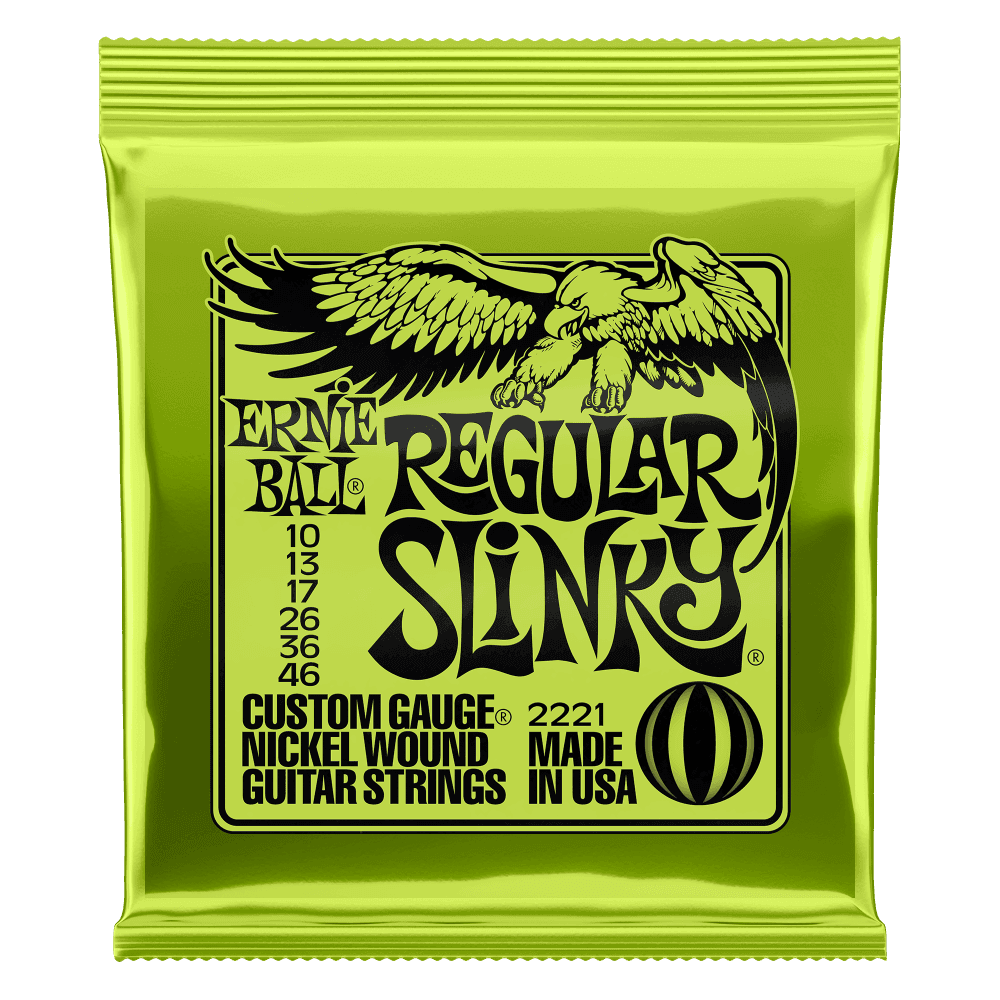
Regular Slinky (.010–.046)
Why this one: The same gauge his guitar tech documented on Paisley's Telecasters. Ernie Ball's coated version from that 2009-2010 interview isn't a clean current-catalog match, so this is the closest uncoated equivalent at the confirmed gauge.
Why this fits
Yes. Until now, everything we've done have been attempts to improve or modify that sound. I don't know if you can really improve on that, though, because it's a great amp, great guitar, and a great pedal!
Asked whether his '68 Tele, a Way Huge Aqua Puss delay, and his '62 Vox Top Boost AC30 add up to his definitive sound
That's the whole tone stack in one answer: a bright, snappy Telecaster, a boosty AC30-style amp, and a single analog delay for depth. It's also why his rig reads simple on paper next to a lot of touring rigs despite the pile of guitars in rotation. Paisley said as much in the same Vintage Guitar interview: "When it comes to guitar sounds, the most important thing is the amp. The second most important is mic placement. The third is the guitar." Then he added the caveat that matters most: "all of these are superseded by touch."
The coated Ernie Ball strings fit that philosophy too. A coated set trades a little top-end sparkle for a broken-in feel and longer life on the road, which is exactly why Weaver told Vintage Guitar he reaches for coated strings on Paisley's brighter-sounding '60s Tele specifically, to tame it without changing the guitar.
Electric guitars
1968 · Original Paisley Red finish · Nicknamed "La Brea"
Fender Telecaster
One of an estimated 300 to 400 original 1968 Paisley Red Telecasters. Paisley bought it unknowingly as a black-refinished Tele from Chicago Music Exchange; master builder Bill Crook found the original paisley pattern hiding under the black paint. "I called it La Brea because it's like a fossil in a tar pit," Paisley said.
Source: Guitar Player, 2026-06-11.
2024 · Signature model
Fender Brad Paisley 1967 "Lost Paisley" Telecaster
Built with Paisley to recreate the original late-1960s Paisley Red finish. "This is an attempt to show what this lost color could have been. It's the best guitar I've ever had," he said at launch.
Source: Guitar Player, 2026-06-11.
Custom-built · 4 in touring rotation, documented 2009-2010
Bill Crook Telecaster-style guitars
Master builder Bill Crook built multiple Telecaster-style guitars for Paisley, including the Crook "Buckocaster" he played on his duet with mentor Buck Owens, "Come On In." His guitar tech documented 4 Crook guitars in the touring lineup alongside 2 Fender Teles.
Source: Vintage Guitar magazine, 2010-02-04.
Acoustic guitars
Documented 2009-2010 · Signature prototypes
Gibson J-45 (x2)
Prototypes of a Paisley signature model with a Red Spruce top and 1942-style bracing, built with hot hide glue and a Fishman Aura preamp. Imaging in the studio ran through a Thuresson CM402 large-diaphragm condenser mic and a Millenia HV-3D preamp, the same setup used live.
Source: Vintage Guitar magazine, 2010-02-04.
Amps
Main live amp, documented 2009-2010
Dr. Z Z-Wreck
An AC30-style circuit Dr. Z built in collaboration with the late Trainwreck designer Ken Fischer. Paisley called it "a great AC30-type amp" and believes it was one of the last amps Fischer worked on before his death.
Source: Vintage Guitar magazine, 2010-02-04.
Personal amp · High-gain live parts
Trainwreck Liverpool 30
Used live for distorted parts like "She's Everything" and his B.B. King duet. "It makes such a great blues amp because it's so responsive. It's hard to live without," Paisley said, adding it travels the road on a padded bunk on the tour bus.
Source: Vintage Guitar magazine, 2010-02-04.
'62 · Named as his "definitive" sound
Vox AC30 Top Boost
Paired with his '68 Tele and a Way Huge Aqua Puss analog delay, Paisley named this specific combination as his signature tone when asked directly by Vintage Guitar.
Source: Vintage Guitar magazine, 2010-02-04.
Strings
Electric · Tech-confirmed gauge
Ernie Ball coated Slinky, .010-.046
Guitar tech Chad Weaver told Vintage Guitar this is what's on Paisley's Fender and Crook Teles, except his vintage '68 and '52 guitars, which run the uncoated version. CYS's closest catalog match is the uncoated Regular Slinky at the same .010-.046 gauge; treat the coating detail as historical, from a 2009-2010 interview, rather than a confirmed current spec.
Acoustic · No exact CYS catalog match
Ernie Ball coated acoustic, .012-.052
Documented on Paisley's 2 Gibson J-45 signature prototypes in the same Vintage Guitar interview. CYS doesn't stock an exact-gauge Ernie Ball coated acoustic set today, so this claim ships without a forced product link rather than pointing to a mismatched alternative.
Source: Vintage Guitar magazine, 2010-02-04.
If you want this rig
Regular Slinky (.010–.046)
Why this one: Paisley's own guitar tech confirmed this exact gauge to Vintage Guitar. Ernie Ball's coated version from that era isn't a clean current-catalog match, so this is the closest uncoated equivalent, reviewed and available on CYS today.