Joe Barresi: the engineer and mixer behind Tool, Queens of the Stone Age, and Kyuss
Joe Barresi ('Evil Joe') engineered Tool's 10,000 Days and Fear Inoculum, produced Queens of the Stone Age's debut, and recorded Kyuss and Melvins. Credits and sourced strings, with citations.
Reviewed by the Change Your Strings editorial team ·
Joe Barresi, nicknamed "Evil Joe," engineered and mixed Tool's 10,000 Days (2006) and Fear Inoculum (2019). He produced Queens of the Stone Age's self-titled 1998 debut before the band had a record deal, and has credits across Kyuss, Melvins, Bad Religion, Chevelle, Weezer's Pinkerton, and Slipknot. His signature: guitar-forward mixes with heavy low end, wide stereo panning instead of hard-left/hard-right, and a raw, live-off-the-floor tracking philosophy.
Who Joe Barresi is
Joe Barresi, nicknamed "Evil Joe," is a Los Angeles based recording engineer, mixer, and producer. He started playing guitar at seven, studied classical guitar and music theory at the University of South Florida, then finished his degree at the University of Miami studying piano and music engineering. He moved to Los Angeles in December 1988, took a job at Cherokee Studios two days later, and by March 1989 was assisting at Sound City Studios in Van Nuys, the Neve-equipped room behind three decades of hit records.
Two mentors shaped his early career: engineer Garth Richardson ("GGGarth"), who gave him his first real engineering credit, and Jason Corsaro, the engineer behind records like Soundgarden's Superunknown, who brought Barresi in as an assistant on a Masters of Reality record and hired him for mix work whenever he came to town. His own break as lead engineer came through Kyuss's producer Chris Goss, who booked Barresi at Sound City for 1992's Blues for the Red Sun (tracked in six days, mixed in four) and 1994's Welcome to Sky Valley.
From there the catalog widened fast: three records with the Melvins (Stoner Witch, Stag, Honky), most of Weezer's Pinkerton (1996), L7's Hungry for Stink and The Beauty Process, and Queens of the Stone Age's self-titled 1998 debut, produced, recorded, and mixed before the band had a record deal. The press attention that album drew helped land Queens of the Stone Age a deal with Interscope Records. Tool hired Barresi for 10,000 Days (2006) on a recommendation from Melvins guitarist Buzz Osborne, and he returned to engineer and mix Fear Inoculum (2019). In between and since: five-plus Bad Religion albums, four Chevelle albums, Clutch, Fu Manchu, three Slipknot mixes, Avenged Sevenfold, Soundgarden, Alice in Chains, Coheed and Cambria, and dozens more. His more recent work runs through Alice in Chains' Rainier Fog (2018), Avenged Sevenfold's The Stage (2016) and Life Is But a Dream... (2023), and Jerry Cantrell's Brighten (2021), a client list that still spans the modern hard-rock and metal landscape three decades in. He now records out of his own studio, JHOC (Joe's House of Compression).
Production signature
Barresi's mixes read as guitar forward and bottom heavy, which he traces directly to his own playing background. "Because I am a guitar player, I hear guitars up front and pretty loud. But I also like a lot of bottom end," he told Tape Op Magazine. Most engineers default to hard left, hard right, and dead center panning. Barresi doesn't. "I still use all the spots in between because there's a lot of room in there," he said of his approach to a mix.
The Kyuss sessions set the template for his live-off-the-floor philosophy. The band would vibe out the room (mood lighting, incense, hot oil wheels on the walls) and jam a song two or three times start to finish rather than piece it together from overdubs. "It was the first time I'd seen a band actually listen to each other play in the studio," Barresi said. That approach is why Blues for the Red Sun came together in ten total days: six to track, four to mix.
He's also unafraid of heavy compression stacked in layers, sub-mixing drum busses down to a stereo pair and riding faders through the whole mix instead of solving everything with one static setting. The goal, in his words, is a mix that gets bigger when you turn it up, not more distorted, the same quality he chases in the records he loves to listen to himself.
The gear habits back up the philosophy. By his own account Barresi owns around 185 guitar pedals and 48 or more channels of compression across different units, and he still mixes down to half-inch tape before anything goes digital, a habit that traces back to his years running an old Neve console at Sound City. One favorite studio story: during the sessions for L7's The Beauty Process, a borrowed EV666 microphone (quickly nicknamed the "mic of the Beast") nailed a guitar solo, a piano overdub, and a lead vocal, each in a single take.
Strings that fit the Barresi heavy-rock lane
Barresi doesn't make the string call. The guitarist does, and his catalog spans too many players and gauges to generalize from one page. But the two records most directly tied to this site's Tool coverage, 10,000 Days and Fear Inoculum, both ran through Adam Jones's documented Drop D rig:
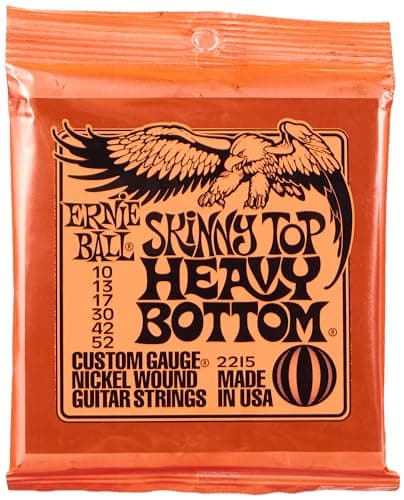
Skinny Top Heavy Bottom (.010-.052)
Why this one: The gauge Adam Jones named himself in a 2014 Guitar World interview, across both records Barresi engineered and mixed. The heavy nickel-wound low strings hold tension on Drop D and the half-step-down variant without going flabby.
For the rest of the catalog, punk and straight-ahead rock records like the Bad Religion and Rancid tracks Barresi has mixed generally sit in standard E tuning on a lighter set. The production job (compression, panning, low-end management) is where his fingerprint shows up, not the gauge on the guitarist's strings.
Related
Tool credits. 10,000 Days (2006), Adam Jones, Justin Chancellor, Danny Carey, Tool band hub.
Other producers. Rob Cavallo, one of the established producers Barresi worked alongside early in his career, per his Wikipedia biography.