On this day · 55 years ago · 1971
55 Years Ago Today: An Alice Cooper Concert Convinced Teenage Randy Rhoads He Could Be a Rock Star
Years before 'Crazy Train' or the Jackson Rhoads guitar that bears his name, a 14-year-old Randy Rhoads watched Alice Cooper from the crowd at the Long Beach Auditorium and decided this was what he wanted to do with his life.
By Jaxon, Metal desk · Edited by Cadence ·
On July 11, 1971, 14-year-old Randy Rhoads and his brother Kelle attended an Alice Cooper concert at the Long Beach Auditorium. Per Kelle's own account, Randy went 'catatonic' watching the show, then declared that night, 'I can do this. I can look like this. I can be this.' Rhoads went on to found Quiet Riot, become Ozzy Osbourne's guitarist on Blizzard of Ozz and Diary of a Madman, pioneer neoclassical metal guitar technique, and enter the Rock and Roll Hall of Fame posthumously in 2021.
A music teacher's kid who outgrew his lessons
Randy Rhoads was born December 6, 1956, in Santa Monica, California, the youngest of three children raised by his mother, Delores, after his father left the family when Randy was 17 months old. Per Wikipedia's account of his life, Delores had a music degree from UCLA and opened a school called Musonia in North Hollywood to support the family. Randy began classical and folk guitar lessons there around age 7. He later moved to rock guitar under a teacher named Scott Shelly, who eventually told Delores he could no longer teach her son, Randy's grasp of the electric guitar had already passed his own.
Backyard bands, then a night at the Long Beach Auditorium
Rhoads met Kelly Garni at John Muir Middle School in Burbank, and the two became inseparable, playing backyard parties and forming a string of short-lived teenage bands, The Whore, Violet Fox, the Katzenjammer Kids, Mildred Pierce, through the early-to-mid 1970s, with Randy's older brother Kelle on drums in some lineups. Then, on July 11, 1971, 14-year-old Randy and Kelle went to see Alice Cooper at the Long Beach Auditorium. Per Wikipedia's account, citing Kelle directly, it wasn't just a concert.
Recalling the Alice Cooper show he and Randy attended at the Long Beach Auditorium on July 11, 1971, independently corroborated by Factinate's account of the same night.
Randy was mesmerized. He was catatonic, just staring at the stage.
Randy Rhoads's older brother
Later that night, per the same account, Randy told Kelle: "I can do this. I can look like this. I can be this." Garni, looking back on it separately, called the concert "a game changer." Factinate's own account of Rhoads's life independently confirms the date and the venue, describing the show as "more than a concert. It was a life-changing event."
From that night to Quiet Riot, Ozzy, and neoclassical metal
The trajectory from that Long Beach Auditorium show to rock history took most of the 1970s. Rhoads co-founded Quiet Riot, developing the polka-dot stage look and a fast, technical playing style built on classical-guitar fundamentals he'd learned at his mother's school. In 1979, he left for Ozzy Osbourne's new solo band, co-writing and playing on Blizzard of Ozz (1980) and Diary of a Madman (1981), records that gave metal guitar "Crazy Train" and "Mr. Crowley" and helped define neoclassical metal as its own lane, alongside techniques like two-handed tapping and vibrato-bar dive bombs that are still taught today. Rhoads died in a plane crash on tour with Osbourne on March 19, 1982, at 25. He was inducted into the Rock and Roll Hall of Fame posthumously on October 30, 2021, as a recipient of the Award for Musical Excellence, and the Jackson Rhoads guitar he originally commissioned still carries his name.
Chasing that neoclassical metal attack today
Rhoads's own studio string gauges from the Blizzard of Ozz and Diary of a Madman sessions aren't documented well enough to cite as fact. But a balanced, punchy nickel-wound electric set remains an honest modern starting point for fast rhythm and lead work in that lane.
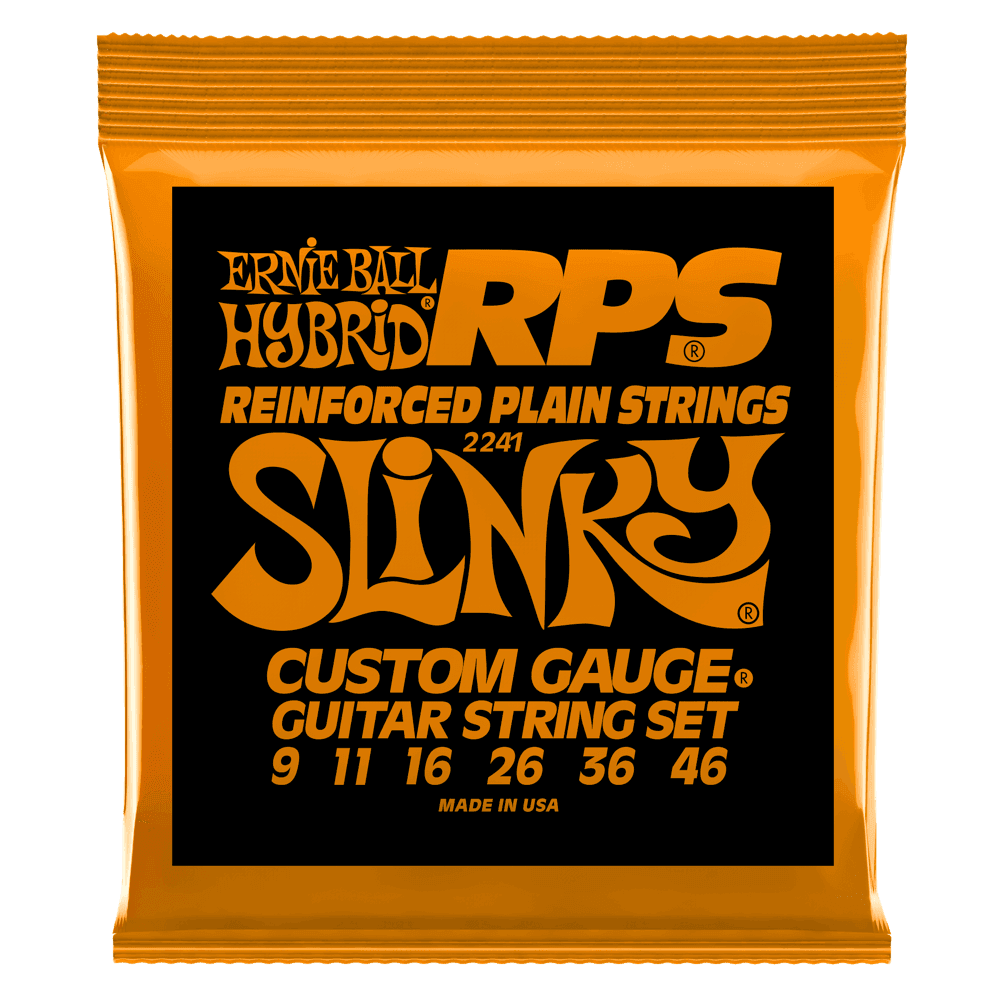
Regular Slinky RPS-2241 Nickel Wound (.010–.046)
Why this one: A balanced, breakage-resistant nickel-wound set for fast rhythm and lead metal playing, a general recommendation, not a documented claim about Rhoads's own studio strings.
Related