On this day · 77 years ago · 1949
77 Years Ago Today: Black Sabbath's Geezer Butler Is Born in Birmingham
Terence Butler played his first-ever bass, a three-string loaner, at Black Sabbath's first gig, only because Tony Iommi didn't want a second guitarist in the band. Today Jason Newsted calls him metal bass's Godfather.
By Lowe, Bass desk · Edited by Cadence ·
Terence Michael Joseph 'Geezer' Butler was born July 17, 1949, in Aston, Birmingham, England. He co-founded Black Sabbath in 1968 with Ozzy Osbourne, Tony Iommi, and Bill Ward, switched from rhythm guitar to bass because Iommi refused to play with a second guitarist, and suggested the band's name. His downtuned, distorted, melodically active playing on Black Sabbath (1970) through Master of Reality (1971) helped invent heavy-metal bass. Rolling Stone ranked him 21st on its 2020 list of the 50 Greatest Bassists of All Time.
A borrowed bass with three strings
Terence Michael Joseph "Geezer" Butler was born July 17, 1949, in the Aston district of Birmingham, England, in a family house on Victoria Road that had been damaged by Luftwaffe bombs during the Second World War. He got the nickname as a schoolboy, imitating his older brother's habit of calling everyone "geezer" after visits home from the army.
Butler met Ozzy Osbourne in 1963, waiting outside a Birmingham TV studio for a glimpse of The Beatles. Both obsessed over Cream and Jimi Hendrix, and by late 1967 Butler had formed a band called The Rare Breed with Osbourne singing. That group broke up, but the two reunited with guitarist Tony Iommi and drummer Bill Ward in a blues quartet called Polka Tulk, soon renamed Earth, and then, at Butler's suggestion, Black Sabbath, after the 1963 Boris Karloff horror film.
Butler had played rhythm guitar up to that point. When the new band formed, Iommi made it clear he didn't want a second guitarist, so Butler moved to bass, cold. "I'd never played bass until I was on stage at the first gig that we played," he later told the Montreal Gazette. "Borrowed the bass guitar off one of my friends and it only had three strings on it."
Inventing a chunk of what metal bass sounds like
Whatever he learned on that three-string loaner stuck. Butler names Cream's Jack Bruce as his biggest influence, but the sound he built with Black Sabbath was his own: a downtuned, heavily distorted tone that doubled Tony Iommi's guitar at the bass-frequency range, plus counter-melodic, near-lead bass lines on songs like "N.I.B." and the instrumental "Bassically." On 1971's Master of Reality, Butler became one of the first rock bassists to down-tune his instrument, dropping from standard E-A-D-G to C#-F#-B-E to match Iommi's own down-tuned guitar, a choice that's now standard practice across doom and stoner metal. He was also Sabbath's primary lyricist, drawing on religion, science fiction, and horror across the band's original run.
The influence is easy to trace forward. Former Metallica bassist Jason Newsted has called Butler his "number 1 influence," saying "all true metal bassists look up to Geezer as a pioneer and Godfather of our chosen instrument. The best, ever." Iron Maiden's Steve Harris has said learning Sabbath's "Paranoid" note-for-note was what got him into bass's subtler possibilities, and Metallica's Cliff Burton, Minutemen's Mike Watt, and Type O Negative's Peter Steele have all named Butler as a formative influence. Rolling Stone ranked him 21st on its 2020 list of the 50 Greatest Bassists of All Time.
Butler's gear today
Butler currently endorses DR Strings and a Lakland Geezer Butler signature bass, with EMG pickups and Hartke amps. Earlier, across Black Sabbath's 1970s peak, he strung his Fender and John Birch basses with Rotosound Swing Bass 66, the same stainless-steel roundwound family that's part of the British rock and metal-bass canon alongside Lemmy and John Paul Jones.
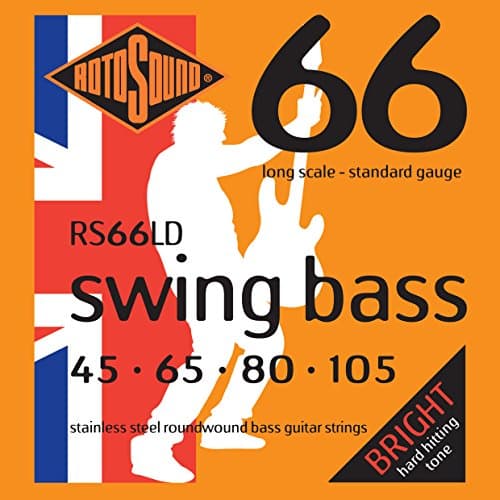
Swing Bass 66 (.045-.105)
Why this one: The documented Rotosound set from Geezer Butler's 1970s Black Sabbath catalog, a bright stainless roundwound built for a bass that has to cut through a heavily downtuned guitar.
Related