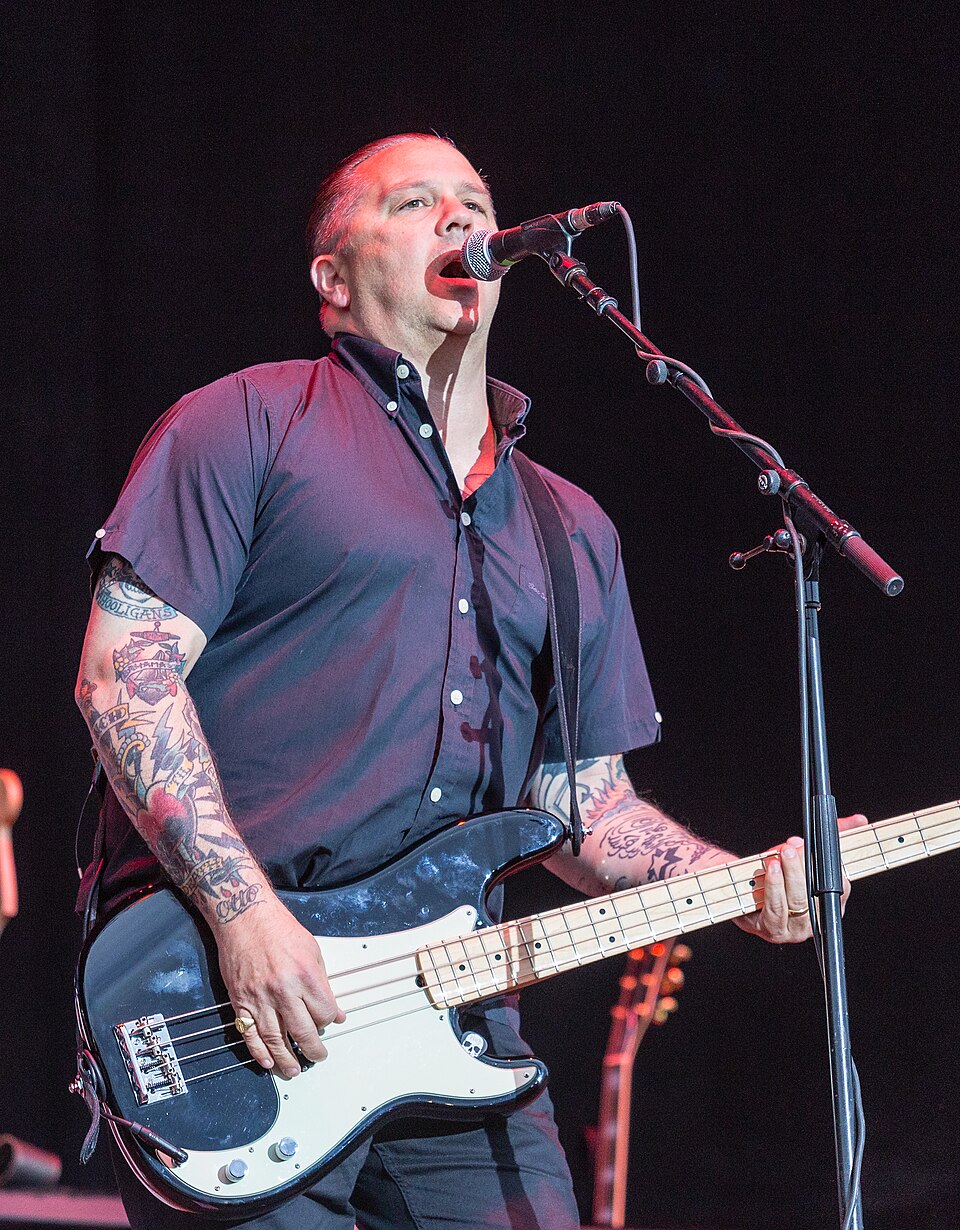
Matt Freeman's bass strings: the Rancid Precision Bass rig, sourced
Documented bass-string gauge and rig details for Rancid's Matt Freeman: Fender Nickel Plated Steel Super 7250 (.045–.105) on a Fender-built chambered Precision Bass. Sourced from Premier Guitar's October 2024 Rig Rundown and Guitar World.
Rancid · written with AI help · updated
Matt Freeman strings his touring Fender Precision Bass with Fender's Nickel Plated Steel Super 7250 set (.045, .065, .085, .105), confirmed in Premier Guitar's October 2024 Rig Rundown. The Rancid bassist plays a one-off chambered P-Bass that Fender's R&D team built for him after he developed back issues. NPS roundwounds give his fast, walking basslines a warm punch, less aggressive than stainless, without losing definition under Tim Armstrong and Lars Frederiksen's guitars.
Who Matt Freeman is
Roger Matthew Freeman, also known as Matt McCall, was born April 23, 1966, and grew up in Albany, California, a few blocks from a kid named Tim Armstrong, whom he met at age five playing Little League. They bonded over the Clash and the Ramones, went through Albany High School together, and eventually built the two bands that define his career.
Freeman began playing music at seven, starting on trumpet, then baritone horn, then a year of trombone, playing in his high school jazz band and taking lessons from a Berkeley teacher named Jeremy Cohen. He's said The Who's Live at Leeds is what turned him onto bass, and that the Specials' first record is what got him into ska. Those two influences, John Entwistle's aggressive, melodic bass vocabulary and second-wave ska's quick-time bounce, are still the clearest way to describe what he does in Rancid.
He and Armstrong formed the ska-punk pioneers Operation Ivy in 1987 (no dedicated CYS band page yet). The band broke up in 1989. Freeman spent the next few years bouncing through short-lived projects, Downfall, Generator, a stint in the political punk band MDC, a brief run in the Dance Hall Crashers, before he and Armstrong recruited drummer Brett Reed in 1992 and formed Rancid (no dedicated CYS band page yet). Guitarist Lars Frederiksen joined in 1993, and the classic lineup was set.
Rancid's studio-album catalog runs from the self-titled 1993 debut through Let's Go (1994), ...And Out Come the Wolves (1995), Life Won't Wait (1998), and Indestructible (2003). Their most recent record, Tomorrow Never Comes (2023), is Guitar World's count for their 10th studio album overall. Guitar World calls Freeman "one of punk's most iconic bassists," pointing specifically to his basswork on Maxwell Murder and the rolling ska groove of Time Bomb as proof he's "far apart from the root-pounding horde" of typical punk bass players.
He's also kept several side projects running. Devils Brigade, formed in 2000 with Armstrong, puts him on lead vocals and double bass for a psychobilly sound distinct from Rancid. Charger, a Motörhead-influenced heavy metal band he started in 2020 with Andrew McGee and drummer Jason Willer, released its debut album Warhorse in 2022. During Rancid's 2004 hiatus he filled in on bass for Social Distortion for part of a tour cycle, though he never intended the gig to be permanent.
What he plays
Freeman's principal touring bass is a Fender Precision Bass with a twist: after he developed back issues, Fender's own R&D team chambered the body to make it lighter. To keep the lightened bass balanced on his shoulder, they fitted it with a denser bridge using barrel saddles. It's strung with Fender's Nickel Plated Steel Super 7250 set, gauged .045, .065, .085, .105, the same long-scale NPS roundwound documented on Mike Dirnt's Green Day rig.
For the big shows, his signal runs wireless from the bass into an Avalon U5 Class A active instrument DI and preamp (with a second U5 as backup), through a Way Huge Pork Loin Overdrive set to push his amp, and out to two Fender Bassman 800 heads paired with matching Bassman 810 Neo 8x10 cabinets. That's the rig Premier Guitar documented in October 2024, backstage before a Nashville tour stop on the Green Day and Smashing Pumpkins stadium run.
The touring P-Bass isn't his only instrument. In the studio and for writing, he still reaches for the original 1977 Fender Precision Bass he bought for $400 in 1984, though he no longer takes it on the road. His personal collection includes a 1966 Precision, a 1974 Precision that once belonged to Rudy Sarzo, a couple of 1977 Jazz Basses, and a 1977 Rickenbacker. He played a 1978 Music Man StingRay specifically during the Life Won't Wait era. For songwriting sessions with Armstrong, who typically works out parts on an old Fender acoustic, Freeman favors a Guild B-50 acoustic bass guitar.
His picking technique is its own signature: medium-thin Dunlop picks, held close to the neck. "I pick the strings up near the neck, which helps with speed," he told Bass Player, describing the mechanics behind the fast walking lines and flatpicked fills that separate his playing from most punk bassists' root-note approach.
Why this fits the rig
A Fender Precision Bass strung with nickel-plated-steel roundwounds is a warmer, more forgiving voicing than the stainless-steel sets some of Freeman's peers favor. That's the right call for Rancid's arrangement: two rhythm guitars (Armstrong and Frederiksen) already crowd the top end, so a brighter bass would compete for the same frequency space instead of anchoring it. NPS rounds give Freeman's aggressive walking lines and ska-inflected fills enough punch to cut through without adding harshness on top.
| Fender Super 7250 (NPS) | Rotosound Swing Bass 66 (stainless) | |
|---|---|---|
| Wrap material | Nickel-plated steel | Stainless steel |
| Voicing | Warmer, punchy midrange | Brighter, more aggressive top end |
| Fret wear | Low | Higher |
| Documented users | Matt Freeman (Rancid), Mike Dirnt (Green Day) | Steve Harris, Geddy Lee, Paul McCartney |
The chambering story matters too. Fender doesn't build a custom-weighted bridge and hollow out a bass body for just anyone, that's the kind of R&D attention reserved for a player with a long, documented relationship with the brand. Even without a named signature model, it's the clearest evidence of how seriously Fender treats his touring setup.