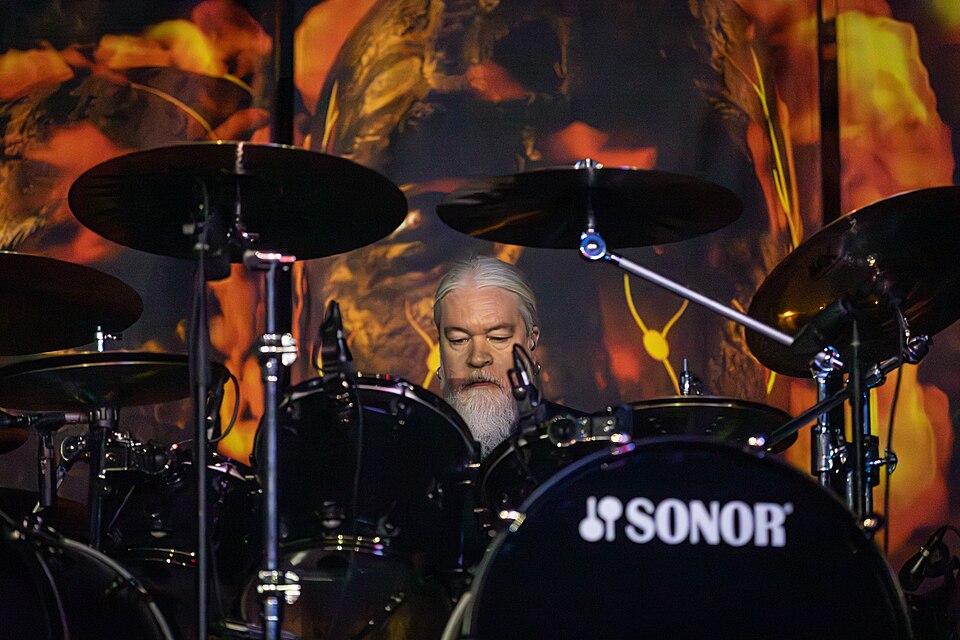
Tomas Haake: Meshuggah's drummer, decoded
Tomas Haake has anchored Meshuggah since 1990. Sonor signature kit, Sabian cymbals, Wincent signature drumstick (W-THS). The polyrhythmic djent drumming canon that influenced an entire generation of extreme-metal drummers.
Meshuggah · written with AI help · updated
Tomas Haake (born July 13, 1971, Örnsköldsvik, Sweden) has anchored Meshuggah since 1990. Sonor signature kit, Sabian cymbals, Wincent signature drumstick. The defining polyrhythmic djent drumming canon, songs like 'Bleed' (obZen, 2008) demonstrate Haake's ability to play a fast 16th-note kick pattern continuously across a song's full duration while his hands navigate odd time signatures over the top. The Toontrack Drumkit From Hell sample library (2000) was modeled on Haake's drum sound and helped distribute his playing's influence to bedroom producers worldwide. Meshuggah's polyrhythmic compositional approach (low-string riffs in odd time signatures locked over a steady 4/4 backbeat) is part of what spawned the djent genre tag.
Who Tomas Haake is
Tomas Haake, born July 13, 1971, in Örnsköldsvik, Sweden, has anchored Meshuggah since joining the band in 1990 (Meshuggah itself formed in 1987). Across nine studio records (Contradictions Collapse through Immutable, 2022), his drum vocabulary defined polyrhythmic extreme-metal drumming.
Outside Meshuggah his influence reached a generation of bedroom producers via the Toontrack Drumkit From Hell sample library (2000 launch), which used his kit and playing as the source. The library distributed his drum sound to producers worldwide; it became one of the most-used metal-drum sample libraries in history.
Meshuggah's polyrhythmic compositional approach (low-string riffs in odd time signatures locked over a steady 4/4 backbeat) is part of what spawned the djent genre tag in the late 2000s. Haake's role in the band's identity is foundational; he's stayed continuously in the lineup since 1990.
Style signatures
Three things across Meshuggah's catalog you can identify as Haake's:
-
The unshakable 4/4 backbeat anchor. While Fredrik Thordendal and Mårten Hagström play riffs in 9/8 / 11/8 / longer cycles, Haake holds the kit in 4/4. The rhythmic friction between the two creates Meshuggah's signature shifting feel.
-
Continuous-kick endurance patterns. 'Bleed' (obZen, 2008) is the canonical case: a polyrhythmic 16th-note double-bass figure that runs the song's full length. Haake plays it with single-foot technique on a double-pedal at velocities most drummers can only execute briefly.
-
Polyrhythmic snare placement. Within Meshuggah's compositional framework, Haake's snare hits land in shifting positions relative to the riff cycles, which creates the band's distinctive sense of grid-against-grid rhythmic perception.
Documented gear
- Wincent Tomas Haake Signature drumstick (W-THS). Haake's current signature stick, per Wincent's own artist page: hickory, 16.38-inch length, .638-inch diameter, oval wood tip, sealed with Wincent's UWP wax coating. On sale since June 2014. Full review at /gear/wincent-tomas-haake-signature. He previously had a namesake model with Vic Firth (SHAA); that product no longer appears on Vic Firth's own site and is listed as discontinued by multiple retailers.
- Sonor SQ2 drum system. Sonor's own artist page lists Haake under a custom SQ2 configuration ("Sweden Progressive Metal Groove Metal SQ2 Drum System"), with a direct quote from Haake calling Sonor drums "the perfect symbiosis of sound, craftsmanship and inventive solutions." No dedicated CYS gear page yet for a specific Sonor shell pack.
- Sabian cymbals. Sabian's own artist page confirms Haake as a Sabian artist; the page doesn't publish a specific current model lineup, and third-party gear-aggregator sites disagree on the exact cymbals in his current touring setup, so CYS isn't naming specific models until a primary source confirms them.
Related
The catalog. Meshuggah from Destroy Erase Improve (1995) through Immutable (2022).
Bandmate. Fredrik Thordendal (Meshuggah's lead guitarist).
Documented gear. Wincent Tomas Haake Signature drumstick.
Drummer hub. Drummers index. Prog/extreme-metal canon parallel: Danny Carey (Tool).