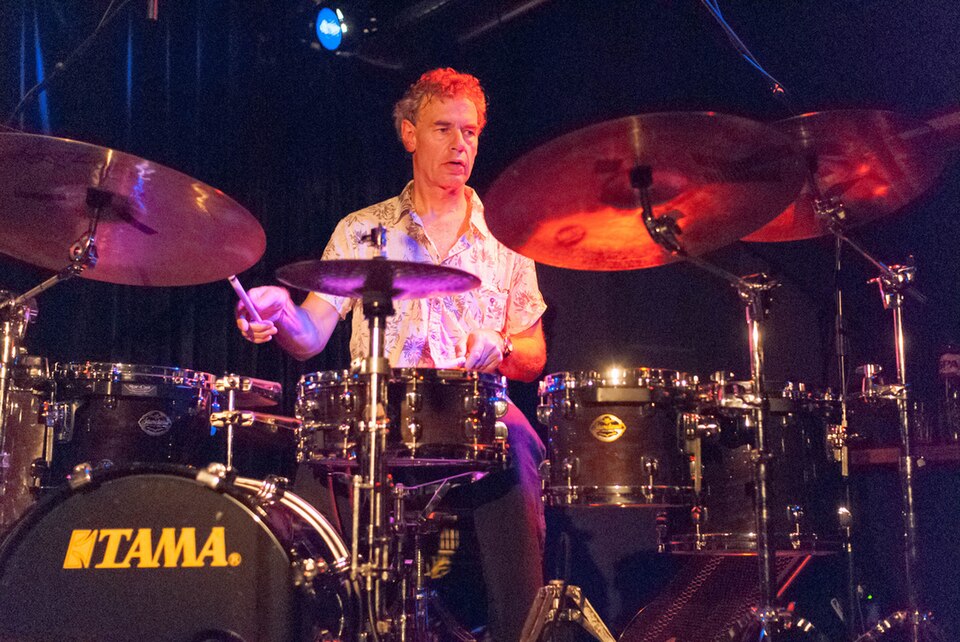
Bill Bruford: Yes + King Crimson drummer, decoded
Bill Bruford anchored Yes (1968-1972) and King Crimson (1972-1997, multiple eras), then led Earthworks (1986-2008) before retiring from public performance in 2009. The progressive-rock drumming canon's most cerebral architect.
Yes / King Crimson · written with AI help · updated
Bill Bruford (born May 17, 1949, Sevenoaks, Kent, England) anchored Yes (1968-1972, founding drummer through Close to the Edge) and King Crimson across three eras (1972-1974, 1981-1984, 1994-1997). U.K. (1977-1978) and his own Earthworks (1986-2008) extended his catalog into jazz-fusion territory. Tama and Paiste signature relationships during the commercial peak. Retired from public performance in 2009. The progressive-rock drumming canon's most cerebral architect: Larks' Tongues in Aspic (1973), Red (1974), Discipline (1981) are the canonical Bruford records.
Who Bill Bruford is
William Scott Bruford, born May 17, 1949, in Sevenoaks, Kent, England, was the founding drummer of Yes (1968-1972) and the recurring drummer in King Crimson across three eras (1972-1974, 1981-1984, 1994-1997). He led the jazz-fusion project Earthworks (1986-2008) and played in the progressive-rock supergroup U.K. (1977-1978) with John Wetton, Eddie Jobson, and Allan Holdsworth.
Bruford retired from public performance in 2009.
Style signatures
Three things across his prog-rock + jazz-fusion catalogs you can identify as Bruford's:
-
Snare-and-tom polyrhythms as melody. The Crimson catalog treats the kit as a melodic instrument; Bruford's parts function as counter-melodies more than grooves.
-
Electronic-percussion integration. The 1981-1984 King Crimson Discipline-era records were among the first major-band rock recordings to integrate roto-toms, Simmons pads, and other electronic percussion at the song-architecture level.
-
Composition-aware drumming. Bruford writes parts; he does not just play grooves. The approach is closer to jazz horn writing than to standard rock drumming.
Documented gear
- Tama BB146 Bill Bruford Signature Snare. A 14x6 inch, 10-lug shell built from 6 plies of Maple/Birch/Maple, finished in Black Metallic Sandblast. Tama's own artist page lists it inside his current Starclassic Maple kit; his own equipment archive documents the identical drum across two separate eras, 2001-2009 and 2022-present. Full review at /gear/tama-bb146-bill-bruford-signature-snare.
- Tama Starclassic (and earlier SuperStar) kits. Tama from 1981-1982 onward, the first itemized Tama era in his own equipment archive; Starclassic Maple/Starclassic Performer from the mid-1990s in finishes including Canary Yellow, Tequila Sunrise, and Royal Walnut. Brand-level documented; no dedicated CYS gear page yet for a specific shell pack.
- Paiste cymbals. Paiste throughout his career; his most recently documented (2022-present) setup lists 15 inch Giant Beat hi-hats, a 20 inch Traditional medium ride, an 18 inch Dimensions light ride, and PSTX Flanger/Splash stacks. Brand-level documented; no dedicated CYS gear page yet for these specific models.
- Promark SD-4 Bill Bruford Signature sticks. Named on his own equipment archive as his current stick. No dedicated CYS gear page yet for this specific model.
- Earlier kits. Premier Olympic (1968-1969), then Ludwig and Hayman through most of the 1970s, per his own equipment archive.
Related
The catalog. Yes, The Yes Album (1971) through Close to the Edge (1972). King Crimson, Larks' Tongues in Aspic (1973) through THRAK (1995). U.K. (1978). Earthworks (1987-2008).
Documented gear. Tama BB146 Bill Bruford Signature Snare Drum.
Drummer hub. Drummers index. Prog canon parallel: Neil Peart (Rush), Mike Portnoy (Dream Theater), Carl Palmer (ELP / Asia).